
NATURAL HISTORY · CATALOGUE RECORD
Kea
Nestor notabilis Gould, 1856
Source-backed taxonomic record
Accepted species in Catalogue of Life’s 11 September 2026 base release. This preserves the source classification and available supporting data; it is not a completed species monograph.
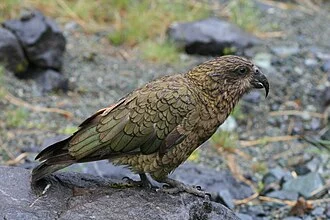
An adult Kea in Fiordland, New Zealand. Some of the feathers look slightly wet and there are some raindrops on its back.
Mark Whatmough · CC BY 2.0 · Image sourceProvider-generated thumbnail requested at 320 pixels; no local editing Local WebP display rendition; resized without cropping.
Open encyclopedia reference
The kea ( KEE-ə; Māori: [kɛ.a]; Nestor notabilis) is a species of large parrot in the family Strigopidae that is endemic to the forested and alpine regions of the South Island of New Zealand. About 48 cm (19 in) long, it is mostly olive-green, with brilliant orange under its wings, and has a large, narrow, curved, grey-brown upper beak. Its omnivorous diet consists mainly of roots, leaves, berries, nectar, and insects, but also includes carrion. It was once killed for bounty due to concern by sheep farmers that it attacked livestock, especially sheep. The kea is now uncommon, and received absolute protection under the Wildlife Act in 1986.
The kea nests in burrows or crevices among the roots of trees. Kea are known for their intelligence and curiosity, both vital to their survival in a harsh mountain environment. Kea can solve logical puzzles, such as pushing and pulling things in a certain order to get to food, and will work together to achieve a certain objective. They have been filmed preparing and using tools.
Wikipedia contributors, Kea; see linked history · CC BY-SA 4.0 . Plain-text lead excerpt, at most 180 words; no infobox or later sections Retrieved 2026-10-05T01:24:25.450207+00:00. This reference remains separate from the taxonomic record.
Identity & source status
- Scientific name
- Nestor notabilis Gould, 1856
- Name authority
- Gould, 1856
- Common name
- Kea
- Rank
- species
- Accepted status
- accepted
- Kingdom
- Animalia
- Phylum
- Chordata
- Class
- Aves
- Order
- Psittaciformes
- Family
- Strigopidae
- Genus
- Nestor
- Extinction status
- Recorded extant
Classification family tree
Nested taxonomic groups from the source. This is not a direct-ancestor chain, a dated evolutionary tree or a phylogenetic reconstruction.
- domainEukaryota (Chatton, 1925) Whittaker & Margulis, 1978
- kingdomAnimalia
- phylumChordata
- subphylumVertebrata
- infraphylumGnathostomata
- parvphylumOsteichthyes
- megaclassTetrapoda
- classAves
- orderPsittaciformes
- familyStrigopidae
- genusNestor R. Lesson, 1830
- speciesNestor notabilis Gould, 1856
Close classified relatives
These entries share the source’s genus, Nestor. They are not necessarily the closest relatives established by molecular evidence.
| Species | Classification | Source status |
|---|---|---|
| Norfolk Island KakaNestor productus (Gould, 1836) | StrigopidaeChordata | Accepted speciesRecorded extinct |
Documented distribution
Source distribution statements, not a complete range map. A listed locality is not necessarily a place of origin.
Source literature & publication evidence
References attached to this source record, including nomenclatural citations where supplied. This is a selected bibliography; abbreviated citations remain in the source’s form.
- https://www.itis.gov/servlet/SingleRpt/SingleRpt?search_topic=TSN&search_value=177500 Source fields: Taxon.tsv dwc:namePublishedIn, Taxon.tsv dcterms:references
Origins, evidence & remaining research
Name authority and publication references document nomenclature where the source supplies it. They do not establish evolutionary origins or the earliest fossil occurrence.
Specimen-level evidence, morphology, ecological research, phylogenetic studies, a comprehensive bibliography and a located literary passage have not yet been compiled for this record.
Dataset citation & attribution
This exact taxon in ChecklistBank · Catalogue of Life 2026-09-11
Catalogue of Life 2026-09-11; dataset 316321; doi:10.48580/dgz5n. https://creativecommons.org/licenses/by/4.0/ . Retrieved 5 October 2026.
Stable key: col:4793F. Classification follows source parent identifiers. English common names may vary by region.