
Nectophryne afra Buchholz & Peters in Peters, 1875
Accepted species in Catalogue of Life’s 11 September 2026 base release. This preserves the source classification and available supporting data; it is not a completed species monograph.
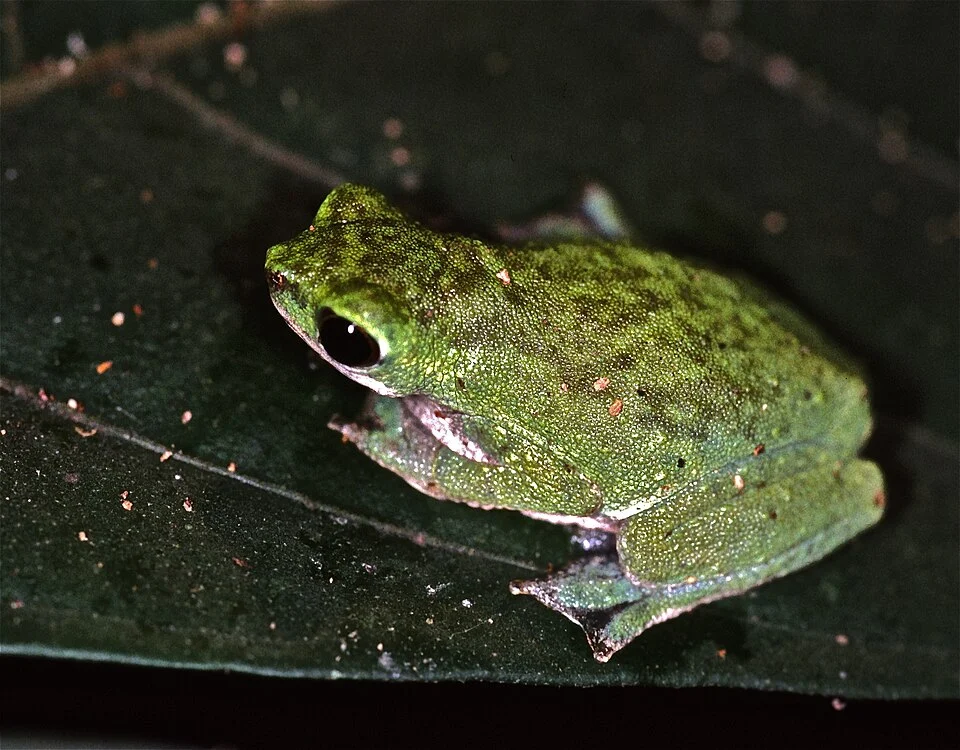
Korup NP, Cameroon
Bernard DUPONT from FRANCE · CC BY-SA 2.0 · Image sourceProvider-generated thumbnail requested at 800 pixels; no local editing Local WebP display rendition; resized without cropping.
Open encyclopedia reference
The African tree toad (Nectophryne afra) is a species of toad in the family Bufonidae. It is found in the West and Central Africa from southwestern Nigeria through Cameroon to Equatorial Guinea (including Bioko), Gabon, and northeastern Democratic Republic of the Congo.
Morphologically, Nectophryne afra is very similar to Nectorphryne batesii except in their snouts and extremities. The snout of N. afra protrudes further and has a light colored line that connects the medial cleft to the upper lip: this is seen less in older specimen. N. afra limbs are also notably shorter than N. batesii.
African tree toads inhabit lowland forests. They are terrestrial by day and climb to vegetation by night. The male guards eggs that the pair lays in tree cavities containing water.
The species can suffer locally from habitat loss. It is present in a number of national parks, including the Korup National Park, Monte Alén National Park, and Virunga National Park.The African tree toad is a species of toad in the family Bufonidae.
Wikipedia contributors, African tree toad; see linked history · CC BY-SA 4.0 . Plain-text lead excerpt, at most 180 words; no infobox or later sections Retrieved 2026-10-05T17:17:15.725552+00:00. This reference remains separate from the taxonomic record.
Identity & source status
- Scientific name
- Nectophryne afra Buchholz & Peters in Peters, 1875
- Name authority
- Buchholz & Peters in Peters, 1875
- Rank
- species
- Accepted status
- accepted
- Kingdom
- Animalia
- Phylum
- Chordata
- Class
- Amphibia
- Order
- Anura
- Family
- Bufonidae
- Genus
- Nectophryne
- Extinction status
- Recorded extant
Classification family tree
Nested taxonomic groups from the source. This is not a direct-ancestor chain, a dated evolutionary tree or a phylogenetic reconstruction.
- domainEukaryota (Chatton, 1925) Whittaker & Margulis, 1978
- kingdomAnimalia
- phylumChordata
- subphylumVertebrata
- infraphylumGnathostomata
- parvphylumOsteichthyes
- megaclassTetrapoda
- classAmphibia
- orderAnura
- familyBufonidae Gray, 1825
- genusNectophryne Buchholz & Peters in Peters, 1875
- speciesNectophryne afra Buchholz & Peters in Peters, 1875
Close classified relatives
These entries share the source’s genus, Nectophryne. They are not necessarily the closest relatives established by molecular evidence.
| Species | Classification | Source status |
|---|---|---|
| Nectophryne batesii Boulenger, 1913 | BufonidaeChordata | Accepted speciesRecorded extant |
Source literature & publication evidence
References attached to this source record, including nomenclatural citations where supplied. This is a selected bibliography; abbreviated citations remain in the source’s form.
- Peters, 1875 Source fields: Taxon.tsv dwc:namePublishedIn, Taxon.tsv dcterms:references
Origins, evidence & remaining research
Name authority and publication references document nomenclature where the source supplies it. They do not establish evolutionary origins or the earliest fossil occurrence.
Specimen-level evidence, morphology, ecological research, phylogenetic studies, a comprehensive bibliography and a located literary passage have not yet been compiled for this record.
Dataset citation & attribution
This exact taxon in ChecklistBank · Catalogue of Life 2026-09-11
Catalogue of Life 2026-09-11; dataset 316321; doi:10.48580/dgz5n. https://creativecommons.org/licenses/by/4.0/ . Retrieved 5 October 2026.
Stable key: col:462VT. Classification follows source parent identifiers. English common names may vary by region.