
NATURAL HISTORY · CATALOGUE RECORD
Proboscis Monkey
Nasalis larvatus (van Wurmb, 1787)
Source-backed taxonomic record
Accepted species in Catalogue of Life’s 11 September 2026 base release. This preserves the source classification and available supporting data; it is not a completed species monograph.
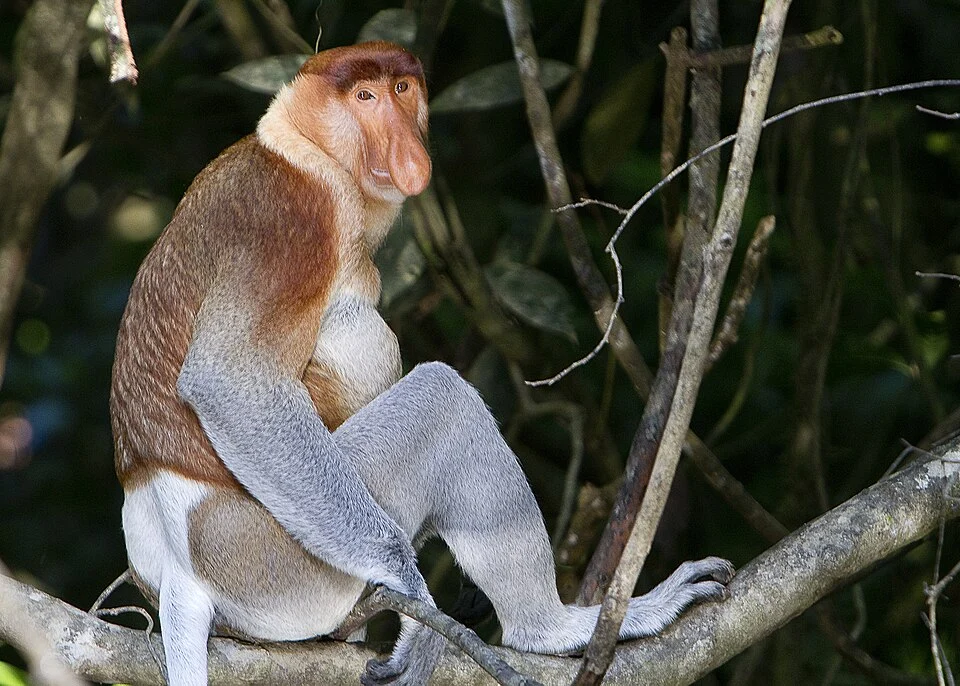
Proboscis Monkey in Borneo
David Dennis · CC BY-SA 2.0 · Image sourceProvider-generated thumbnail requested at 800 pixels; no local editing Local WebP display rendition; resized without cropping.
Open encyclopedia reference
The proboscis monkey or long-nosed monkey (Nasalis larvatus) is an arboreal Old World monkey with an unusually large nose (or proboscis), a reddish-brown skin color and a long tail. It is endemic to the Southeast Asian island of Borneo and is found mostly in mangrove forests and on the coastal areas of the island.
This species co-exists with the Bornean orangutan and monkeys such as the silvery lutung. It belongs in the monotypic genus Nasalis.
Wikipedia contributors, Proboscis monkey; see linked history · CC BY-SA 4.0 . Plain-text lead excerpt, at most 180 words; no infobox or later sections Retrieved 2026-10-05T05:21:17.072880+00:00. This reference remains separate from the taxonomic record.
Identity & source status
- Scientific name
- Nasalis larvatus (van Wurmb, 1787)
- Name authority
- (van Wurmb, 1787)
- Common name
- Proboscis Monkey
- Rank
- species
- Accepted status
- accepted
- Kingdom
- Animalia
- Phylum
- Chordata
- Class
- Mammalia
- Order
- Primates
- Family
- Cercopithecidae
- Genus
- Nasalis
- Extinction status
- Recorded extant
Classification family tree
Nested taxonomic groups from the source. This is not a direct-ancestor chain, a dated evolutionary tree or a phylogenetic reconstruction.
- domainEukaryota (Chatton, 1925) Whittaker & Margulis, 1978
- kingdomAnimalia
- phylumChordata
- subphylumVertebrata
- infraphylumGnathostomata
- parvphylumOsteichthyes
- megaclassTetrapoda
- classMammalia Linnaeus, 1758
- subclassTheria Parker & Haswell, 1897
- infraclassEutheria Gill, 1872
- orderPrimates Linnaeus, 1758
- suborderHaplorrhini Pocock, 1918
- infraorderSimiiformes Haeckel, 1866
- superfamilyCercopithecoidea Gray, 1821
- familyCercopithecidae Gray, 1821
- subfamilyColobinae Jerdon, 1867
- tribePresbytini Gray, 1825
- genusNasalis É. Geoffroy Saint-Hilaire, 1812
- speciesNasalis larvatus (van Wurmb, 1787)
Close classified relatives
No other member of this genus is present in the selected snapshot.
Names & synonyms
Names explicitly linked to this accepted taxon in the source. Synonymy can change with revision.
| Recorded name | Source status |
|---|---|
| Simia capistratus Kerr, 1792 Kerr, 1792 | synonym |
| Nasalis recurvus Vigors & Horsfield, 1828 Vigors & Horsfield, 1828 | synonym |
| Nasalis larvatus orientalis Chasen, 1940 Chasen, 1940 | synonym |
| Cercopithecus nasica Lacépède, 1799 Lacépède, 1799 | synonym |
Documented distribution
Source distribution statements, not a complete range map. A listed locality is not necessarily a place of origin.
Source literature & publication evidence
References attached to this source record, including nomenclatural citations where supplied. This is a selected bibliography; abbreviated citations remain in the source’s form.
- https://www.itis.gov/servlet/SingleRpt/SingleRpt?search_topic=TSN&search_value=573040 Source fields: Taxon.tsv dwc:namePublishedIn, Taxon.tsv dcterms:references
Origins, evidence & remaining research
Name authority and publication references document nomenclature where the source supplies it. They do not establish evolutionary origins or the earliest fossil occurrence.
Specimen-level evidence, morphology, ecological research, phylogenetic studies, a comprehensive bibliography and a located literary passage have not yet been compiled for this record.
Dataset citation & attribution
This exact taxon in ChecklistBank · Catalogue of Life 2026-09-11
Catalogue of Life 2026-09-11; dataset 316321; doi:10.48580/dgz5n. https://creativecommons.org/licenses/by/4.0/ . Retrieved 5 October 2026.
Stable key: col:45QBH. Classification follows source parent identifiers. English common names may vary by region.