
NATURAL HISTORY · CATALOGUE RECORD
Greater Streaked Honeyeater
Myza sarasinorum A. B. Meyer & Wiglesworth, 1895
Source-backed taxonomic record
Accepted species in Catalogue of Life’s 11 September 2026 base release. This preserves the source classification and available supporting data; it is not a completed species monograph.
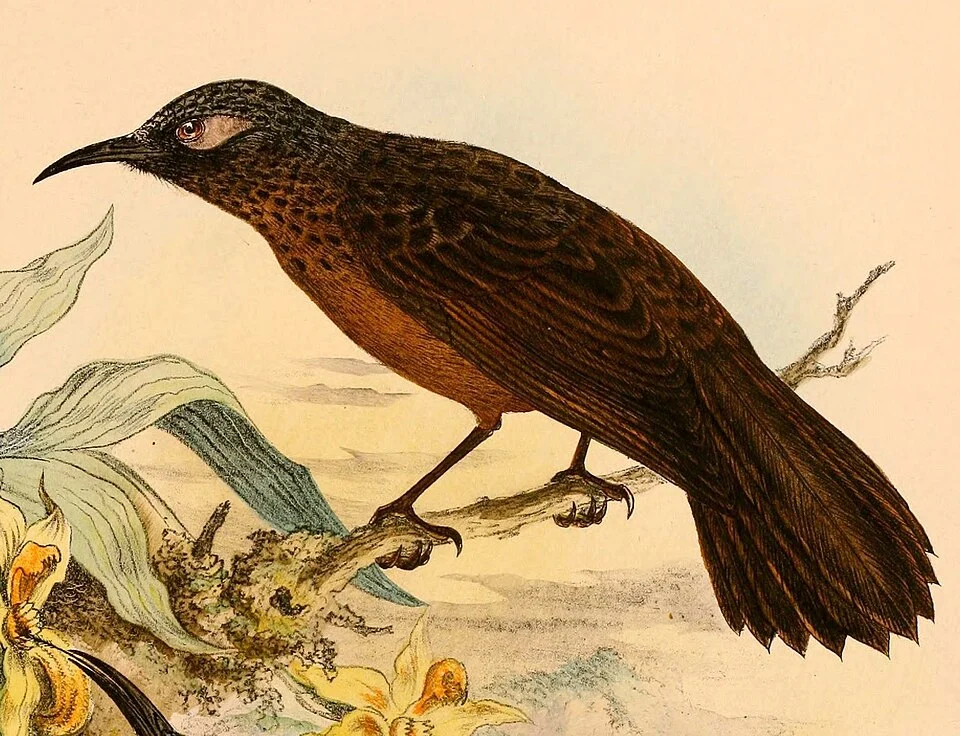
« Myza sarasinorum » = Myza sarasinorum sarasinorum (Subspecies of White-eared Myza)
Bruno Geisler · Public domain · Image sourceProvider-generated thumbnail requested at 800 pixels; no local editing Local WebP display rendition; resized without cropping.
Open encyclopedia reference
The white-eared myza or greater Sulawesi honeyeater (Myza sarasinorum) is a species of bird in the family Meliphagidae, with only its sharp calls revealing its presence. The white-eared myza is approximately 20 cm long.
It is endemic to the island of Sulawesi in Indonesia. It is regularly observed by specialised birding tours at Lore Lindu National Park in Central Sulawesi. Field observers have remarked on its squirrel-like behaviour as it scurries about the branches of moss-laden trees.
Its natural habitat is subtropical or tropical moist montane, usually between 1700 and 2800 metres.
Wikipedia contributors, White-eared myza; see linked history · CC BY-SA 4.0 . Plain-text lead excerpt, at most 180 words; no infobox or later sections Retrieved 2026-10-05T11:51:01.908753+00:00. This reference remains separate from the taxonomic record.
Identity & source status
- Scientific name
- Myza sarasinorum A. B. Meyer & Wiglesworth, 1895
- Name authority
- A. B. Meyer & Wiglesworth, 1895
- Common name
- Greater Streaked Honeyeater
- Rank
- species
- Accepted status
- accepted
- Kingdom
- Animalia
- Phylum
- Chordata
- Class
- Aves
- Order
- Passeriformes
- Family
- Meliphagidae
- Genus
- Myza
- Extinction status
- Recorded extant
Classification family tree
Nested taxonomic groups from the source. This is not a direct-ancestor chain, a dated evolutionary tree or a phylogenetic reconstruction.
- domainEukaryota (Chatton, 1925) Whittaker & Margulis, 1978
- kingdomAnimalia
- phylumChordata
- subphylumVertebrata
- infraphylumGnathostomata
- parvphylumOsteichthyes
- megaclassTetrapoda
- classAves
- orderPasseriformes
- familyMeliphagidae
- genusMyza A. B. Meyer & Wiglesworth, 1895
- speciesMyza sarasinorum A. B. Meyer & Wiglesworth, 1895
Close classified relatives
These entries share the source’s genus, Myza. They are not necessarily the closest relatives established by molecular evidence.
| Species | Classification | Source status |
|---|---|---|
| Dark-eared HoneyeaterMyza celebensis (A. B. Meyer & Wiglesworth, 1894) | MeliphagidaeChordata | Accepted speciesRecorded extant |
Documented distribution
Source distribution statements, not a complete range map. A listed locality is not necessarily a place of origin.
Source literature & publication evidence
References attached to this source record, including nomenclatural citations where supplied. This is a selected bibliography; abbreviated citations remain in the source’s form.
- https://www.itis.gov/servlet/SingleRpt/SingleRpt?search_topic=TSN&search_value=561434 Source fields: Taxon.tsv dwc:namePublishedIn, Taxon.tsv dcterms:references
Origins, evidence & remaining research
Name authority and publication references document nomenclature where the source supplies it. They do not establish evolutionary origins or the earliest fossil occurrence.
Specimen-level evidence, morphology, ecological research, phylogenetic studies, a comprehensive bibliography and a located literary passage have not yet been compiled for this record.
Dataset citation & attribution
This exact taxon in ChecklistBank · Catalogue of Life 2026-09-11
Catalogue of Life 2026-09-11; dataset 316321; doi:10.48580/dgz5n. https://creativecommons.org/licenses/by/4.0/ . Retrieved 5 October 2026.
Stable key: col:45HLK. Classification follows source parent identifiers. English common names may vary by region.