
NATURAL HISTORY · CATALOGUE RECORD
Black Kite
Milvus migrans (Boddaert, 1783)
Source-backed taxonomic record
Accepted species in Catalogue of Life’s 11 September 2026 base release. This preserves the source classification and available supporting data; it is not a completed species monograph.
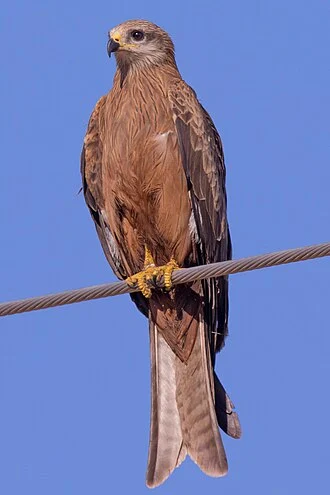
Black kite
Andreas Trepte · CC BY-SA 4.0 · Image sourceProvider-generated thumbnail requested at 320 pixels; no local editing Local WebP display rendition; resized without cropping.
Open encyclopedia reference
The black kite or fire kite (Milvus migrans) is a medium-sized bird of prey in the family Accipitridae, which also includes many other diurnal raptors. It is thought to be the world's most abundant species of Accipitridae, although some populations have experienced dramatic declines or fluctuations. Current global population estimates run up to 6.7 million individuals.
Unlike others of the group, black kites are opportunistic hunters and are more likely to scavenge. They spend much of their time gliding in thermals in search of food. Their angled wing and distinctive forked tail make them easy to identify. They are vociferous with a distinct shrill whinnying call.
The black kite is widely distributed through temperate and tropical parts of Eurasia and parts of Australasia and Oceania. Temperate populations tend to be migratory. Several subspecies are recognized, with several having previously had English names. The European populations are small, but the South Asian population is comparatively very large.
Wikipedia contributors, Black kite; see linked history · CC BY-SA 4.0 . Plain-text lead excerpt, at most 180 words; no infobox or later sections Retrieved 2026-10-05T01:53:50.552660+00:00. This reference remains separate from the taxonomic record.
Identity & source status
- Scientific name
- Milvus migrans (Boddaert, 1783)
- Name authority
- (Boddaert, 1783)
- Common name
- Black Kite
- Rank
- species
- Accepted status
- accepted
- Kingdom
- Animalia
- Phylum
- Chordata
- Class
- Aves
- Order
- Accipitriformes
- Family
- Accipitridae
- Genus
- Milvus
- Extinction status
- Recorded extant
Classification family tree
Nested taxonomic groups from the source. This is not a direct-ancestor chain, a dated evolutionary tree or a phylogenetic reconstruction.
- domainEukaryota (Chatton, 1925) Whittaker & Margulis, 1978
- kingdomAnimalia
- phylumChordata
- subphylumVertebrata
- infraphylumGnathostomata
- parvphylumOsteichthyes
- megaclassTetrapoda
- classAves
- orderAccipitriformes
- familyAccipitridae Vigors, 1824
- genusMilvus Lacépède, 1799
- speciesMilvus migrans (Boddaert, 1783)
Close classified relatives
These entries share the source’s genus, Milvus. They are not necessarily the closest relatives established by molecular evidence.
| Species | Classification | Source status |
|---|---|---|
| Yellow-billed KiteMilvus aegyptius (J. F. Gmelin, 1788) | AccipitridaeChordata | Accepted speciesRecorded extant |
| Red KiteMilvus milvus (Linnaeus, 1758) | AccipitridaeChordata | Accepted speciesRecorded extant |
Names & synonyms
Names explicitly linked to this accepted taxon in the source. Synonymy can change with revision.
| Recorded name | Source status |
|---|---|
| Falco migrans Boddaert, 1783 Boddaert, 1783 | synonym |
Documented distribution
Source distribution statements, not a complete range map. A listed locality is not necessarily a place of origin.
Australia
Europe & Northern Asia (excluding China)
Oceania
Southern Asia
Source literature & publication evidence
References attached to this source record, including nomenclatural citations where supplied. This is a selected bibliography; abbreviated citations remain in the source’s form.
- https://www.itis.gov/servlet/SingleRpt/SingleRpt?search_topic=TSN&search_value=175469 Source fields: Taxon.tsv dwc:namePublishedIn, Taxon.tsv dcterms:references
Origins, evidence & remaining research
Name authority and publication references document nomenclature where the source supplies it. They do not establish evolutionary origins or the earliest fossil occurrence.
Specimen-level evidence, morphology, ecological research, phylogenetic studies, a comprehensive bibliography and a located literary passage have not yet been compiled for this record.
Dataset citation & attribution
This exact taxon in ChecklistBank · Catalogue of Life 2026-09-11
Catalogue of Life 2026-09-11; dataset 316321; doi:10.48580/dgz5n. https://creativecommons.org/licenses/by/4.0/ . Retrieved 5 October 2026.
Stable key: col:43DZH. Classification follows source parent identifiers. English common names may vary by region.