
NATURAL HISTORY · CATALOGUE RECORD
Common Big-eared Bat
Micronycteris (Micronycteris) microtis Miller, 1898
Source-backed taxonomic record
Accepted species in Catalogue of Life’s 11 September 2026 base release. This preserves the source classification and available supporting data; it is not a completed species monograph.
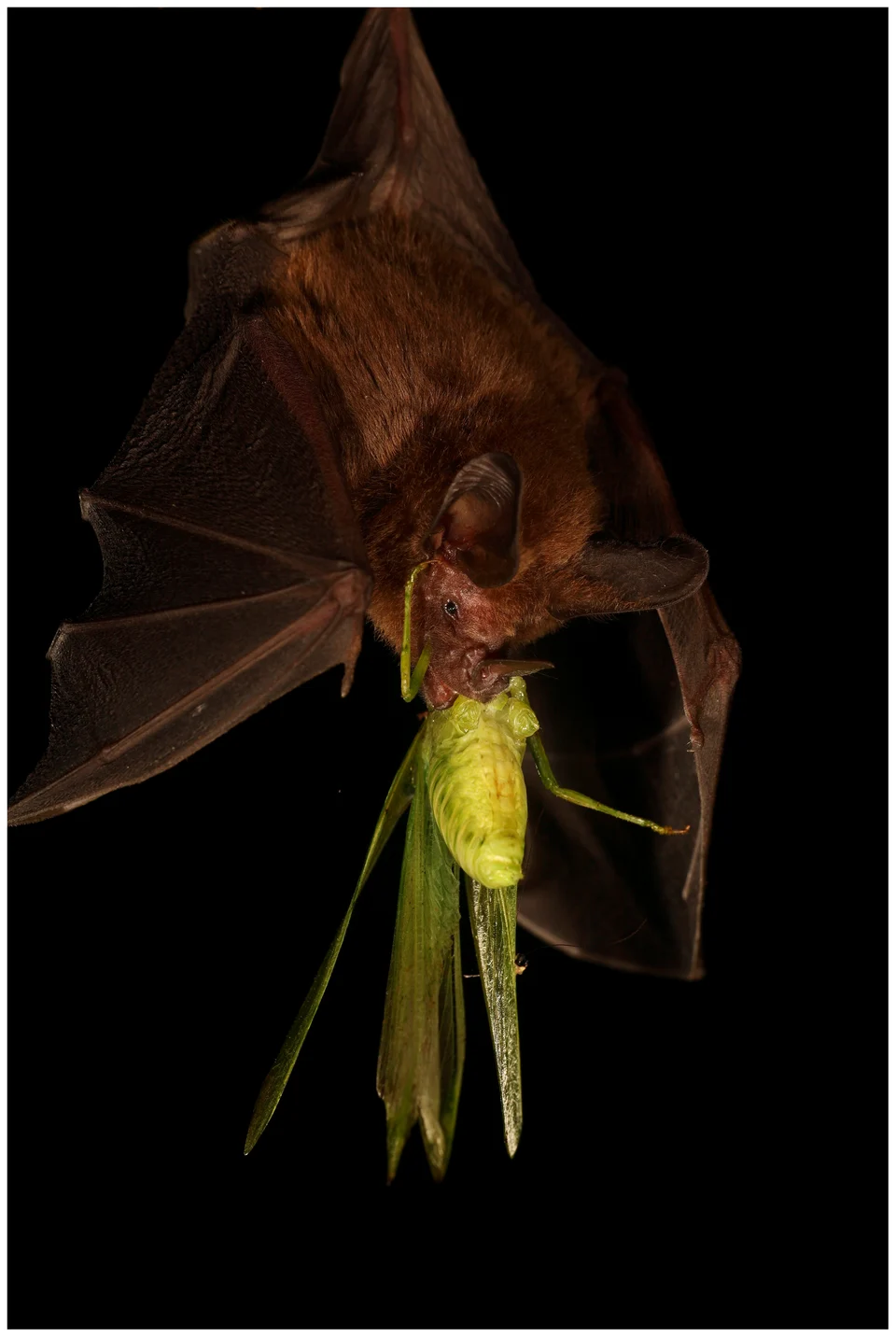
Micronycteris microtis consuming a katydid. This image illustrates the relatively large size of some prey items included in the diet of this bat (Photo by Christian Ziegler). doi:10.1371/journal.pone.0028584.g001.
Christian Ziegler · CC BY 2.5 · Image sourceProvider-generated thumbnail requested at 800 pixels; no local editing Local WebP display rendition; resized without cropping.
Open encyclopedia reference
The common big-eared bat (Micronycteris microtis) is a bat species from South and Central America. It is a member of the family Phyllostomidae.
Recent research has demonstrated this bat's ability to find motionless food within clutter. Echolocating bats discriminate between background and prey based on glints or Doppler shifts in the echo induced by the (wing-)movements of the prey, but M. microtis can detect completely motionless prey. The species shares both the leaf-nose formation and the trait of sound emission through the nostrils with all Phyllostomidae, but its behavior is understood to be unique: the bat is able to discriminate ecologically relevant stimuli within an extremely complex cluttered sonic environment.
The echolocation call of M. microtis is a broad band multi-harmonic FM sweep with most energy in the second harmonic between 95 and 75 kHz, i.e. quite similar to that of Macrophyllum macrophyllum, although presumably of lower intensity.
M. microtis mothers will provide pups with prey items for 5 months after weaning.
Wikipedia contributors, Common big-eared bat; see linked history · CC BY-SA 4.0 . Plain-text lead excerpt, at most 180 words; no infobox or later sections Retrieved 2026-10-05T08:36:15.017654+00:00. This reference remains separate from the taxonomic record.
Identity & source status
- Scientific name
- Micronycteris (Micronycteris) microtis Miller, 1898
- Name authority
- Miller, 1898
- Common name
- Common Big-eared Bat
- Rank
- species
- Accepted status
- accepted
- Kingdom
- Animalia
- Phylum
- Chordata
- Class
- Mammalia
- Order
- Chiroptera
- Family
- Phyllostomidae
- Genus
- Micronycteris
- Extinction status
- Recorded extant
Classification family tree
Nested taxonomic groups from the source. This is not a direct-ancestor chain, a dated evolutionary tree or a phylogenetic reconstruction.
- domainEukaryota (Chatton, 1925) Whittaker & Margulis, 1978
- kingdomAnimalia
- phylumChordata
- subphylumVertebrata
- infraphylumGnathostomata
- parvphylumOsteichthyes
- megaclassTetrapoda
- classMammalia Linnaeus, 1758
- subclassTheria Parker & Haswell, 1897
- infraclassEutheria Gill, 1872
- orderChiroptera Blumenbach, 1779
- suborderYangochiroptera Koopman, 1984
- superfamilyNoctilionoidea Gray, 1821
- familyPhyllostomidae Gray, 1825
- subfamilyMicronycterinae Van Den Bussche, 1992
- genusMicronycteris Gray, 1866
- subgenusMicronycteris Gray, 1866
- speciesMicronycteris (Micronycteris) microtis Miller, 1898
Close classified relatives
These entries share the source’s genus, Micronycteris. They are not necessarily the closest relatives established by molecular evidence.
| Species | Classification | Source status |
|---|---|---|
| Matses Big-eared BatMicronycteris (Micronycteris) matses Simmons, Voss & Fleck, 2002 | PhyllostomidaeChordata | Accepted speciesRecorded extant |
| Little Big-eared BatMicronycteris (Micronycteris) megalotis (Gray, 1842) | PhyllostomidaeChordata | Accepted speciesRecorded extant |
| Giovanni's Big-eared BatMicronycteris (Micronycteris) giovanniae Baker & Fonseca, 2007 | PhyllostomidaeChordata | Accepted speciesRecorded extant |
| Brosset's Big-eared BatMicronycteris (Leuconycteris) brosseti Simmons & Voss, 1998 | PhyllostomidaeChordata | Accepted speciesRecorded extant |
| Hairy Big-eared BatMicronycteris (Xenoctenes) hirsuta (Peters, 1869) | PhyllostomidaeChordata | Accepted speciesRecorded extant |
| Tiny Big-eared BatMicronycteris (Schizonycteris) minuta (Gervais, 1856) | PhyllostomidaeChordata | Accepted speciesRecorded extant |
| Sanborn's Big-eared BatMicronycteris (Schizonycteris) sanborni Simmons, 1996 | PhyllostomidaeChordata | Accepted speciesRecorded extant |
| Schmidt's Big-eared BatMicronycteris (Leuconycteris) schmidtorum Sanborn, 1935 | PhyllostomidaeChordata | Accepted speciesRecorded extant |
| Yates's Big-eared BatMicronycteris (Schizonycteris) yatesi Siles & Brooks, 2013 | PhyllostomidaeChordata | Accepted speciesRecorded extant |
Documented distribution
Source distribution statements, not a complete range map. A listed locality is not necessarily a place of origin.
South America
Source literature & publication evidence
References attached to this source record, including nomenclatural citations where supplied. This is a selected bibliography; abbreviated citations remain in the source’s form.
- https://www.itis.gov/servlet/SingleRpt/SingleRpt?search_topic=TSN&search_value=946058 Source fields: Taxon.tsv dwc:namePublishedIn, Taxon.tsv dcterms:references
Origins, evidence & remaining research
Name authority and publication references document nomenclature where the source supplies it. They do not establish evolutionary origins or the earliest fossil occurrence.
Specimen-level evidence, morphology, ecological research, phylogenetic studies, a comprehensive bibliography and a located literary passage have not yet been compiled for this record.
Dataset citation & attribution
This exact taxon in ChecklistBank · Catalogue of Life 2026-09-11
Catalogue of Life 2026-09-11; dataset 316321; doi:10.48580/dgz5n. https://creativecommons.org/licenses/by/4.0/ . Retrieved 5 October 2026.
Stable key: col:4326L. Classification follows source parent identifiers. English common names may vary by region.