
NATURAL HISTORY · CATALOGUE RECORD
Silvery Marmoset
Mico argentatus (Linnaeus, 1771)
Source-backed taxonomic record
Accepted species in Catalogue of Life’s 11 September 2026 base release. This preserves the source classification and available supporting data; it is not a completed species monograph.
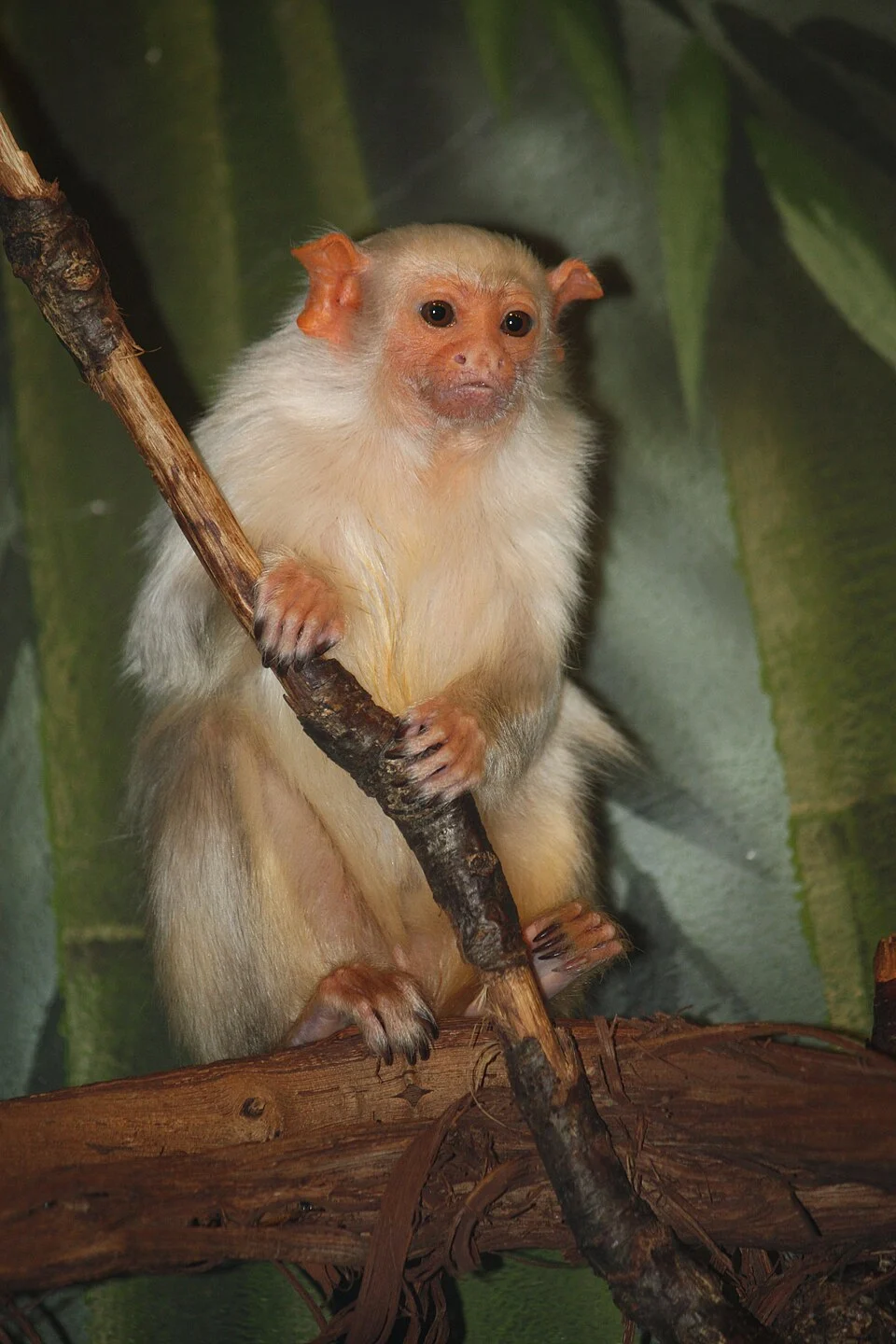
Silvery Marmoset (Callithrix argentata). Bronx Zoo, New York City.
Postdlf · CC BY-SA 3.0 · Image sourceProvider-generated thumbnail requested at 800 pixels; no local editing Local WebP display rendition; resized without cropping.
Open encyclopedia reference
The silvery marmoset (Mico argentatus) is a New World monkey that lives in the eastern Amazon Rainforest in Brazil. The fur of the silvery marmoset is colored whitish silver-grey except for a dark tail. Remarkable are its naked, flesh-colored ears which stand out from the skin. They reach a size of 18 to 28 cm (7.1 to 11.0 in) and weigh from 300 to 400 g (11 to 14 oz). Silvery marmosets are diurnal and arboreal, using their claws to climb trees. Originally rain forest inhabitants, plantations have caused them to expand their range. They spend the night in tree hollows or in very close vegetation. They live together in small groups and mark their territory with scent glands, driving out intruders by shouting or by facial expressions (lowered brows and guarded lips). The diet of the silvery marmosets predominantly consists of tree sap. To a lesser extent, they also eat bird eggs, fruit, insects, and small vertebrates. After a 145-day gestation period, the female bears two (or rarely three) offspring.
Wikipedia contributors, Silvery marmoset; see linked history · CC BY-SA 4.0 . Plain-text lead excerpt, at most 180 words; no infobox or later sections Retrieved 2026-10-05T05:22:20.984098+00:00. This reference remains separate from the taxonomic record.
Identity & source status
- Scientific name
- Mico argentatus (Linnaeus, 1771)
- Name authority
- (Linnaeus, 1771)
- Common name
- Silvery Marmoset
- Rank
- species
- Accepted status
- accepted
- Kingdom
- Animalia
- Phylum
- Chordata
- Class
- Mammalia
- Order
- Primates
- Family
- Callitrichidae
- Genus
- Mico
- Extinction status
- Recorded extant
Classification family tree
Nested taxonomic groups from the source. This is not a direct-ancestor chain, a dated evolutionary tree or a phylogenetic reconstruction.
- domainEukaryota (Chatton, 1925) Whittaker & Margulis, 1978
- kingdomAnimalia
- phylumChordata
- subphylumVertebrata
- infraphylumGnathostomata
- parvphylumOsteichthyes
- megaclassTetrapoda
- classMammalia Linnaeus, 1758
- subclassTheria Parker & Haswell, 1897
- infraclassEutheria Gill, 1872
- orderPrimates Linnaeus, 1758
- suborderHaplorrhini Pocock, 1918
- infraorderSimiiformes Haeckel, 1866
- familyCallitrichidae Gray, 1821
- genusMico Lesson, 1840
- speciesMico argentatus (Linnaeus, 1771)
Close classified relatives
These entries share the source’s genus, Mico. They are not necessarily the closest relatives established by molecular evidence.
| Species | Classification | Source status |
|---|---|---|
| Rio Acarí MarmosetMico acariensis (M. van Roosmalen, T. van Roosmalen, Mittermeier & Rylands, 2000) | CallitrichidaeChordata | Accepted speciesRecorded extant |
| Emilia's MarmosetMico emiliae (Thomas, 1920) | CallitrichidaeChordata | Accepted speciesRecorded extant |
| Marca's MarmosetMico marcai (Alperin, 1993) | CallitrichidaeChordata | Accepted speciesRecorded extant |
| Maués MarmosetMico mauesi (Mittermeier, Schwarz & Ayres, 1992) | CallitrichidaeChordata | Accepted speciesRecorded extant |
| Black-tailed MarmosetMico melanurus (É. Geoffroy Saint-Hilaire, 1812) | CallitrichidaeChordata | Accepted speciesRecorded extant |
| Rondon's MarmosetMico rondoni Ferrari, Sena, Schneider & Silva Jr., 2010 | CallitrichidaeChordata | Accepted speciesRecorded extant |
| Gold-and-white MarmosetMico chrysoleucos (Wagner, 1842) | CallitrichidaeChordata | Accepted speciesRecorded extant |
| Munduruku MarmosetMico munduruku Costa-Araújo, Farias & Hrbek in Costa-Araújo, Melo, Canale, Hernández-Rangel, Messias et al., 2019 | CallitrichidaeChordata | Accepted speciesRecorded extant |
| Schneider's MarmosetMico schneideri Costa-Araújo, Silva-Jr., Boubli, Rossi, Hrbek & Farias, 2021 | CallitrichidaeChordata | Accepted speciesRecorded extant |
| Santarém MarmosetMico humeralifer (É. Geoffroy Saint-Hilaire, 1812) | CallitrichidaeChordata | Accepted speciesRecorded extant |
| Black-crowned Dwarf MarmosetMico humilis (M. van Roosmalen, T. van Roosmalen, Mittermeier & de Fonseca, 1998) | CallitrichidaeChordata | Accepted speciesRecorded extant |
| Hershkovitz's MarmosetMico intermedius (Hershkovitz, 1977) | CallitrichidaeChordata | Accepted speciesRecorded extant |
Names & synonyms
Names explicitly linked to this accepted taxon in the source. Synonymy can change with revision.
| Recorded name | Source status |
|---|---|
| Callithrix argentata (Linnaeus, 1771) (Linnaeus, 1771) | synonym |
Documented distribution
Source distribution statements, not a complete range map. A listed locality is not necessarily a place of origin.
Source literature & publication evidence
References attached to this source record, including nomenclatural citations where supplied. This is a selected bibliography; abbreviated citations remain in the source’s form.
- https://www.itis.gov/servlet/SingleRpt/SingleRpt?search_topic=TSN&search_value=944125 Source fields: Taxon.tsv dwc:namePublishedIn, Taxon.tsv dcterms:references
Origins, evidence & remaining research
Name authority and publication references document nomenclature where the source supplies it. They do not establish evolutionary origins or the earliest fossil occurrence.
Specimen-level evidence, morphology, ecological research, phylogenetic studies, a comprehensive bibliography and a located literary passage have not yet been compiled for this record.
Dataset citation & attribution
This exact taxon in ChecklistBank · Catalogue of Life 2026-09-11
Catalogue of Life 2026-09-11; dataset 316321; doi:10.48580/dgz5n. https://creativecommons.org/licenses/by/4.0/ . Retrieved 5 October 2026.
Stable key: col:42MHT. Classification follows source parent identifiers. English common names may vary by region.