
NATURAL HISTORY · CATALOGUE RECORD
Golden Hamster
Mesocricetus auratus (Waterhouse, 1839)
Source-backed taxonomic record
Accepted species in Catalogue of Life’s 11 September 2026 base release. This preserves the source classification and available supporting data; it is not a completed species monograph.
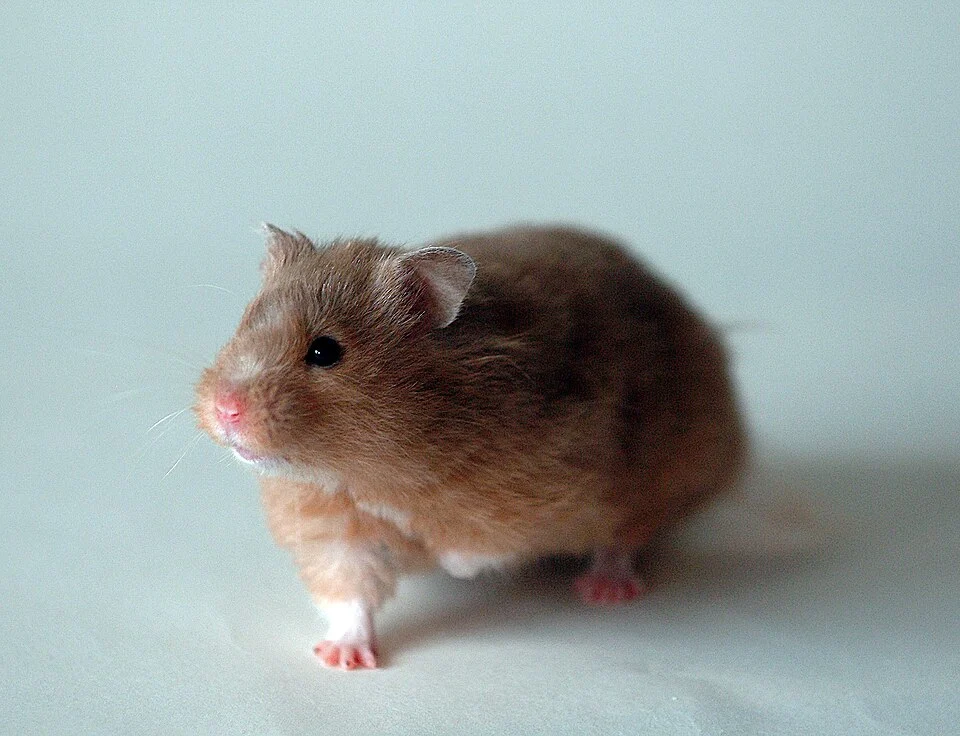
This photo shows a Golden Hamster (she is a rescued hamster called Vince), she is a great pet. Photo was taken 19th April 2006 when Vince was approx 1 year old. This photos is my own work. Adamjennison111 21:51, 31 August 2006 (UTC)
Adamjennison111 at English Wikipedia · CC BY 2.5 · Image sourceProvider-generated thumbnail requested at 800 pixels; no local editing Local WebP display rendition; resized without cropping.
Open encyclopedia reference
The golden hamster or Syrian hamster (Mesocricetus auratus) is a rodent belonging to the hamster subfamily, Cricetinae. Their natural geographical range is in an arid region of northern Syria and southern Turkey. Their numbers have been declining in the wild due to a loss of habitat from agriculture and deliberate elimination by humans. Thus, wild golden hamsters are now considered endangered by the International Union for Conservation of Nature. However, captive breeding programs are well established, and captive-bred golden hamsters are often kept as small house pets. They are also used as scientific research animals. Syrian hamsters kept as pets are sensitive to their housing conditions, and many welfare concerns have been identified in association with inadequate care. Major concerns include undersized cages, the presence of predatory species (dogs and cats) in the hamster's environment, insufficient substrate depth, excessive handling, noise, and wet tail (proliferative ileitis), the risk of which is increased by poor hygiene and cage cleanliness and high levels of stress.
Wikipedia contributors, Golden hamster; see linked history · CC BY-SA 4.0 . Plain-text lead excerpt, at most 180 words; no infobox or later sections Retrieved 2026-10-05T03:40:49.863978+00:00. This reference remains separate from the taxonomic record.
Identity & source status
- Scientific name
- Mesocricetus auratus (Waterhouse, 1839)
- Name authority
- (Waterhouse, 1839)
- Common name
- Golden Hamster
- Rank
- species
- Accepted status
- accepted
- Kingdom
- Animalia
- Phylum
- Chordata
- Class
- Mammalia
- Order
- Rodentia
- Family
- Cricetidae
- Genus
- Mesocricetus
- Extinction status
- Recorded extant
Classification family tree
Nested taxonomic groups from the source. This is not a direct-ancestor chain, a dated evolutionary tree or a phylogenetic reconstruction.
- domainEukaryota (Chatton, 1925) Whittaker & Margulis, 1978
- kingdomAnimalia
- phylumChordata
- subphylumVertebrata
- infraphylumGnathostomata
- parvphylumOsteichthyes
- megaclassTetrapoda
- classMammalia Linnaeus, 1758
- subclassTheria Parker & Haswell, 1897
- infraclassEutheria Gill, 1872
- orderRodentia Bowdich, 1821
- suborderMyomorpha Brandt, 1855
- superfamilyMuroidea Illiger, 1811
- familyCricetidae Fischer, 1817
- subfamilyCricetinae Fischer, 1817
- genusMesocricetus Nehring, 1898
- speciesMesocricetus auratus (Waterhouse, 1839)
Close classified relatives
These entries share the source’s genus, Mesocricetus. They are not necessarily the closest relatives established by molecular evidence.
| Species | Classification | Source status |
|---|---|---|
| Brandt's HamsterMesocricetus brandti (Nehring, 1898) | CricetidaeChordata | Accepted speciesRecorded extant |
| Romanian HamsterMesocricetus newtoni (Nehring, 1898) | CricetidaeChordata | Accepted speciesRecorded extant |
| Ciscaucasian HamsterMesocricetus raddei (Nehring, 1894) | CricetidaeChordata | Accepted speciesRecorded extant |
Documented distribution
Source distribution statements, not a complete range map. A listed locality is not necessarily a place of origin.
Source literature & publication evidence
References attached to this source record, including nomenclatural citations where supplied. This is a selected bibliography; abbreviated citations remain in the source’s form.
- https://www.itis.gov/servlet/SingleRpt/SingleRpt?search_topic=TSN&search_value=632735 Source fields: Taxon.tsv dwc:namePublishedIn, Taxon.tsv dcterms:references
Origins, evidence & remaining research
Name authority and publication references document nomenclature where the source supplies it. They do not establish evolutionary origins or the earliest fossil occurrence.
Specimen-level evidence, morphology, ecological research, phylogenetic studies, a comprehensive bibliography and a located literary passage have not yet been compiled for this record.
Dataset citation & attribution
This exact taxon in ChecklistBank · Catalogue of Life 2026-09-11
Catalogue of Life 2026-09-11; dataset 316321; doi:10.48580/dgz5n. https://creativecommons.org/licenses/by/4.0/ . Retrieved 5 October 2026.
Stable key: col:4237W. Classification follows source parent identifiers. English common names may vary by region.