
NATURAL HISTORY · CATALOGUE RECORD
Humpback Whale
Megaptera novaeangliae (Borowski, 1781)
Source-backed taxonomic record
Accepted species in Catalogue of Life’s 11 September 2026 base release. This preserves the source classification and available supporting data; it is not a completed species monograph.
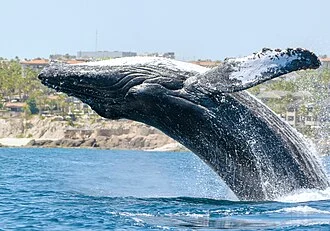
Humpback whale breaching off Cabo San Lucas, Mexico
Juan Cruzado Cortés · CC BY 4.0 · Image sourceProvider-generated thumbnail requested at 320 pixels; no local editing Local WebP display rendition; resized without cropping.
Open encyclopedia reference
The humpback whale (Megaptera novaeangliae) is a species of baleen whale. It is a rorqual (a member of the family Balaenopteridae) and is the only species in the genus Megaptera. Adults range in length from 14–17 m (46–56 ft) and weigh up to 40 metric tons (44 short tons). The humpback has a distinctive body shape, with long pectoral fins and tubercles on its head. It is known for breaching and other distinctive surface behaviors, making it popular with whale watchers. Males produce a complex song that typically lasts from 4 to 33 minutes. Found in oceans and seas around the world, humpback whales typically migrate between feeding areas towards the poles and breeding areas near the equator. Their diet consists mostly of krill and small fish, and they usually use bubbles to catch prey. They are polygynandrous breeders, with both sexes having multiple partners. Males will follow females and fight off rivals. Mothers give birth to calves in shallower water. Orcas are the main natural predators of humpback whales. The bodies of humpbacks host barnacles and whale lice.
Wikipedia contributors, Humpback whale; see linked history · CC BY-SA 4.0 . Plain-text lead excerpt, at most 180 words; no infobox or later sections Retrieved 2026-10-05T01:19:40.020743+00:00. This reference remains separate from the taxonomic record.
Identity & source status
- Scientific name
- Megaptera novaeangliae (Borowski, 1781)
- Name authority
- (Borowski, 1781)
- Common name
- Humpback Whale
- Rank
- species
- Accepted status
- accepted
- Kingdom
- Animalia
- Phylum
- Chordata
- Class
- Mammalia
- Order
- Cetacea
- Family
- Balaenopteridae
- Genus
- Megaptera
- Extinction status
- Recorded extant
Classification family tree
Nested taxonomic groups from the source. This is not a direct-ancestor chain, a dated evolutionary tree or a phylogenetic reconstruction.
- domainEukaryota (Chatton, 1925) Whittaker & Margulis, 1978
- kingdomAnimalia
- phylumChordata
- subphylumVertebrata
- infraphylumGnathostomata
- parvphylumOsteichthyes
- megaclassTetrapoda
- classMammalia Linnaeus, 1758
- subclassTheria Parker & Haswell, 1897
- infraclassEutheria Gill, 1872
- orderCetacea Brisson, 1762
- suborderMysticeti Flower, 1864
- familyBalaenopteridae Gray, 1864
- genusMegaptera Gray, 1846
- speciesMegaptera novaeangliae (Borowski, 1781)
Close classified relatives
No other member of this genus is present in the selected snapshot.
Names & synonyms
Names explicitly linked to this accepted taxon in the source. Synonymy can change with revision.
| Recorded name | Source status |
|---|---|
| Megaptera indica Gervais, 1883 Gervais, 1883 | synonym |
| Megaptera longimana (Rudolphi, 1832) (Rudolphi, 1832) | synonym |
| Megaptera osphya Cope, 1865 Cope, 1865 | synonym |
| Megaptera novaeangliae australis (Lesson, 1828) (Lesson, 1828) | synonym |
| Megaptera novaeangliae kuzira (Gray, 1850) (Gray, 1850) | synonym |
| Megaptera novaeangliae novaeangliae (Borowski, 1781) (Borowski, 1781) | synonym |
| Megaptera braziliensis Cope, 1867 Cope, 1867 | synonym |
| Balaena nodosa Bonnaterre, 1789 Bonnaterre, 1789 | synonym |
| Balaena novaeangliae Borowski, 1781 Borowski, 1781 | synonym |
| Megaptera lalandii (Fischer, 1829) (Fischer, 1829) | synonym |
| Megaptera longipinna Gray, 1846 Gray, 1846 | synonym |
| Megaptera nodosa (Bonnaterre, 1789) (Bonnaterre, 1789) | synonym |
| Megaptera versabilis Cope, 1869 Cope, 1869 | synonym |
| Balaena lalandii Fischer, 1829 Fischer, 1829 | synonym |
| Balaena longimana Rudolphi, 1832 Rudolphi, 1832 | synonym |
Documented distribution
Source distribution statements, not a complete range map. A listed locality is not necessarily a place of origin.
East Pacific
Eastern Atlantic Ocean
Indo-West Pacific
Western Atlantic Ocean
Source literature & publication evidence
References attached to this source record, including nomenclatural citations where supplied. This is a selected bibliography; abbreviated citations remain in the source’s form.
- https://www.itis.gov/servlet/SingleRpt/SingleRpt?search_topic=TSN&search_value=180530 Source fields: Taxon.tsv dwc:namePublishedIn, Taxon.tsv dcterms:references
Origins, evidence & remaining research
Name authority and publication references document nomenclature where the source supplies it. They do not establish evolutionary origins or the earliest fossil occurrence.
Specimen-level evidence, morphology, ecological research, phylogenetic studies, a comprehensive bibliography and a located literary passage have not yet been compiled for this record.
Dataset citation & attribution
This exact taxon in ChecklistBank · Catalogue of Life 2026-09-11
Catalogue of Life 2026-09-11; dataset 316321; doi:10.48580/dgz5n. https://creativecommons.org/licenses/by/4.0/ . Retrieved 5 October 2026.
Stable key: col:3YWY2. Classification follows source parent identifiers. English common names may vary by region.