
NATURAL HISTORY · CATALOGUE RECORD
Barbary Macaque
Macaca sylvanus (Linnaeus, 1758)
Source-backed taxonomic record
Accepted species in Catalogue of Life’s 11 September 2026 base release. This preserves the source classification and available supporting data; it is not a completed species monograph.
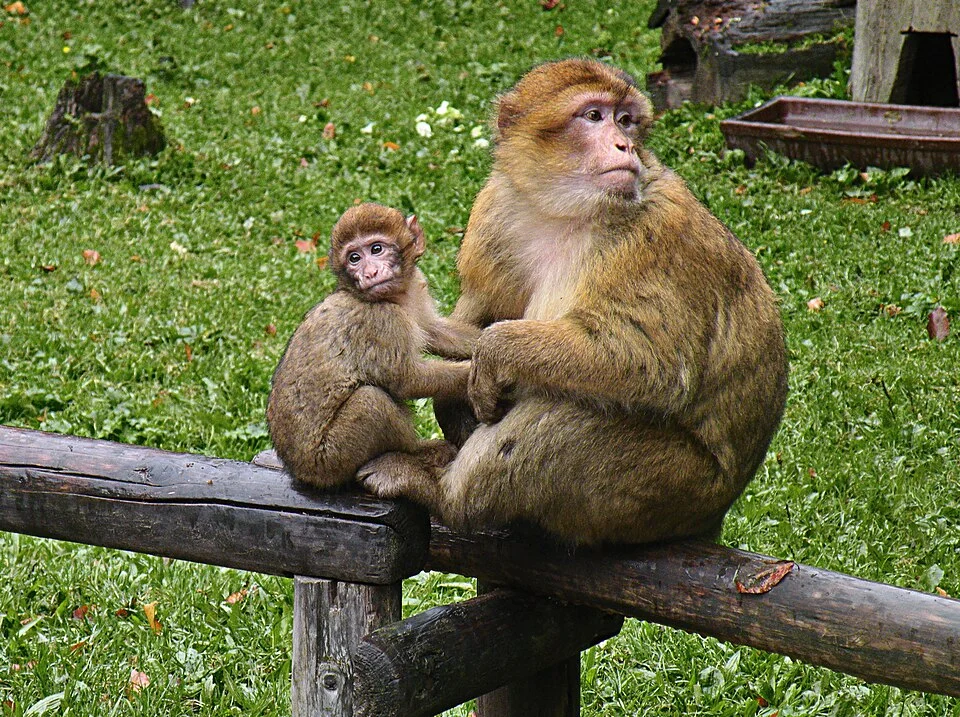
Macaca sylvanus. Mother and baby.
Vitold Muratov · CC BY-SA 3.0 · Image sourceProvider-generated thumbnail requested at 800 pixels; no local editing Local WebP display rendition; resized without cropping.
Open encyclopedia reference
The Barbary macaque (Macaca sylvanus) is a macaque species native to the Atlas Mountains of Morocco, Algeria and Tunisia, along with a small introduced population in Gibraltar. It is the type species of the genus Macaca. From the Early Pliocene to the Late Pleistocene, until around 85–40,000 years ago, it was widely distributed in Europe. Today, the Barbary macaques in Gibraltar are the only Old World monkeys in Europe. About 300 individuals live on the Rock of Gibraltar. This population appears to be stable or increasing, while the North African population is declining.
The diet of the Barbary macaque consists primarily of plants and insects. Males play an atypical role in rearing young. Because of uncertain paternity, males are integral to raising all infants. Generally, both sexes and all ages contribute in alloparental care of the young. Males live to around 25 years old while females may live up to 30 years.
Wikipedia contributors, Barbary macaque; see linked history · CC BY-SA 4.0 . Plain-text lead excerpt, at most 180 words; no infobox or later sections Retrieved 2026-10-05T04:23:16.871709+00:00. This reference remains separate from the taxonomic record.
Identity & source status
- Scientific name
- Macaca sylvanus (Linnaeus, 1758)
- Name authority
- (Linnaeus, 1758)
- Common name
- Barbary Macaque
- Rank
- species
- Accepted status
- accepted
- Kingdom
- Animalia
- Phylum
- Chordata
- Class
- Mammalia
- Order
- Primates
- Family
- Cercopithecidae
- Genus
- Macaca
- Extinction status
- Recorded extant
Classification family tree
Nested taxonomic groups from the source. This is not a direct-ancestor chain, a dated evolutionary tree or a phylogenetic reconstruction.
- domainEukaryota (Chatton, 1925) Whittaker & Margulis, 1978
- kingdomAnimalia
- phylumChordata
- subphylumVertebrata
- infraphylumGnathostomata
- parvphylumOsteichthyes
- megaclassTetrapoda
- classMammalia Linnaeus, 1758
- subclassTheria Parker & Haswell, 1897
- infraclassEutheria Gill, 1872
- orderPrimates Linnaeus, 1758
- suborderHaplorrhini Pocock, 1918
- infraorderSimiiformes Haeckel, 1866
- superfamilyCercopithecoidea Gray, 1821
- familyCercopithecidae Gray, 1821
- subfamilyCercopithecinae Gray, 1821
- tribePapionini
- genusMacaca Lacépède, 1799
- speciesMacaca sylvanus (Linnaeus, 1758)
Close classified relatives
These entries share the source’s genus, Macaca. They are not necessarily the closest relatives established by molecular evidence.
| Species | Classification | Source status |
|---|---|---|
| Crab-eating MacaqueMacaca fascicularis (Raffles, 1821) | CercopithecidaeChordata | Accepted speciesRecorded extant |
| Japanese MacaqueMacaca fuscata (Blyth, 1875) | CercopithecidaeChordata | Accepted speciesRecorded extant |
| Southern Pig-tailed MacaqueMacaca nemestrina (Linnaeus, 1766) | CercopithecidaeChordata | Accepted speciesRecorded extant |
| Gorontalo MacaqueMacaca nigrescens (Temminck, 1849) | CercopithecidaeChordata | Accepted speciesRecorded extant |
| Booted MacaqueMacaca ochreata (Ogilby, 1841) | CercopithecidaeChordata | Accepted speciesRecorded extant |
| Pagai Island MacaqueMacaca pagensis (Miller, 1903) | CercopithecidaeChordata | Accepted speciesRecorded extant |
| Bonnet MacaqueMacaca radiata (É. Geoffroy Saint-Hilaire, 1812) | CercopithecidaeChordata | Accepted speciesRecorded extant |
| Siberut MacaqueMacaca siberu Fuentes & Olson, 1995 | CercopithecidaeChordata | Accepted speciesRecorded extant |
| Lion-tailed MacaqueMacaca silenus (Linnaeus, 1758) | CercopithecidaeChordata | Accepted speciesRecorded extant |
| Milne-Edwards's MacaqueMacaca thibetana (A. Milne-Edwards, 1870) | CercopithecidaeChordata | Accepted speciesRecorded extant |
| Assam MacaqueMacaca assamensis (McClelland, 1840) | CercopithecidaeChordata | Accepted speciesRecorded extant |
| Celebes Crested MacaqueMacaca nigra (Desmarest, 1822) | CercopithecidaeChordata | Accepted speciesRecorded extant |
Names & synonyms
Names explicitly linked to this accepted taxon in the source. Synonymy can change with revision.
| Recorded name | Source status |
|---|---|
| Pithecus pygmaeus Reichenbach, 1863 Reichenbach, 1863 | synonym |
| Simia inuus Linnaeus, 1766 Linnaeus, 1766 | synonym |
| Simia pithecus Schreber, 1799 Schreber, 1799 | synonym |
| Inuus ecaudatus É. Geoffroy Saint-Hilaire, 1812 É. Geoffroy Saint-Hilaire, 1812 | synonym |
Documented distribution
Source distribution statements, not a complete range map. A listed locality is not necessarily a place of origin.
Source literature & publication evidence
References attached to this source record, including nomenclatural citations where supplied. This is a selected bibliography; abbreviated citations remain in the source’s form.
- https://www.itis.gov/servlet/SingleRpt/SingleRpt?search_topic=TSN&search_value=573027 Source fields: Taxon.tsv dwc:namePublishedIn, Taxon.tsv dcterms:references
Origins, evidence & remaining research
Name authority and publication references document nomenclature where the source supplies it. They do not establish evolutionary origins or the earliest fossil occurrence.
Specimen-level evidence, morphology, ecological research, phylogenetic studies, a comprehensive bibliography and a located literary passage have not yet been compiled for this record.
Dataset citation & attribution
This exact taxon in ChecklistBank · Catalogue of Life 2026-09-11
Catalogue of Life 2026-09-11; dataset 316321; doi:10.48580/dgz5n. https://creativecommons.org/licenses/by/4.0/ . Retrieved 5 October 2026.
Stable key: col:3WWP8. Classification follows source parent identifiers. English common names may vary by region.