
tilefish
Lopholatilus chamaeleonticeps Goode & Bean, 1879
Accepted species in Catalogue of Life’s 11 September 2026 base release. This preserves the source classification and available supporting data; it is not a completed species monograph.
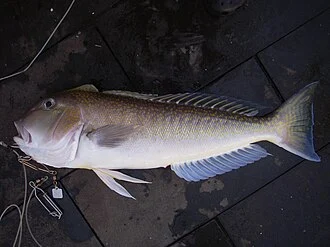
Lopholatilus chamaeleonticeps from the Gulf of Mexico
SEFSC Pascagoula Laboratory; Collection of Brandi Noble, NOAA/NMFS/SEFSC · Public domain · Image sourceProvider-generated thumbnail requested at 320 pixels; no local editing Local WebP display rendition; resized without cropping.
Open encyclopedia reference
The great northern tilefish (Lopholatilus chamaeleonticeps) or golden tile, is the largest species in the family Malacanthidae (tilefishes). It grows to a length of between 38 and 44 inches (970 and 1,120 mm). The great northern tilefish is a slow-growing and long-lived species that has four stages of life. After hatching from eggs, the larvae are found in plankton. As they grow into juveniles, the individuals seek shelter until finding or making their own burrows. As adults, the tilefish continue to expand their burrows in the sediment throughout their lives. The diet of the larvae is unknown, but presumed to consist of zooplankton; juveniles and adults feed upon various benthic invertebrates, crustaceans, and fish. After reaching sexual maturity between 5 and 7 years of age, females lay eggs throughout the mating season for the male to fertilize, with each female laying an average of 2.3 million eggs. The great northern tilefish fishery has been regulated to prevent overfishing. Regulations include catch limits and gear restrictions to prevent damage to the species' habitat and population.
Wikipedia contributors, Great northern tilefish; see linked history · CC BY-SA 4.0 . Plain-text lead excerpt, at most 180 words; no infobox or later sections Retrieved 2026-10-05T02:35:34.045917+00:00. This reference remains separate from the taxonomic record.
Identity & source status
- Scientific name
- Lopholatilus chamaeleonticeps Goode & Bean, 1879
- Name authority
- Goode & Bean, 1879
- Common name
- tilefish
- Rank
- species
- Accepted status
- accepted
- Kingdom
- Animalia
- Phylum
- Chordata
- Class
- Teleostei
- Family
- Malacanthidae
- Genus
- Lopholatilus
- Extinction status
- Not supplied by this source
Source habitat flags: Marine: yes · Freshwater: no · Terrestrial: no. These do not form a complete habitat description.
Classification family tree
Nested taxonomic groups from the source. This is not a direct-ancestor chain, a dated evolutionary tree or a phylogenetic reconstruction.
- domainEukaryota (Chatton, 1925) Whittaker & Margulis, 1978
- kingdomAnimalia
- phylumChordata
- subphylumVertebrata
- infraphylumGnathostomata
- parvphylumOsteichthyes
- gigaclassActinopterygii
- superclassActinopteri
- classTeleostei
- familyMalacanthidae Poey, 1861
- subfamilyLatilinae Gill, 1862
- genusLopholatilus Goode & Bean, 1879
- speciesLopholatilus chamaeleonticeps Goode & Bean, 1879
Close classified relatives
These entries share the source’s genus, Lopholatilus. They are not necessarily the closest relatives established by molecular evidence.
| Species | Classification | Source status |
|---|---|---|
| Lopholatilus villarii Miranda Ribeiro, 1915 | MalacanthidaeChordata | Accepted speciesExtinction status not supplied |
Source literature & publication evidence
References attached to this source record, including nomenclatural citations where supplied. This is a selected bibliography; abbreviated citations remain in the source’s form.
- Goode, G. B., & Bean, T. H. (1879). Description of a new genus and species of fish, Lopholatilus chamaeleonticeps, from the south coast of New England. Proceedings of the United States National Museum, v. 2 (no. 77): 205–209. https://doi.org/10.5479/si.00963801.2-77.205 Source fields: Taxon.tsv dwc:namePublishedIn, Taxon.tsv dcterms:references
Origins, evidence & remaining research
Name authority and publication references document nomenclature where the source supplies it. They do not establish evolutionary origins or the earliest fossil occurrence.
Specimen-level evidence, morphology, ecological research, phylogenetic studies, a comprehensive bibliography and a located literary passage have not yet been compiled for this record.
Dataset citation & attribution
This exact taxon in ChecklistBank · Catalogue of Life 2026-09-11
Catalogue of Life 2026-09-11; dataset 316321; doi:10.48580/dgz5n. https://creativecommons.org/licenses/by/4.0/ . Retrieved 5 October 2026.
Stable key: col:3W3LB. Classification follows source parent identifiers. English common names may vary by region.