
NATURAL HISTORY · CATALOGUE RECORD
Crabeater Seal
Lobodon carcinophaga (Hombron & Jacquinot, 1842)
Source-backed taxonomic record
Accepted species in Catalogue of Life’s 11 September 2026 base release. This preserves the source classification and available supporting data; it is not a completed species monograph.
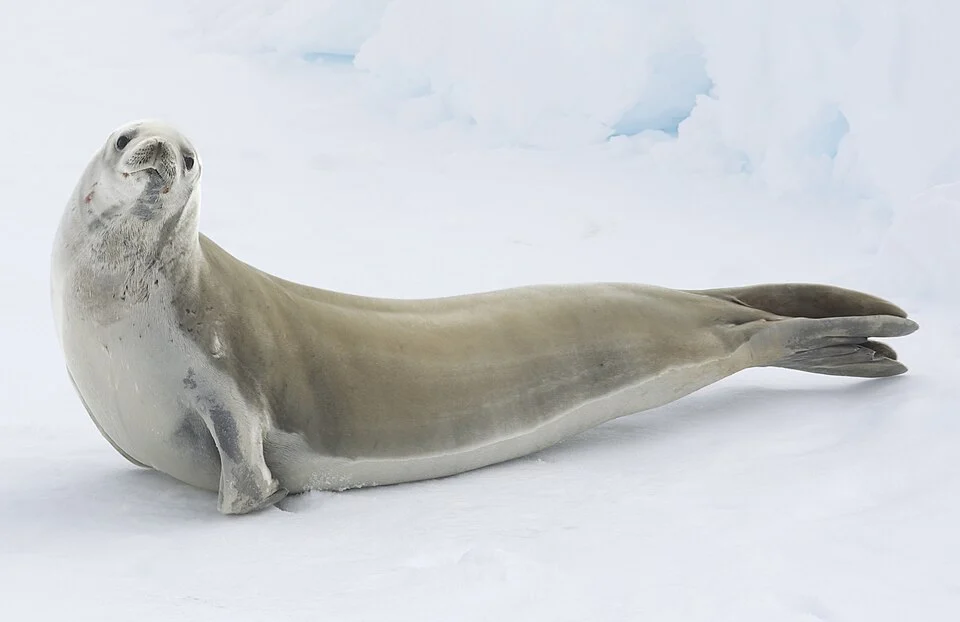
Crabeater seal on the sea ice in Antarctica
François Guerraz · CC BY-SA 3.0 · Image sourceProvider-generated thumbnail requested at 800 pixels; no local editing Local WebP display rendition; resized without cropping.
Open encyclopedia reference
The crabeater seal (Lobodon carcinophaga), also known as the krill-eater seal, is a true seal with a circumpolar distribution around the coast of Antarctica. They are the only member of the genus Lobodon. They are medium- to large-sized (over 2 m (6.6 ft) in length), relatively slender and pale-colored, found primarily on the free-floating pack ice that extends seasonally out from the Antarctic coast, which they use as a platform for resting, mating, social aggregation and accessing their prey. They are by far the most abundant seal species in the world. While population estimates are uncertain, there are at least 7 million and possibly as many as 75 million individuals. This success of this species is due to its specialized predation on the abundant Antarctic krill of the Southern Ocean, for which it has uniquely adapted, sieve-like tooth structure. Indeed, its scientific name, translated as "lobe-toothed (lobodon) crab eater (carcinophaga)", refers specifically to the finely lobed teeth adapted to filtering their small crustacean prey. Despite its name, the crabeater seal does not eat crabs.
Wikipedia contributors, Crabeater seal; see linked history · CC BY-SA 4.0 . Plain-text lead excerpt, at most 180 words; no infobox or later sections Retrieved 2026-10-05T03:39:13.847057+00:00. This reference remains separate from the taxonomic record.
Identity & source status
- Scientific name
- Lobodon carcinophaga (Hombron & Jacquinot, 1842)
- Name authority
- (Hombron & Jacquinot, 1842)
- Common name
- Crabeater Seal
- Rank
- species
- Accepted status
- accepted
- Kingdom
- Animalia
- Phylum
- Chordata
- Class
- Mammalia
- Order
- Carnivora
- Family
- Phocidae
- Genus
- Lobodon
- Extinction status
- Recorded extant
Classification family tree
Nested taxonomic groups from the source. This is not a direct-ancestor chain, a dated evolutionary tree or a phylogenetic reconstruction.
- domainEukaryota (Chatton, 1925) Whittaker & Margulis, 1978
- kingdomAnimalia
- phylumChordata
- subphylumVertebrata
- infraphylumGnathostomata
- parvphylumOsteichthyes
- megaclassTetrapoda
- classMammalia Linnaeus, 1758
- subclassTheria Parker & Haswell, 1897
- infraclassEutheria Gill, 1872
- orderCarnivora Bowdich, 1821
- suborderCaniformia Kretzoi, 1938
- familyPhocidae Gray, 1821
- genusLobodon Gray, 1844
- speciesLobodon carcinophaga (Hombron & Jacquinot, 1842)
Close classified relatives
No other member of this genus is present in the selected snapshot.
Names & synonyms
Names explicitly linked to this accepted taxon in the source. Synonymy can change with revision.
| Recorded name | Source status |
|---|---|
| Lobodon carcinophagus (Hombron & Jacquinot, 1842) (Hombron & Jacquinot, 1842) | synonym |
| Phoca carcinophaga Hombron & Jacquinot, 1842 Hombron & Jacquinot, 1842 | synonym |
Documented distribution
Source distribution statements, not a complete range map. A listed locality is not necessarily a place of origin.
South America
Source literature & publication evidence
References attached to this source record, including nomenclatural citations where supplied. This is a selected bibliography; abbreviated citations remain in the source’s form.
- https://www.itis.gov/servlet/SingleRpt/SingleRpt?search_topic=TSN&search_value=622023 Source fields: Taxon.tsv dwc:namePublishedIn, Taxon.tsv dcterms:references
Origins, evidence & remaining research
Name authority and publication references document nomenclature where the source supplies it. They do not establish evolutionary origins or the earliest fossil occurrence.
Specimen-level evidence, morphology, ecological research, phylogenetic studies, a comprehensive bibliography and a located literary passage have not yet been compiled for this record.
Dataset citation & attribution
This exact taxon in ChecklistBank · Catalogue of Life 2026-09-11
Catalogue of Life 2026-09-11; dataset 316321; doi:10.48580/dgz5n. https://creativecommons.org/licenses/by/4.0/ . Retrieved 5 October 2026.
Stable key: col:3VT8H. Classification follows source parent identifiers. English common names may vary by region.