
Lissotriton helveticus (Razoumovsky, 1789)
Accepted species in Catalogue of Life’s 11 September 2026 base release. This preserves the source classification and available supporting data; it is not a completed species monograph.
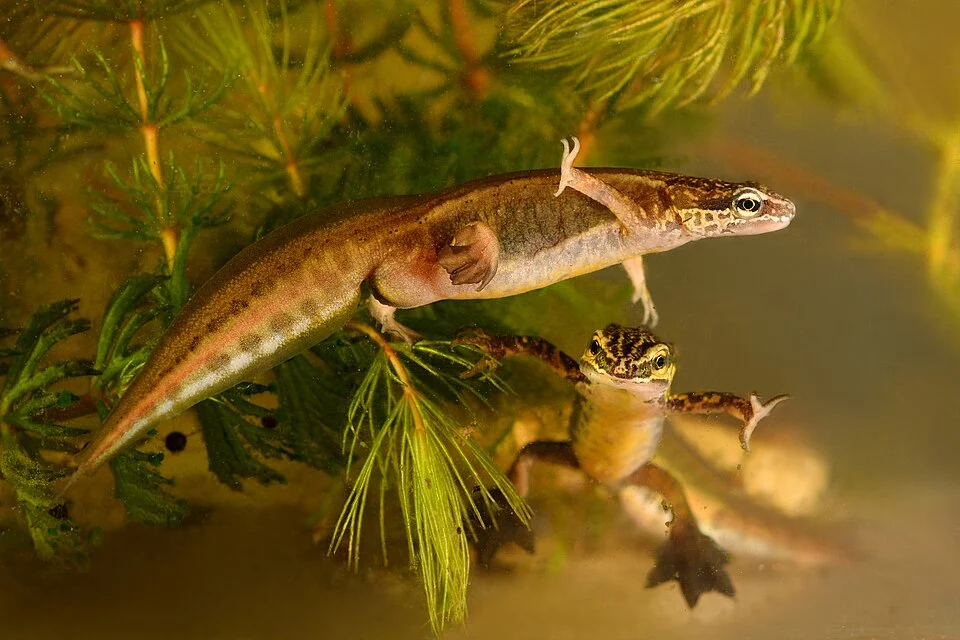
Lissotriton helveticus
Gilles San Martin from Namur, Belgium · CC BY-SA 2.0 · Image sourceProvider-generated thumbnail requested at 800 pixels; no local editing Local WebP display rendition; resized without cropping.
Open encyclopedia reference
The palmate newt (Lissotriton helveticus) is a species of newt found in Western Europe, from Great Britain to the northern Iberian Peninsula. It is 5–9.5 cm (2.0–3.7 in) long and olive or brown with some dark spots. The underside is yellow to orange, and the throat, unlike in the similar smooth newt, always unspotted. A dark stripe runs along the head and through the eyes. Breeding males develop a distinct filament on the end of their tail, strongly webbed hind feet, and a low, smooth crest on their back. Habitats include forests, marshes, pastures or gardens. While on land, the newts are mainly nocturnal. After emerging from hibernation in spring, they move to stagnant, fish-free bodies of water for breeding. Following a courtship display, the male deposits a spermatophore that is picked up by the female. Larvae develop over after 1.5–3.5 months before metamorphosing into land-dwelling juveniles (efts). Sexual maturity is reached after two to three years, and the newts can live up to 12 years in the wild.
Wikipedia contributors, Palmate newt; see linked history · CC BY-SA 4.0 . Plain-text lead excerpt, at most 180 words; no infobox or later sections Retrieved 2026-10-05T17:02:22.859971+00:00. This reference remains separate from the taxonomic record.
Identity & source status
- Scientific name
- Lissotriton helveticus (Razoumovsky, 1789)
- Name authority
- (Razoumovsky, 1789)
- Rank
- species
- Accepted status
- accepted
- Kingdom
- Animalia
- Phylum
- Chordata
- Class
- Amphibia
- Order
- Caudata
- Family
- Salamandridae
- Genus
- Lissotriton
- Extinction status
- Recorded extant
Classification family tree
Nested taxonomic groups from the source. This is not a direct-ancestor chain, a dated evolutionary tree or a phylogenetic reconstruction.
- domainEukaryota (Chatton, 1925) Whittaker & Margulis, 1978
- kingdomAnimalia
- phylumChordata
- subphylumVertebrata
- infraphylumGnathostomata
- parvphylumOsteichthyes
- megaclassTetrapoda
- classAmphibia
- orderCaudata
- familySalamandridae Goldfuss, 1820
- subfamilyPleurodelinae Tschudi, 1838
- genusLissotriton Bell, 1839
- speciesLissotriton helveticus (Razoumovsky, 1789)
Close classified relatives
These entries share the source’s genus, Lissotriton. They are not necessarily the closest relatives established by molecular evidence.
| Species | Classification | Source status |
|---|---|---|
| Lissotriton boscai (Lataste in Tourneville, 1879) | SalamandridaeChordata | Accepted speciesRecorded extant |
| Lissotriton italicus (Peracca, 1898) | SalamandridaeChordata | Accepted speciesRecorded extant |
| Lissotriton maltzani (Boettger, 1879) | SalamandridaeChordata | Accepted speciesRecorded extant |
| Lissotriton montandoni (Boulenger, 1880) | SalamandridaeChordata | Accepted speciesRecorded extant |
| Lissotriton graecus (Wolterstorff, 1906) | SalamandridaeChordata | Accepted speciesRecorded extant |
| Lissotriton kosswigi (Freytag, 1955) | SalamandridaeChordata | Accepted speciesRecorded extant |
Names & synonyms
Names explicitly linked to this accepted taxon in the source. Synonymy can change with revision.
Source literature & publication evidence
References attached to this source record, including nomenclatural citations where supplied. This is a selected bibliography; abbreviated citations remain in the source’s form.
- https://www.itis.gov/servlet/SingleRpt/SingleRpt?search_topic=TSN&search_value=775919 Source fields: Taxon.tsv dwc:namePublishedIn, Taxon.tsv dcterms:references
Origins, evidence & remaining research
Name authority and publication references document nomenclature where the source supplies it. They do not establish evolutionary origins or the earliest fossil occurrence.
Specimen-level evidence, morphology, ecological research, phylogenetic studies, a comprehensive bibliography and a located literary passage have not yet been compiled for this record.
Dataset citation & attribution
This exact taxon in ChecklistBank · Catalogue of Life 2026-09-11
Catalogue of Life 2026-09-11; dataset 316321; doi:10.48580/dgz5n. https://creativecommons.org/licenses/by/4.0/ . Retrieved 5 October 2026.
Stable key: col:3VGGY. Classification follows source parent identifiers. English common names may vary by region.