
NATURAL HISTORY · CATALOGUE RECORD
Striped Polecat
Ictonyx striatus (Perry, 1810)
Source-backed taxonomic record
Accepted species in Catalogue of Life’s 11 September 2026 base release. This preserves the source classification and available supporting data; it is not a completed species monograph.
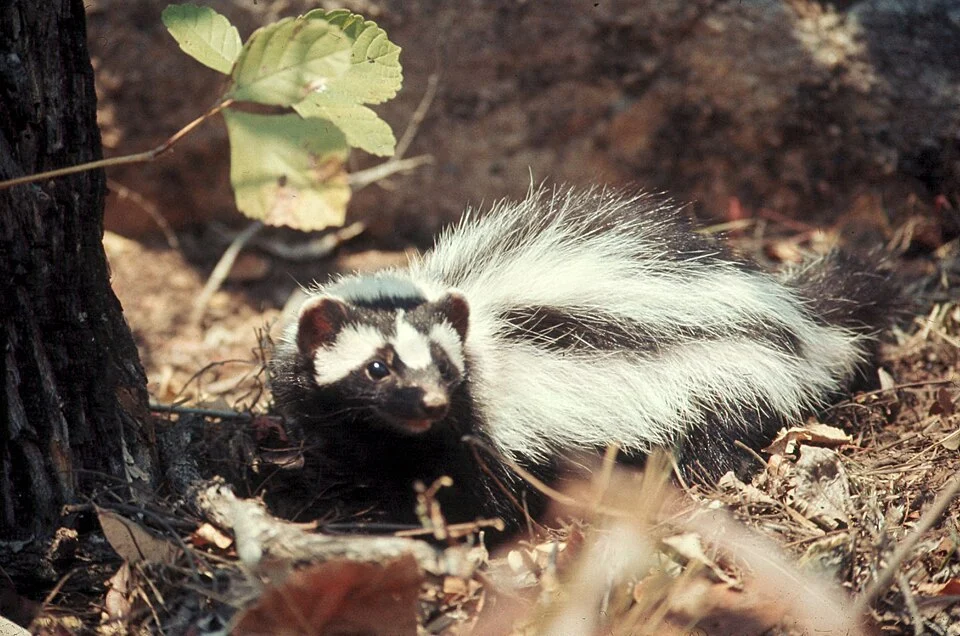
35 mm slide; color. Scientific Classification: Kingdom: Animalia; Phylum: Chordata; Class: Mammalia; Order: Carnivora; Family: Mustelidae; Genus: Ictonyx; Genus species: Ictonyx striatus. Animal characteristics: Head-Body Length: 30-38 cm; Height: 10-15 cm; Weight: 600-1400 g; Identification: The African polecat is mostly black with white stripes and a white tail. Their underside is black; Habitat: Grasslands, steppes; Diet: Carnivore: invertebrates, rats, reptiles, hares; Reproduction: One to four baby polecats are born, blind and naked, after a gestation period of 36 days. After leaving the den at two months of age, they will accompany their mother for several months; Social Structure: Polecats are solitary animals but may be found in pairs or family parties; Behavior: This nocturnal species usually hunts between 10 p.m. and dawn. If threatened, they will squirt noxious anal secretions at the attacker; Status: No special status; Interesting Facts: As a defense mechanism, the polecat will spray its aggressor with a foul-smelling fluid from its anal glands.
Garst, Warren, 1922-2016, photographer · CC BY-SA 4.0 · Image sourceProvider-generated thumbnail requested at 800 pixels; no local editing Local WebP display rendition; resized without cropping.
Open encyclopedia reference
The striped polecat (Ictonyx striatus), also called the African polecat, zoril, zorille, zorilla, African muishond, striped muishond, Cape polecat, and African skunk, is a species of mammal native to sub-Saharan Africa. Despite bearing some resemblance to a skunk (of the family Mephitidae), it belongs in a separate family known as the Mustelidae, and genetic analysis suggests that its closest living relative is the African striped weasel. It is adaptable and lives in a wide range of habitats and elevations, preferring open environments with lower levels of shrubs. This species measures 30–38 cm (12–15 in) in length excluding the tail, with males growing larger than females. Its fur is mostly black, with distinctive white stripes running down its back and white patches on its face and tail, though the exact patterning is highly variable. The forelimbs of this animal bear long, curved claws which it uses to excavate burrows or dig for invertebrate prey in soil or dung.
Wikipedia contributors, Striped polecat; see linked history · CC BY-SA 4.0 . Plain-text lead excerpt, at most 180 words; no infobox or later sections Retrieved 2026-10-05T04:34:13.421714+00:00. This reference remains separate from the taxonomic record.
Identity & source status
- Scientific name
- Ictonyx striatus (Perry, 1810)
- Name authority
- (Perry, 1810)
- Common name
- Striped Polecat
- Rank
- species
- Accepted status
- accepted
- Kingdom
- Animalia
- Phylum
- Chordata
- Class
- Mammalia
- Order
- Carnivora
- Family
- Mustelidae
- Genus
- Ictonyx
- Extinction status
- Recorded extant
Classification family tree
Nested taxonomic groups from the source. This is not a direct-ancestor chain, a dated evolutionary tree or a phylogenetic reconstruction.
- domainEukaryota (Chatton, 1925) Whittaker & Margulis, 1978
- kingdomAnimalia
- phylumChordata
- subphylumVertebrata
- infraphylumGnathostomata
- parvphylumOsteichthyes
- megaclassTetrapoda
- classMammalia Linnaeus, 1758
- subclassTheria Parker & Haswell, 1897
- infraclassEutheria Gill, 1872
- orderCarnivora Bowdich, 1821
- suborderCaniformia Kretzoi, 1938
- familyMustelidae G. Fischer von Waldheim, 1817
- subfamilyIctonychinae Pocock, 1922
- genusIctonyx Kaup, 1835
- speciesIctonyx striatus (Perry, 1810)
Close classified relatives
These entries share the source’s genus, Ictonyx. They are not necessarily the closest relatives established by molecular evidence.
| Species | Classification | Source status |
|---|---|---|
| Saharan Striped PolecatIctonyx libycus (Hemprich & Ehrenberg, 1833) | MustelidaeChordata | Accepted speciesRecorded extant |
Names & synonyms
Names explicitly linked to this accepted taxon in the source. Synonymy can change with revision.
Documented distribution
Source distribution statements, not a complete range map. A listed locality is not necessarily a place of origin.
Source literature & publication evidence
References attached to this source record, including nomenclatural citations where supplied. This is a selected bibliography; abbreviated citations remain in the source’s form.
- https://www.itis.gov/servlet/SingleRpt/SingleRpt?search_topic=TSN&search_value=621938 Source fields: Taxon.tsv dwc:namePublishedIn, Taxon.tsv dcterms:references
Origins, evidence & remaining research
Name authority and publication references document nomenclature where the source supplies it. They do not establish evolutionary origins or the earliest fossil occurrence.
Specimen-level evidence, morphology, ecological research, phylogenetic studies, a comprehensive bibliography and a located literary passage have not yet been compiled for this record.
Dataset citation & attribution
This exact taxon in ChecklistBank · Catalogue of Life 2026-09-11
Catalogue of Life 2026-09-11; dataset 316321; doi:10.48580/dgz5n. https://creativecommons.org/licenses/by/4.0/ . Retrieved 5 October 2026.
Stable key: col:3PBCF. Classification follows source parent identifiers. English common names may vary by region.