
NATURAL HISTORY · CATALOGUE RECORD
Southern Bottlenose Whale
Hyperoodon planifrons Flower, 1882
Source-backed taxonomic record
Accepted species in Catalogue of Life’s 11 September 2026 base release. This preserves the source classification and available supporting data; it is not a completed species monograph.
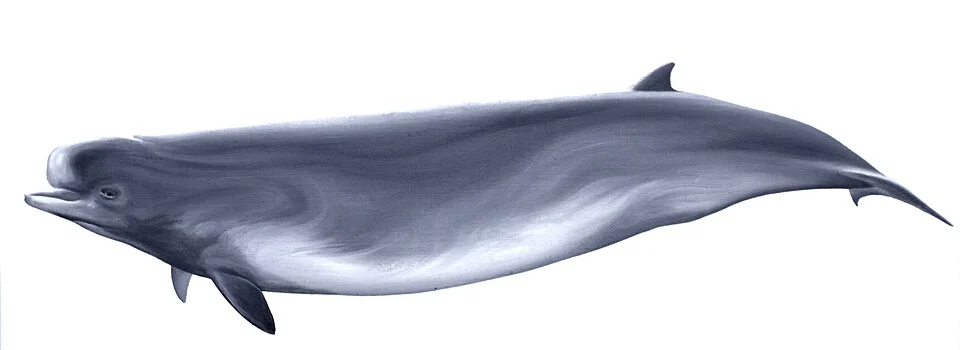
Hyperoodon planifrons (Southern bottlenose whale), oil on paper
Jörg Mazur · CC BY-SA 4.0 · Image sourceProvider-generated thumbnail requested at 800 pixels; no local editing Local WebP display rendition; resized without cropping.
Open encyclopedia reference
The southern bottlenose whale (Hyperoodon planifrons) is a species of whale, in the ziphiid family, one of two members of the genus Hyperoodon. Seldom observed, the southern bottlenose whale is resident in Antarctic waters. The species was first described by English zoologist William Henry Flower in 1882, based on a water-worn skull from Lewis Island, in the Dampier Archipelago, Western Australia. It lives in deep ocean waters over 1,000 m (3,300 ft).
Wikipedia contributors, Southern bottlenose whale; see linked history · CC BY-SA 4.0 . Plain-text lead excerpt, at most 180 words; no infobox or later sections Retrieved 2026-10-05T11:08:42.887253+00:00. This reference remains separate from the taxonomic record.
Identity & source status
- Scientific name
- Hyperoodon planifrons Flower, 1882
- Name authority
- Flower, 1882
- Common name
- Southern Bottlenose Whale
- Rank
- species
- Accepted status
- accepted
- Kingdom
- Animalia
- Phylum
- Chordata
- Class
- Mammalia
- Order
- Cetacea
- Family
- Hyperoodontidae
- Genus
- Hyperoodon
- Extinction status
- Recorded extant
Classification family tree
Nested taxonomic groups from the source. This is not a direct-ancestor chain, a dated evolutionary tree or a phylogenetic reconstruction.
- domainEukaryota (Chatton, 1925) Whittaker & Margulis, 1978
- kingdomAnimalia
- phylumChordata
- subphylumVertebrata
- infraphylumGnathostomata
- parvphylumOsteichthyes
- megaclassTetrapoda
- classMammalia Linnaeus, 1758
- subclassTheria Parker & Haswell, 1897
- infraclassEutheria Gill, 1872
- orderCetacea Brisson, 1762
- suborderOdontoceti Flower, 1867
- familyHyperoodontidae Gray, 1846
- genusHyperoodon Lacépède, 1804
- speciesHyperoodon planifrons Flower, 1882
Close classified relatives
These entries share the source’s genus, Hyperoodon. They are not necessarily the closest relatives established by molecular evidence.
| Species | Classification | Source status |
|---|---|---|
| North Atlantic bottle-nosed whaleHyperoodon ampullatus (Forster, 1770) | HyperoodontidaeChordata | Accepted speciesRecorded extant |
Names & synonyms
Names explicitly linked to this accepted taxon in the source. Synonymy can change with revision.
| Recorded name | Source status |
|---|---|
| Hyperoodon burmeisterei Moreno, 1895 Moreno, 1895 | synonym |
Documented distribution
Source distribution statements, not a complete range map. A listed locality is not necessarily a place of origin.
East Pacific
Eastern Atlantic Ocean
Indo-West Pacific
Western Atlantic Ocean
Source literature & publication evidence
References attached to this source record, including nomenclatural citations where supplied. This is a selected bibliography; abbreviated citations remain in the source’s form.
- https://www.itis.gov/servlet/SingleRpt/SingleRpt?search_topic=TSN&search_value=180505 Source fields: Taxon.tsv dwc:namePublishedIn, Taxon.tsv dcterms:references
Origins, evidence & remaining research
Name authority and publication references document nomenclature where the source supplies it. They do not establish evolutionary origins or the earliest fossil occurrence.
Specimen-level evidence, morphology, ecological research, phylogenetic studies, a comprehensive bibliography and a located literary passage have not yet been compiled for this record.
Dataset citation & attribution
This exact taxon in ChecklistBank · Catalogue of Life 2026-09-11
Catalogue of Life 2026-09-11; dataset 316321; doi:10.48580/dgz5n. https://creativecommons.org/licenses/by/4.0/ . Retrieved 5 October 2026.
Stable key: col:3NR77. Classification follows source parent identifiers. English common names may vary by region.