
Hyalinobatrachium yaku Guayasamin, Cisneros-Heredia, Maynard, Lynch, Culebras & Hamilton, 2017
Accepted species in Catalogue of Life’s 11 September 2026 base release. This preserves the source classification and available supporting data; it is not a completed species monograph.
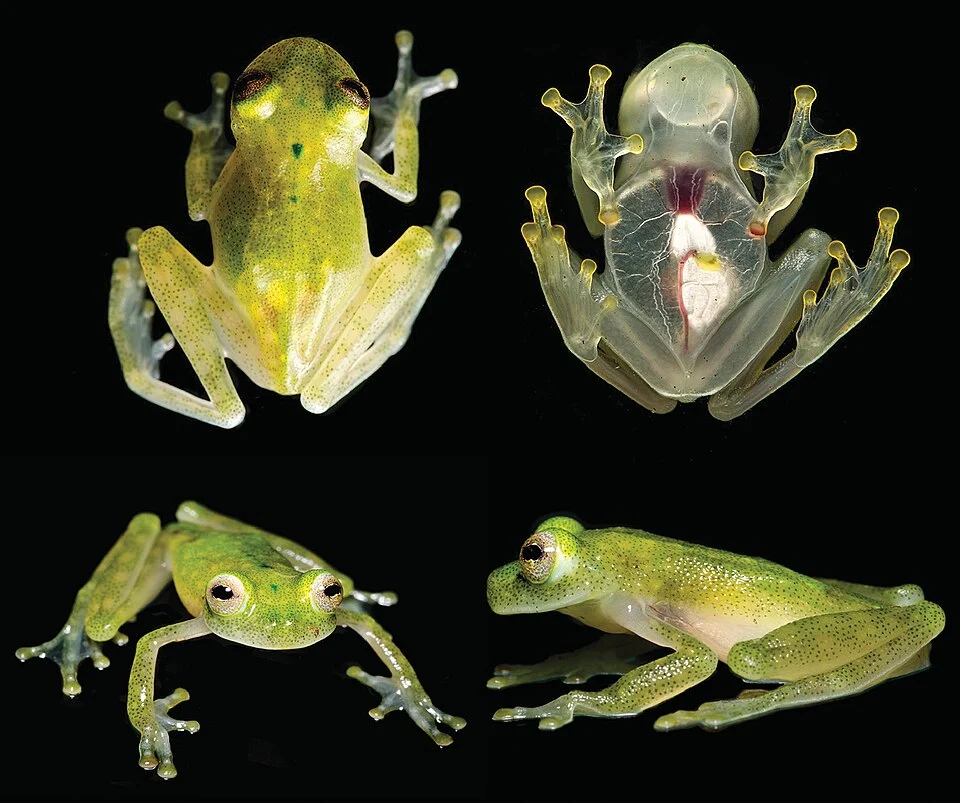
Hyalinobatrachium yaku sp. n. in life. Top row: adult male, MZUTI 5001, holotype, in dorsal and ventral view. Bottom row: adult male, paratype, QCAZ 55628.
Guayasamin JM, Cisneros-Heredia DF, Maynard RJ, Lynch RL, Culebras J, Hamilton PS · CC BY-SA 4.0 · Image sourceProvider-generated thumbnail requested at 800 pixels; no local editing Local WebP display rendition; resized without cropping.
Open encyclopedia reference
Hyalinobatrachium yaku is a species of frog in the family Centrolenidae. It is found in the Pastaza, Orellana and Napo Provinces of Ecuador. One of the remarkable characteristics of this species is that their belly and some internal organs are transparent leaving the red heart completely exposed through transparent parietal peritoneum and pericardium. The glassfrogs are generally small, ranging from 0.8 to 3 inches (2-7.5 cm) in length. This species can be differentiated from other frogs in the Hyalinobatrachium genus by the row of dark green spots down the middle of its back.
It was described, by five researchers namely Juan Manuel Guayasamin, Diego F. Cisneros-Heredia, Ross J. Maynard, Ryan L. Lynch, Jaime Culebras and Paul S. Hamilton first published about the finding on May 12, 2017, in the journal ZooKeys.
Wikipedia contributors, Hyalinobatrachium yaku; see linked history · CC BY-SA 4.0 . Plain-text lead excerpt, at most 180 words; no infobox or later sections Retrieved 2026-10-05T16:22:26.895227+00:00. This reference remains separate from the taxonomic record.
Identity & source status
- Scientific name
- Hyalinobatrachium yaku Guayasamin, Cisneros-Heredia, Maynard, Lynch, Culebras & Hamilton, 2017
- Name authority
- Guayasamin, Cisneros-Heredia, Maynard, Lynch, Culebras & Hamilton, 2017
- Rank
- species
- Accepted status
- accepted
- Kingdom
- Animalia
- Phylum
- Chordata
- Class
- Amphibia
- Order
- Anura
- Family
- Centrolenidae
- Genus
- Hyalinobatrachium
- Extinction status
- Recorded extant
Classification family tree
Nested taxonomic groups from the source. This is not a direct-ancestor chain, a dated evolutionary tree or a phylogenetic reconstruction.
- domainEukaryota (Chatton, 1925) Whittaker & Margulis, 1978
- kingdomAnimalia
- phylumChordata
- subphylumVertebrata
- infraphylumGnathostomata
- parvphylumOsteichthyes
- megaclassTetrapoda
- classAmphibia
- orderAnura
- familyCentrolenidae Taylor, 1951
- subfamilyHyalinobatrachinae Guayasamin, Castroviejo-Fisher, Trueb, Ayarzagüena, Rada & Vilà, 2009
- genusHyalinobatrachium Ruiz-Carranza & Lynch, 1991
- speciesHyalinobatrachium yaku Guayasamin, Cisneros-Heredia, Maynard, Lynch, Culebras & Hamilton, 2017
Close classified relatives
These entries share the source’s genus, Hyalinobatrachium. They are not necessarily the closest relatives established by molecular evidence.
Source literature & publication evidence
References attached to this source record, including nomenclatural citations where supplied. This is a selected bibliography; abbreviated citations remain in the source’s form.
- https://www.itis.gov/servlet/SingleRpt/SingleRpt?search_topic=TSN&search_value=1104459 Source fields: Taxon.tsv dwc:namePublishedIn, Taxon.tsv dcterms:references
Origins, evidence & remaining research
Name authority and publication references document nomenclature where the source supplies it. They do not establish evolutionary origins or the earliest fossil occurrence.
Specimen-level evidence, morphology, ecological research, phylogenetic studies, a comprehensive bibliography and a located literary passage have not yet been compiled for this record.
Dataset citation & attribution
This exact taxon in ChecklistBank · Catalogue of Life 2026-09-11
Catalogue of Life 2026-09-11; dataset 316321; doi:10.48580/dgz5n. https://creativecommons.org/licenses/by/4.0/ . Retrieved 5 October 2026.
Stable key: col:3MW2T. Classification follows source parent identifiers. English common names may vary by region.