
honeycomb stingray
Himantura uarnak (Gmelin, 1789)
Accepted species in Catalogue of Life’s 11 September 2026 base release. This preserves the source classification and available supporting data; it is not a completed species monograph.
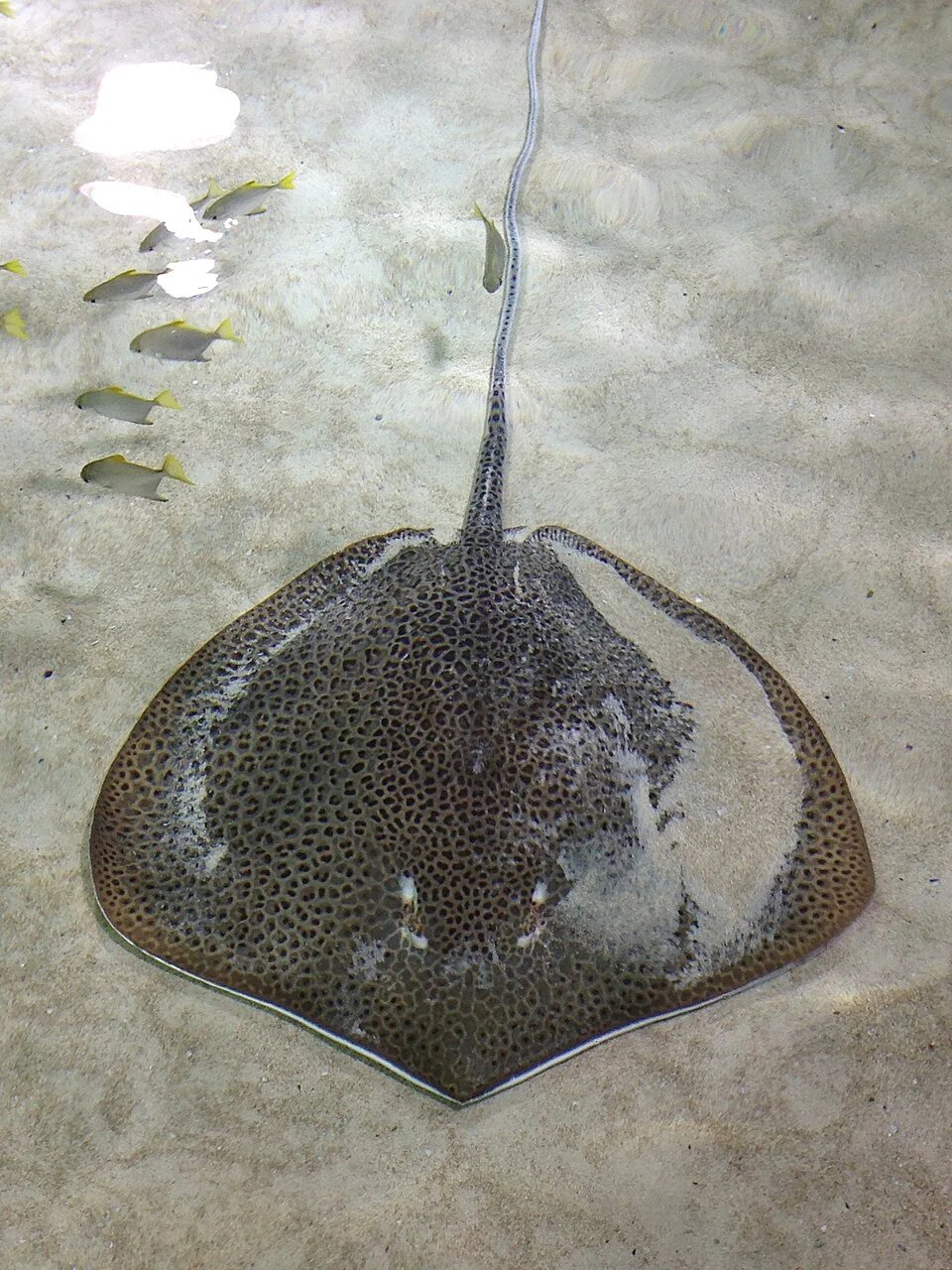
A fine-spotted leopard whipray (Himantura tutul) at the California Academy of Sciences' Philippine Mangrove Lagoon exhibit.
User:Steven Walling · CC BY-SA 3.0 · Image sourceProvider-generated thumbnail requested at 800 pixels; no local editing Local WebP display rendition; resized without cropping.
Open encyclopedia reference
The reticulate whipray or honeycomb stingray (Himantura uarnak) is a species of stingray in the family Dasyatidae. It inhabits coastal waters in the western Indian Ocean including the Red Sea, Natal and the Arabian Sea; also a Lessepsian transmigrant in the eastern Mediterranean. A large species reaching 2 m (6.6 ft) in width, the reticulate whipray has a diamond-shaped pectoral fin disc and an extremely long tail without fin folds. Both its common and scientific names refer to its ornate dorsal color pattern of many small, close-set dark spots or reticulations on a lighter background. However, the reticulate whipray is only one of several large spotted stingrays in the Indo-Pacific which, coupled with the variability of its coloration with age and locality, has resulted in a great deal of taxonomic confusion. Often encountered resting on the bottom during daytime, the reticulate whipray is a predator of bottom-dwelling invertebrates and bony fishes. Like other stingrays, it is aplacental viviparous, with the developing embryos nourished at first by yolk and later by histotroph ("uterine milk").
Wikipedia contributors, Reticulate whipray; see linked history · CC BY-SA 4.0 . Plain-text lead excerpt, at most 180 words; no infobox or later sections Retrieved 2026-10-05T07:26:54.466025+00:00. This reference remains separate from the taxonomic record.
Identity & source status
- Scientific name
- Himantura uarnak (Gmelin, 1789)
- Name authority
- (Gmelin, 1789)
- Common name
- honeycomb stingray
- Rank
- species
- Accepted status
- accepted
- Kingdom
- Animalia
- Phylum
- Chordata
- Class
- Elasmobranchii
- Order
- Myliobatiformes
- Family
- Dasyatidae
- Genus
- Himantura
- Extinction status
- Not supplied by this source
Source habitat flags: Marine: yes · Freshwater: no · Terrestrial: no. These do not form a complete habitat description.
Classification family tree
Nested taxonomic groups from the source. This is not a direct-ancestor chain, a dated evolutionary tree or a phylogenetic reconstruction.
- domainEukaryota (Chatton, 1925) Whittaker & Margulis, 1978
- kingdomAnimalia
- phylumChordata
- subphylumVertebrata
- infraphylumGnathostomata
- parvphylumChondrichthyes
- classElasmobranchii
- subclassNeoselachii
- infraclassBatoidea
- orderMyliobatiformes
- familyDasyatidae Jordan & Gilbert, 1879
- genusHimantura Müller & Henle, 1837
- speciesHimantura uarnak (Gmelin, 1789)
Close classified relatives
These entries share the source’s genus, Himantura. They are not necessarily the closest relatives established by molecular evidence.
| Species | Classification | Source status |
|---|---|---|
| Himantura australis Last, White & Naylor, 2016 | DasyatidaeChordata | Accepted speciesExtinction status not supplied |
| Himantura krempfi (Chabanaud, 1923) | DasyatidaeChordata | Accepted speciesExtinction status not supplied |
| Himantura marginata (Blyth, 1860) | DasyatidaeChordata | Accepted speciesExtinction status not supplied |
| Himantura pareh (Bleeker, 1852) | DasyatidaeChordata | Accepted speciesExtinction status not supplied |
| Himantura arlyzae Borsa, Hernawan, Hocdé & Pouyaud, 2026 | DasyatidaeChordata | Accepted speciesExtinction status not supplied |
| Himantura alcockii (Annandale, 1909) | DasyatidaeChordata | Accepted speciesExtinction status not supplied |
| Himantura fava (Annandale, 1909) | DasyatidaeChordata | Accepted speciesExtinction status not supplied |
| Himantura fluviatilis (Hamilton, 1822) | DasyatidaeChordata | Accepted speciesExtinction status not supplied |
| Himantura leoparda Manjaji-Matsumoto & Last, 2008 | DasyatidaeChordata | Accepted speciesExtinction status not supplied |
| Himantura microphthalma (Chen, 1948) | DasyatidaeChordata | Accepted speciesExtinction status not supplied |
| Himantura tutul Borsa, Durand, Shen, Alyza, Solihin & Berrebi, 2013 | DasyatidaeChordata | Accepted speciesExtinction status not supplied |
| Himantura undulata (Bleeker, 1852) | DasyatidaeChordata | Accepted speciesExtinction status not supplied |
Names & synonyms
Names explicitly linked to this accepted taxon in the source. Synonymy can change with revision.
| Recorded name | Source status |
|---|---|
| Dasybatus uarnak (Gmelin, 1789) (Gmelin, 1789) | synonym |
| Himantura punctata (Günther, 1870) (Günther, 1870) | synonym |
| Raja sephen var. uarnak Forsskål, 1775 Forsskål, 1775 | synonym |
| Raja uarnak Gmelin, 1789 Gmelin, 1789 | synonym |
| Raja sephen uarnak Forsskål, 1775 Forsskål, 1775 | synonym |
| Dasyatis uarnak (Gmelin, 1789) (Gmelin, 1789) | synonym |
| Trygon uarnak (Gmelin, 1789) (Gmelin, 1789) | synonym |
| Trygon punctata Günther, 1870 Günther, 1870 | synonym |
Source literature & publication evidence
References attached to this source record, including nomenclatural citations where supplied. This is a selected bibliography; abbreviated citations remain in the source’s form.
- https://www.marinespecies.org/aphia.php?p=taxdetails&id=105854 Source fields: Taxon.tsv dwc:namePublishedIn, Taxon.tsv dcterms:references
Origins, evidence & remaining research
Name authority and publication references document nomenclature where the source supplies it. They do not establish evolutionary origins or the earliest fossil occurrence.
Specimen-level evidence, morphology, ecological research, phylogenetic studies, a comprehensive bibliography and a located literary passage have not yet been compiled for this record.
Dataset citation & attribution
This exact taxon in ChecklistBank · Catalogue of Life 2026-09-11
Catalogue of Life 2026-09-11; dataset 316321; doi:10.48580/dgz5n. https://creativecommons.org/licenses/by/4.0/ . Retrieved 5 October 2026.
Stable key: col:3LY4N. Classification follows source parent identifiers. English common names may vary by region.