
NATURAL HISTORY · CATALOGUE RECORD
California Condor
Gymnogyps californianus (Shaw, 1797)
Source-backed taxonomic record
Accepted species in Catalogue of Life’s 11 September 2026 base release. This preserves the source classification and available supporting data; it is not a completed species monograph.
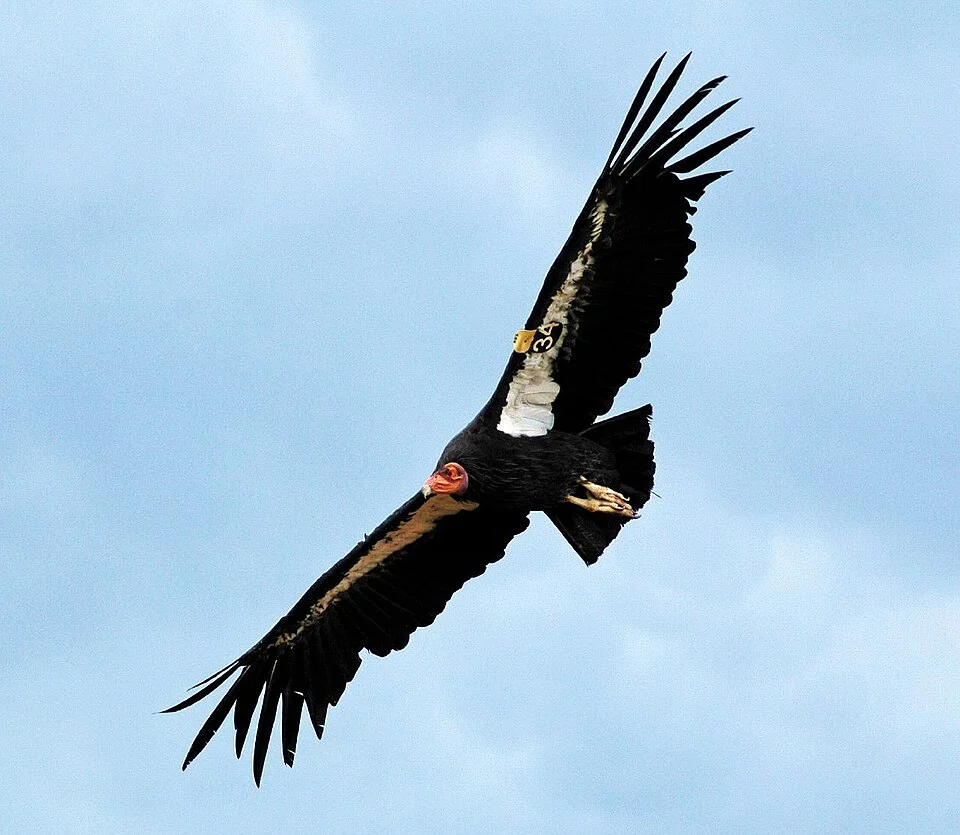
(1 in a multiple picture album) This is a stock photo of a California Condor in flight. When you see them sitting they are just a blob of black and they don't look that large. There is not much beauty to them. Their face is one only a mother could love. BUT . . . when they fly, they are beautiful. I watched one soar over the Grand Canyon last week. He was something to see. When he had enough of soaring, he tucked in his wings and dive bombed down to a ledge, opening his wings again only just before landing. Amazing thing!
Don Graham from Redlands, CA, USA - God bless it! · CC BY-SA 2.0 · Image sourceProvider-generated thumbnail requested at 800 pixels; no local editing Local WebP display rendition; resized without cropping.
Open encyclopedia reference
The California condor (Gymnogyps californianus) is a New World vulture and the largest North American land bird. It became extinct in the wild in 1987 when all remaining wild individuals were captured, but has since been reintroduced to northern Arizona and southern Utah (including the Grand Canyon area and Zion National Park), the coastal mountains of California, and northern Baja California in Mexico. It is the only surviving member of the genus Gymnogyps, although four extinct members of the genus are also known. The species is listed by IUCN as critically endangered, and similarly considered Critically Imperiled by NatureServe. The plumage is black with patches of white on the underside of the wings; the head is largely bald, with skin color ranging from gray on young birds to yellow and bright orange on breeding adults. Its 3.0 m (9.8 ft) wingspan is the widest of any North American bird, and its weight of up to 14 kg (31 lb) nearly equals that of the trumpeter swan, the heaviest among native North American bird species.
Wikipedia contributors, California condor; see linked history · CC BY-SA 4.0 . Plain-text lead excerpt, at most 180 words; no infobox or later sections Retrieved 2026-10-05T06:17:21.471121+00:00. This reference remains separate from the taxonomic record.
Identity & source status
- Scientific name
- Gymnogyps californianus (Shaw, 1797)
- Name authority
- (Shaw, 1797)
- Common name
- California Condor
- Rank
- species
- Accepted status
- accepted
- Kingdom
- Animalia
- Phylum
- Chordata
- Class
- Aves
- Order
- Accipitriformes
- Family
- Cathartidae
- Genus
- Gymnogyps
- Extinction status
- Recorded extant
Classification family tree
Nested taxonomic groups from the source. This is not a direct-ancestor chain, a dated evolutionary tree or a phylogenetic reconstruction.
- domainEukaryota (Chatton, 1925) Whittaker & Margulis, 1978
- kingdomAnimalia
- phylumChordata
- subphylumVertebrata
- infraphylumGnathostomata
- parvphylumOsteichthyes
- megaclassTetrapoda
- classAves
- orderAccipitriformes
- familyCathartidae Lafresnaye, 1839
- genusGymnogyps R. P. Lesson, 1842
- speciesGymnogyps californianus (Shaw, 1797)
Close classified relatives
No other member of this genus is present in the selected snapshot.
Names & synonyms
Names explicitly linked to this accepted taxon in the source. Synonymy can change with revision.
| Recorded name | Source status |
|---|---|
| Vultur californianus Shaw, 1797 Shaw, 1797 | synonym |
Documented distribution
Source distribution statements, not a complete range map. A listed locality is not necessarily a place of origin.
Source literature & publication evidence
References attached to this source record, including nomenclatural citations where supplied. This is a selected bibliography; abbreviated citations remain in the source’s form.
- https://www.itis.gov/servlet/SingleRpt/SingleRpt?search_topic=TSN&search_value=175274 Source fields: Taxon.tsv dwc:namePublishedIn, Taxon.tsv dcterms:references
Origins, evidence & remaining research
Name authority and publication references document nomenclature where the source supplies it. They do not establish evolutionary origins or the earliest fossil occurrence.
Specimen-level evidence, morphology, ecological research, phylogenetic studies, a comprehensive bibliography and a located literary passage have not yet been compiled for this record.
Dataset citation & attribution
This exact taxon in ChecklistBank · Catalogue of Life 2026-09-11
Catalogue of Life 2026-09-11; dataset 316321; doi:10.48580/dgz5n. https://creativecommons.org/licenses/by/4.0/ . Retrieved 5 October 2026.
Stable key: col:3HSM2. Classification follows source parent identifiers. English common names may vary by region.