
NATURAL HISTORY · CATALOGUE RECORD
Satanic Nightjar
Eurostopodus diabolicus Stresemann, 1931
Source-backed taxonomic record
Accepted species in Catalogue of Life’s 11 September 2026 base release. This preserves the source classification and available supporting data; it is not a completed species monograph.
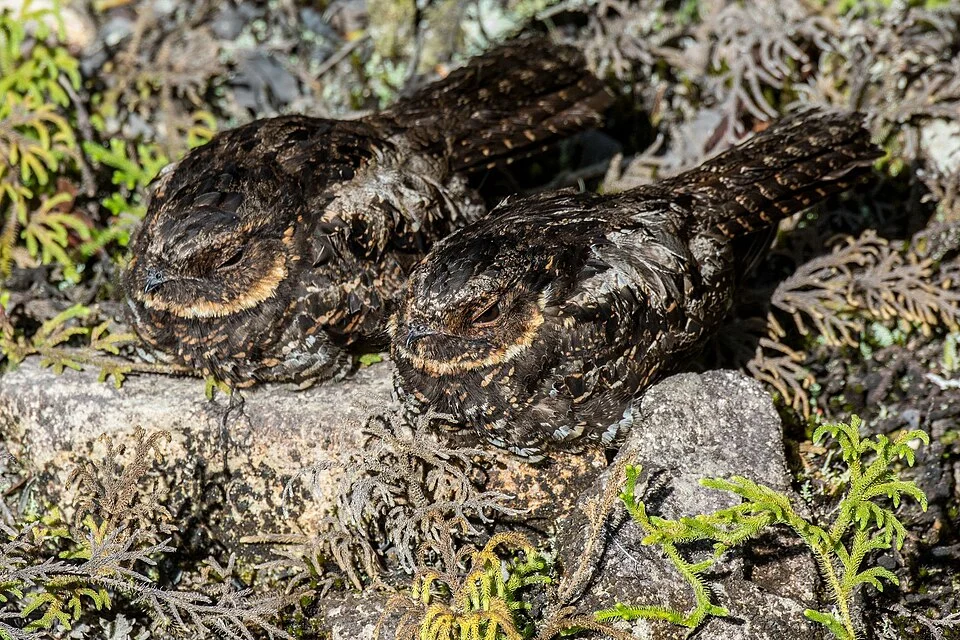
*Creator: William Stephens Publisher: iNaturalist Record license: https://creativecommons.org/licenses/by/4.0/ References: https://www.inaturalist.org/photos/64408683 Created: 2014-09-08T02:56:57.000+00:00 Rights holder: William Stephens Identifier: https://inaturalist-open-data.s3.amazonaws.com/photos/64408683/original.jpg?1585055111 Suggested attribution: Eurostopodus diabolicus Stresemann, 1931 observed in Indonesia by William Stephens (licensed under https://creativecommons.org/licenses/by/4.0/)
William Stephens · CC BY 4.0 · Image sourceProvider-generated thumbnail requested at 800 pixels; no local editing Local WebP display rendition; resized without cropping.
Open encyclopedia reference
The Satanic nightjar (Eurostopodus diabolicus), also Heinrich's nightjar, satanic eared-nightjar, Sulawesi eared-nightjar, Satanic goatsucker or diabolical nightjar is a mid-sized, spotted, dark brown nightjar endemic to the Indonesian island of Sulawesi. The species was discovered in 1931 by Gerd Heinrich, a German natural historian who collected a single female holotype from Mount Klabat on the Minahasa peninsula of Northern Sulawesi.
In the following decades, there were a few unconfirmed reports of sightings and calls of the bird, but it did not officially resurface until 1996 when David Bishop and Jared Diamond positively identified it in Lore Lindu National Park by its sound. This made the visible rediscovery available for multiple people in the tour group including poet and writer Jan Zwaaneveld. This increased the bird's estimated range by 750 km (470 mi). It has since been observed and described in literature multiple times.
Wikipedia contributors, Satanic nightjar; see linked history · CC BY-SA 4.0 . Plain-text lead excerpt, at most 180 words; no infobox or later sections Retrieved 2026-10-05T05:40:46.939307+00:00. This reference remains separate from the taxonomic record.
Identity & source status
- Scientific name
- Eurostopodus diabolicus Stresemann, 1931
- Name authority
- Stresemann, 1931
- Common name
- Satanic Nightjar
- Rank
- species
- Accepted status
- accepted
- Kingdom
- Animalia
- Phylum
- Chordata
- Class
- Aves
- Order
- Caprimulgiformes
- Family
- Caprimulgidae
- Genus
- Eurostopodus
- Extinction status
- Recorded extant
Classification family tree
Nested taxonomic groups from the source. This is not a direct-ancestor chain, a dated evolutionary tree or a phylogenetic reconstruction.
- domainEukaryota (Chatton, 1925) Whittaker & Margulis, 1978
- kingdomAnimalia
- phylumChordata
- subphylumVertebrata
- infraphylumGnathostomata
- parvphylumOsteichthyes
- megaclassTetrapoda
- classAves
- orderCaprimulgiformes
- familyCaprimulgidae
- genusEurostopodus Gould, 1838
- speciesEurostopodus diabolicus Stresemann, 1931
Close classified relatives
These entries share the source’s genus, Eurostopodus. They are not necessarily the closest relatives established by molecular evidence.
| Species | Classification | Source status |
|---|---|---|
| Spotted NightjarEurostopodus argus Hartert, 1892 | CaprimulgidaeChordata | Accepted speciesRecorded extant |
| New Caledonian NightjarEurostopodus exul Mayr, 1941 | CaprimulgidaeChordata | Accepted speciesRecorded extant |
| White-throated NightjarEurostopodus mystacalis (Temminck, 1826) | CaprimulgidaeChordata | Accepted speciesRecorded extant |
| Archbold's NightjarEurostopodus archboldi (Mayr & Rand, 1935) | CaprimulgidaeChordata | Accepted speciesRecorded extant |
| Solomons NightjarEurostopodus nigripennis E. P. Ramsay, 1882 | CaprimulgidaeChordata | Accepted speciesRecorded extant |
| Papuan NightjarEurostopodus papuensis (Schlegel, 1866) | CaprimulgidaeChordata | Accepted speciesRecorded extant |
Documented distribution
Source distribution statements, not a complete range map. A listed locality is not necessarily a place of origin.
Source literature & publication evidence
References attached to this source record, including nomenclatural citations where supplied. This is a selected bibliography; abbreviated citations remain in the source’s form.
- https://www.itis.gov/servlet/SingleRpt/SingleRpt?search_topic=TSN&search_value=555533 Source fields: Taxon.tsv dwc:namePublishedIn, Taxon.tsv dcterms:references
Origins, evidence & remaining research
Name authority and publication references document nomenclature where the source supplies it. They do not establish evolutionary origins or the earliest fossil occurrence.
Specimen-level evidence, morphology, ecological research, phylogenetic studies, a comprehensive bibliography and a located literary passage have not yet been compiled for this record.
Dataset citation & attribution
This exact taxon in ChecklistBank · Catalogue of Life 2026-09-11
Catalogue of Life 2026-09-11; dataset 316321; doi:10.48580/dgz5n. https://creativecommons.org/licenses/by/4.0/ . Retrieved 5 October 2026.
Stable key: col:3D2H4. Classification follows source parent identifiers. English common names may vary by region.