
NATURAL HISTORY · CATALOGUE RECORD
Eurasian Yellow Bunting
Emberiza citrinella Linnaeus, 1758
Source-backed taxonomic record
Accepted species in Catalogue of Life’s 11 September 2026 base release. This preserves the source classification and available supporting data; it is not a completed species monograph.
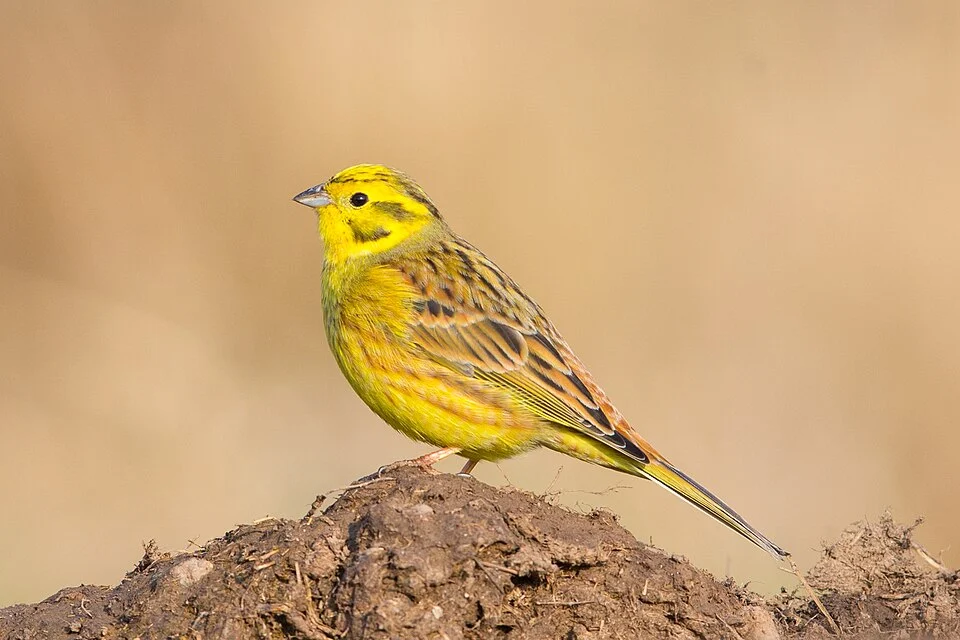
male Yellowhammer
Andreas Trepte · CC BY-SA 2.5 · Image sourceProvider-generated thumbnail requested at 800 pixels; no local editing Local WebP display rendition; resized without cropping.
Open encyclopedia reference
The yellowhammer (Emberiza citrinella) is a passerine bird in the bunting family that is native to Eurasia and has been introduced to New Zealand and Australia. Most European birds remain in the breeding range year-round, but the eastern subspecies is partially migratory, with much of the population wintering further south. The male yellowhammer has a bright yellow head, streaked brown back, chestnut rump, and yellow under parts. Other plumages are duller versions of the same pattern. The yellowhammer is common in open areas with some shrubs or trees, and forms small flocks in winter. Its song has a rhythm like "A little bit of bread and no cheese". The song is very similar to that of its closest relative, the pine bunting, with which it interbreeds. Breeding commences mainly in April and May, with the female building a lined cup nest in a concealed location on or near the ground. The three to five eggs are patterned with a mesh of fine dark lines, giving rise to the old name for the bird of "scribble lark" or "writing lark".
Wikipedia contributors, Yellowhammer; see linked history · CC BY-SA 4.0 . Plain-text lead excerpt, at most 180 words; no infobox or later sections Retrieved 2026-10-05T10:17:35.346964+00:00. This reference remains separate from the taxonomic record.
Identity & source status
- Scientific name
- Emberiza citrinella Linnaeus, 1758
- Name authority
- Linnaeus, 1758
- Common name
- Eurasian Yellow Bunting
- Rank
- species
- Accepted status
- accepted
- Kingdom
- Animalia
- Phylum
- Chordata
- Class
- Aves
- Order
- Passeriformes
- Family
- Emberizidae
- Genus
- Emberiza
- Extinction status
- Recorded extant
Classification family tree
Nested taxonomic groups from the source. This is not a direct-ancestor chain, a dated evolutionary tree or a phylogenetic reconstruction.
- domainEukaryota (Chatton, 1925) Whittaker & Margulis, 1978
- kingdomAnimalia
- phylumChordata
- subphylumVertebrata
- infraphylumGnathostomata
- parvphylumOsteichthyes
- megaclassTetrapoda
- classAves
- orderPasseriformes
- familyEmberizidae
- genusEmberiza Linnaeus, 1758
- speciesEmberiza citrinella Linnaeus, 1758
Close classified relatives
These entries share the source’s genus, Emberiza. They are not necessarily the closest relatives established by molecular evidence.
| Species | Classification | Source status |
|---|---|---|
| Brown-rumped BuntingEmberiza affinis Heuglin, 1867 | EmberizidaeChordata | Accepted speciesRecorded extant |
| Yellow-breasted BuntingEmberiza aureola Pallas, 1773 | EmberizidaeChordata | Accepted speciesRecorded extant |
| Meadow BuntingEmberiza cioides J. F. Brandt, 1843 | EmberizidaeChordata | Accepted speciesRecorded extant |
| Yellow-throated BuntingEmberiza elegans Temminck, 1836 | EmberizidaeChordata | Accepted speciesRecorded extant |
| Chestnut-eared BuntingEmberiza fucata Pallas, 1776 | EmberizidaeChordata | Accepted speciesRecorded extant |
| Godlewski's BuntingEmberiza godlewskii Taczanowski, 1874 | EmberizidaeChordata | Accepted speciesRecorded extant |
| Gosling's BuntingEmberiza goslingi (Alexander, 1906) | EmberizidaeChordata | Accepted speciesRecorded extant |
| Ortolan BuntingEmberiza hortulana Linnaeus, 1758 | EmberizidaeChordata | Accepted speciesRecorded extant |
| Crested BuntingEmberiza lathami J. E. Gray, 1831 | EmberizidaeChordata | Accepted speciesRecorded extant |
| Pine BuntingEmberiza leucocephalos S. G. Gmelin, 1771 | EmberizidaeChordata | Accepted speciesRecorded extant |
| Pallas' Reed-BuntingEmberiza pallasi (Cabanis, 1851) | EmberizidaeChordata | Accepted speciesRecorded extant |
| Somali BuntingEmberiza poliopleura (Salvadori, 1888) | EmberizidaeChordata | Accepted speciesRecorded extant |
Documented distribution
Source distribution statements, not a complete range map. A listed locality is not necessarily a place of origin.
Source literature & publication evidence
References attached to this source record, including nomenclatural citations where supplied. This is a selected bibliography; abbreviated citations remain in the source’s form.
- Linnaeus, & Carolus. (1758). Systema Naturae per Regna Tria Naturae, Secundum Classes, Ordines, Genera, Species, Cum Characteribus, Differentiis, Synonymis, Locis, 10th Edition, Vol. 1. Source fields: Taxon.tsv dwc:namePublishedIn, Taxon.tsv dcterms:references
Origins, evidence & remaining research
Name authority and publication references document nomenclature where the source supplies it. They do not establish evolutionary origins or the earliest fossil occurrence.
Specimen-level evidence, morphology, ecological research, phylogenetic studies, a comprehensive bibliography and a located literary passage have not yet been compiled for this record.
Dataset citation & attribution
This exact taxon in ChecklistBank · Catalogue of Life 2026-09-11
Catalogue of Life 2026-09-11; dataset 316321; doi:10.48580/dgz5n. https://creativecommons.org/licenses/by/4.0/ . Retrieved 5 October 2026.
Stable key: col:39FSZ. Classification follows source parent identifiers. English common names may vary by region.