
NATURAL HISTORY · CATALOGUE RECORD
Passenger Pigeon
Ectopistes migratorius (Linnaeus, 1766)
Source-backed taxonomic record
Accepted species in Catalogue of Life’s 11 September 2026 base release. This preserves the source classification and available supporting data; it is not a completed species monograph.
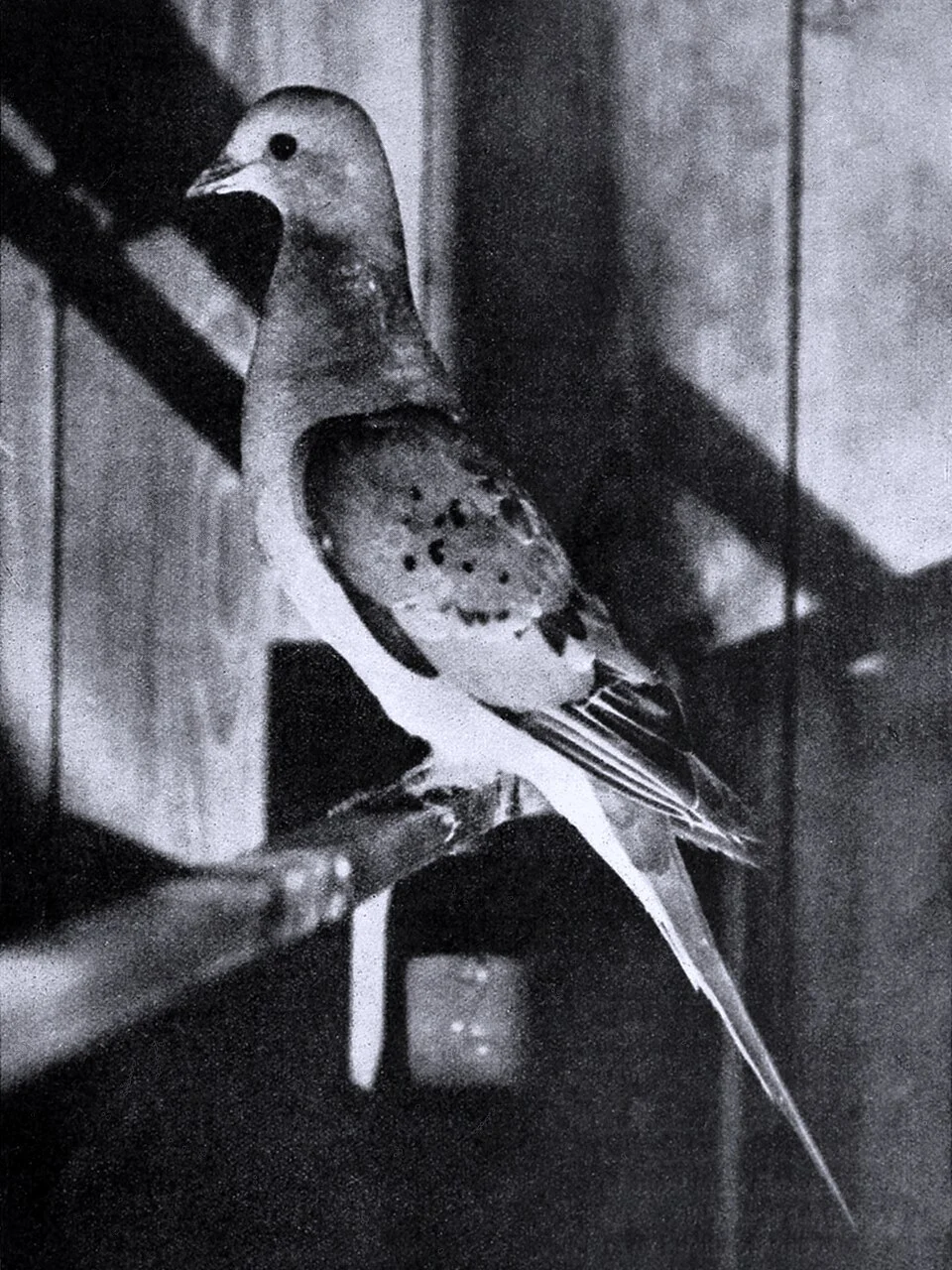
Identifier: birdlore151913nati (find matches) Title: Bird lore Year: 1899 (1890s) Authors: National Committee of the Audubon Societies of America National Association of Audubon Societies for the Protection of Wild Birds and Animals National Audubon Society Subjects: Birds Birds Ornithology Publisher: New York City : Macmillan Co. Contributing Library: Smithsonian Institution Libraries Digitizing Sponsor: Biodiversity Heritage Library View Book Page: Book Viewer About This Book: Catalog Entry View All Images: All Images From Book Click here to view book online to see this illustration in context in a browseable online version of this book. Text Appearing Before Image: nce an actual study of the Passenger Pigeon in the field is no longerpossible, information concerning its distribution and habits must be soughtfor in the records of former generations, and obtained from those yet livingwho knew the bird in its prime. Imperfect as this material is and difficult toprocure, the recent revival of interest in its tragic fate has brought to lightsufficient data to trace the life history of the race, and to fathom the causeswhich brought about its sudden and mysterious disappearance from the worldof the living. The habitat of the Pigeon, embracing as it did the vast native forest ofeastern North America, offered the bird a choice of food and residence, definiteregions thereof being occupied in proper season and in regular rotation. Eventhe fruits of the lowly herbs contributed to its bill of fare, and the handsomepoke-weed is locally known as Pigeon berry at the present day. But thebulk of its food consisted of the acorns of the numerous species of oak, the Text Appearing After Image: PASSENGER PIGEON, ADULT FEMALENote the characteristically erect pose (79) 80 Bird - Lore seeds of beech, chestnut, maple, elm, and other hardwoods, of pine and hem-lock, and of the fruits and berries of bushes and shrubs. Angleworms, snails,caterpillars, and soft-bodied insects, such as grasshoppers, helped to vary thevegetarian diet. From the frequent mineral springs and licks the bird grati-fied its craving for salt, a condiment eagerly sought by all grain feeders. The winter range of the bird comprised the territory south of Mason andDixons line, a land well stocked with its chief food supply during the inclementseasons. In one of these natural granaries the flocks would settle down andforage until the mast within a radius of two hundred miles and over had beenconsumed. While feeding in concert, the rear ranks successively rose and,passing over the whole flock, alighted in front, giving every bird an equalchance. Like an enormous wheel in slow motion, the birds moved through thewoo Note About Images Photograph of a female Passenger Pigeon (Ectopistes migratorius) in captivity from the year 1898. Please note that these images are extracted from scanned page images that may have been digitally enhanced for readability - coloration and appearance of these illustrations may not perfectly resemble the original work.
J. G. Hubbard, Internet Archive Book Images · Public domain · Image sourceProvider-generated thumbnail requested at 800 pixels; no local editing Local WebP display rendition; resized without cropping.
Open encyclopedia reference
The passenger pigeon or wild pigeon (Ectopistes migratorius) is an extinct species of pigeon that was endemic to North America. Its common name is derived from the French word passager, meaning "passing by", due to the migratory habits of the species. The scientific name also refers to its migratory characteristics. The morphologically similar mourning dove (Zenaida macroura) was long thought to be its closest relative, and the two were at times confused, but genetic analysis has shown that the genus Patagioenas is more closely related to it than the Zenaida doves. The passenger pigeon was sexually dimorphic in size and coloration. The male was 390 to 410 mm (15.4 to 16.1 in) in length, mainly gray on the upperparts, lighter on the underparts, with iridescent bronze feathers on the neck, and black spots on the wings. The female was 380 to 400 mm (15.0 to 15.7 in), and was duller and browner than the male overall. The juvenile was similar to the female, but without iridescence.
Wikipedia contributors, Passenger pigeon; see linked history · CC BY-SA 4.0 . Plain-text lead excerpt, at most 180 words; no infobox or later sections Retrieved 2026-10-05T05:33:51.213412+00:00. This reference remains separate from the taxonomic record.
Identity & source status
- Scientific name
- Ectopistes migratorius (Linnaeus, 1766)
- Name authority
- (Linnaeus, 1766)
- Common name
- Passenger Pigeon
- Rank
- species
- Accepted status
- accepted
- Kingdom
- Animalia
- Phylum
- Chordata
- Class
- Aves
- Order
- Columbiformes
- Family
- Columbidae
- Genus
- Ectopistes
- Extinction status
- Recorded extinct
Classification family tree
Nested taxonomic groups from the source. This is not a direct-ancestor chain, a dated evolutionary tree or a phylogenetic reconstruction.
- domainEukaryota (Chatton, 1925) Whittaker & Margulis, 1978
- kingdomAnimalia
- phylumChordata
- subphylumVertebrata
- infraphylumGnathostomata
- parvphylumOsteichthyes
- megaclassTetrapoda
- classAves
- orderColumbiformes
- familyColumbidae
- subfamilyColumbinae
- genusEctopistes Swainson, 1827
- speciesEctopistes migratorius (Linnaeus, 1766)
Close classified relatives
No other member of this genus is present in the selected snapshot.
Names & synonyms
Names explicitly linked to this accepted taxon in the source. Synonymy can change with revision.
| Recorded name | Source status |
|---|---|
| Columba migratoria Linnaeus, 1766 Linnaeus, 1766 | synonym |
Documented distribution
Source distribution statements, not a complete range map. A listed locality is not necessarily a place of origin.
Source literature & publication evidence
References attached to this source record, including nomenclatural citations where supplied. This is a selected bibliography; abbreviated citations remain in the source’s form.
- https://www.itis.gov/servlet/SingleRpt/SingleRpt?search_topic=TSN&search_value=177132 Source fields: Taxon.tsv dwc:namePublishedIn, Taxon.tsv dcterms:references
Origins, evidence & remaining research
Name authority and publication references document nomenclature where the source supplies it. They do not establish evolutionary origins or the earliest fossil occurrence.
Specimen-level evidence, morphology, ecological research, phylogenetic studies, a comprehensive bibliography and a located literary passage have not yet been compiled for this record.
Dataset citation & attribution
This exact taxon in ChecklistBank · Catalogue of Life 2026-09-11
Catalogue of Life 2026-09-11; dataset 316321; doi:10.48580/dgz5n. https://creativecommons.org/licenses/by/4.0/ . Retrieved 5 October 2026.
Stable key: col:38QWF. Classification follows source parent identifiers. English common names may vary by region.