
NATURAL HISTORY · CATALOGUE RECORD
Diadophis punctatus (Linnaeus, 1766)
Source-backed taxonomic record
Accepted species in Catalogue of Life’s 11 September 2026 base release. This preserves the source classification and available supporting data; it is not a completed species monograph.
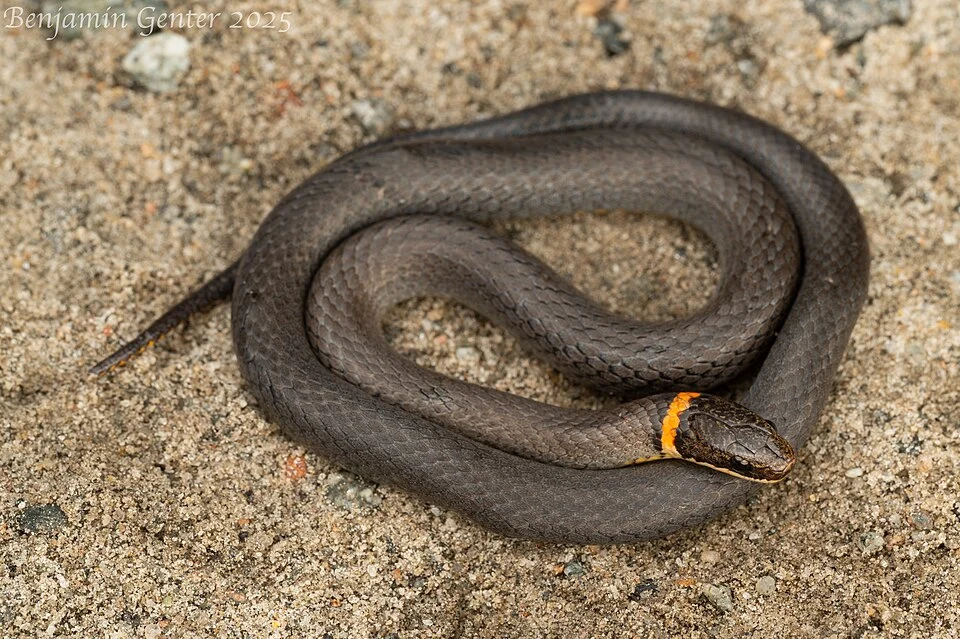
Georgia Coastal Plain - Winter 2025
Benjamin Genter · Public domain · Image sourceProvider-generated thumbnail requested at 800 pixels; no local editing Local WebP display rendition; resized without cropping.
Open encyclopedia reference
Diadophis punctatus, commonly known as the ring-necked snake or ringneck snake, is a small, harmless species of colubrid snake found throughout much of the United States, as well as south in Central Mexico and as far north as Nova Scotia, Canada. Ring-necked snakes are generally fossorial and somewhat secretive, by nature, and, as a nocturnal species, are rarely seen during the daytime. These snakes are believed to be fairly abundant throughout most of their range, though no scientific evaluation supports this hypothesis. Scientific research is lacking for the species, despite their apparently common status, and more in-depth investigations are greatly needed. It is the only species within the genus Diadophis and, currently, 14 subspecies are identified, though many herpetologists question the morphologically based classifications. The ring-necked snake is perhaps best known for its unique defensive posture: when threatened, it curls its tail into a tight coil, partially rolls onto its back, and shows its bright red-orange underside and ventral surface.
Wikipedia contributors, Ring-necked snake; see linked history · CC BY-SA 4.0 . Plain-text lead excerpt, at most 180 words; no infobox or later sections Retrieved 2026-10-05T14:24:52.465619+00:00. This reference remains separate from the taxonomic record.
Identity & source status
- Scientific name
- Diadophis punctatus (Linnaeus, 1766)
- Name authority
- (Linnaeus, 1766)
- Rank
- species
- Accepted status
- accepted
- Kingdom
- Animalia
- Phylum
- Chordata
- Class
- Reptilia
- Order
- Squamata
- Family
- Colubridae
- Genus
- Diadophis
- Extinction status
- Not supplied by this source
Classification family tree
Nested taxonomic groups from the source. This is not a direct-ancestor chain, a dated evolutionary tree or a phylogenetic reconstruction.
- domainEukaryota (Chatton, 1925) Whittaker & Margulis, 1978
- kingdomAnimalia
- phylumChordata
- subphylumVertebrata
- infraphylumGnathostomata
- parvphylumOsteichthyes
- megaclassTetrapoda
- classReptilia Laurenti, 1768
- orderSquamata Oppel, 1811
- suborderSerpentes Linnaeus, 1758
- infraorderAlethinophidia Nopcsa, 1923
- familyColubridae
- subfamilyDipsadinae
- genusDiadophis
- speciesDiadophis punctatus (Linnaeus, 1766)
Close classified relatives
No other member of this genus is present in the selected snapshot.
Names & synonyms
Names explicitly linked to this accepted taxon in the source. Synonymy can change with revision.
Documented distribution
Source distribution statements, not a complete range map. A listed locality is not necessarily a place of origin.
Source literature & publication evidence
References attached to this source record, including nomenclatural citations where supplied. This is a selected bibliography; abbreviated citations remain in the source’s form.
- https://reptile-database.reptarium.cz/species?genus=Diadophis&species=punctatus Source fields: Taxon.tsv dwc:namePublishedIn, Taxon.tsv dcterms:references
Origins, evidence & remaining research
Name authority and publication references document nomenclature where the source supplies it. They do not establish evolutionary origins or the earliest fossil occurrence.
Specimen-level evidence, morphology, ecological research, phylogenetic studies, a comprehensive bibliography and a located literary passage have not yet been compiled for this record.
Dataset citation & attribution
This exact taxon in ChecklistBank · Catalogue of Life 2026-09-11
Catalogue of Life 2026-09-11; dataset 316321; doi:10.48580/dgz5n. https://creativecommons.org/licenses/by/4.0/ . Retrieved 5 October 2026.
Stable key: col:3589D. Classification follows source parent identifiers. English common names may vary by region.