
NATURAL HISTORY · CATALOGUE RECORD
Fulvous Whistling Duck
Dendrocygna bicolor (Vieillot, 1816)
Source-backed taxonomic record
Accepted species in Catalogue of Life’s 11 September 2026 base release. This preserves the source classification and available supporting data; it is not a completed species monograph.
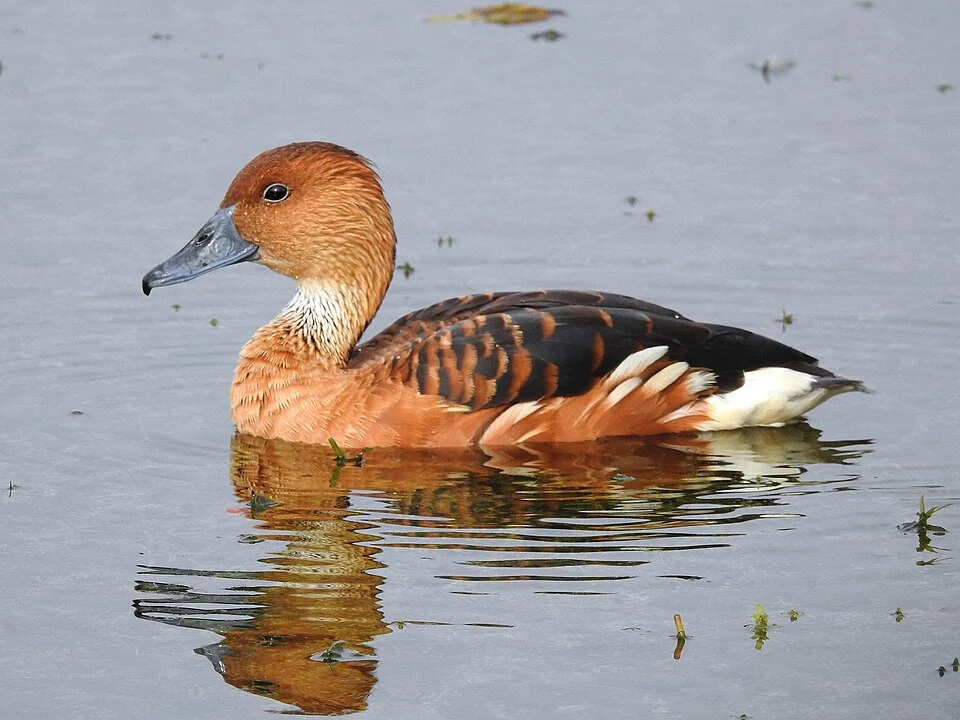
Lake Apopka Florida, USA
JeffreyGammon · CC BY 4.0 · Image sourceProvider-generated thumbnail requested at 800 pixels; no local editing Local WebP display rendition; resized without cropping.
Open encyclopedia reference
The fulvous whistling duck or fulvous tree duck (Dendrocygna bicolor) is a species of whistling duck that breeds across the world's tropical regions in much of Mexico and South America, the West Indies, the southern United States, sub-Saharan Africa and the Indian subcontinent. It has plumage that is mainly reddish brown, long legs and a long grey bill, and shows a distinctive white band across its black tail in flight. Like other members of its ancient lineage, it has a whistling call which is given in flight or on the ground. Its preferred habitat consists of wetlands with plentiful vegetation, including shallow lakes and paddy fields. The nest, built from plant material and unlined, is placed among dense vegetation or in a tree hole. The typical clutch is around ten whitish eggs. The breeding adults, which pair for life, take turns to incubate, and the eggs hatch in 24–29 days. The downy grey ducklings leave the nest within a day or so of hatching, but the parents continue to protect them until they fledge around nine weeks later.
Wikipedia contributors, Fulvous whistling duck; see linked history · CC BY-SA 4.0 . Plain-text lead excerpt, at most 180 words; no infobox or later sections Retrieved 2026-10-05T09:52:06.000542+00:00. This reference remains separate from the taxonomic record.
Identity & source status
- Scientific name
- Dendrocygna bicolor (Vieillot, 1816)
- Name authority
- (Vieillot, 1816)
- Common name
- Fulvous Whistling Duck
- Rank
- species
- Accepted status
- accepted
- Kingdom
- Animalia
- Phylum
- Chordata
- Class
- Aves
- Order
- Anseriformes
- Family
- Anatidae
- Genus
- Dendrocygna
- Extinction status
- Recorded extant
Classification family tree
Nested taxonomic groups from the source. This is not a direct-ancestor chain, a dated evolutionary tree or a phylogenetic reconstruction.
- domainEukaryota (Chatton, 1925) Whittaker & Margulis, 1978
- kingdomAnimalia
- phylumChordata
- subphylumVertebrata
- infraphylumGnathostomata
- parvphylumOsteichthyes
- megaclassTetrapoda
- classAves
- orderAnseriformes
- familyAnatidae Leach, 1820
- genusDendrocygna Swainson, 1837
- speciesDendrocygna bicolor (Vieillot, 1816)
Close classified relatives
These entries share the source’s genus, Dendrocygna. They are not necessarily the closest relatives established by molecular evidence.
| Species | Classification | Source status |
|---|---|---|
| West Indian Whistling DuckDendrocygna arborea (Linnaeus, 1758) | AnatidaeChordata | Accepted speciesRecorded extant |
| Wandering Whistling DuckDendrocygna arcuata (Horsfield, 1824) | AnatidaeChordata | Accepted speciesRecorded extant |
| Black-bellied Whistling DuckDendrocygna autumnalis (Linnaeus, 1758) | AnatidaeChordata | Accepted speciesRecorded extant |
| Plumed Whistling DuckDendrocygna eytoni (Eyton, 1838) | AnatidaeChordata | Accepted speciesRecorded extant |
| Spotted Whistling DuckDendrocygna guttata Schlegel, 1866 | AnatidaeChordata | Accepted speciesRecorded extant |
| Lesser Whistling DuckDendrocygna javanica (Horsfield, 1821) | AnatidaeChordata | Accepted speciesRecorded extant |
| White-faced Whistling DuckDendrocygna viduata (Linnaeus, 1766) | AnatidaeChordata | Accepted speciesRecorded extant |
Names & synonyms
Names explicitly linked to this accepted taxon in the source. Synonymy can change with revision.
| Recorded name | Source status |
|---|---|
| Dendrocygna bicolor helva Whetmore & Peters, 1922 Whetmore & Peters, 1922 | synonym |
| Anas bicolor Vieillot, 1816 Vieillot, 1816 | synonym |
Documented distribution
Source distribution statements, not a complete range map. A listed locality is not necessarily a place of origin.
Caribbean
Middle America
North America
South America
Southern Asia
Source literature & publication evidence
References attached to this source record, including nomenclatural citations where supplied. This is a selected bibliography; abbreviated citations remain in the source’s form.
- https://www.itis.gov/servlet/SingleRpt/SingleRpt?search_topic=TSN&search_value=175046 Source fields: Taxon.tsv dwc:namePublishedIn, Taxon.tsv dcterms:references
Origins, evidence & remaining research
Name authority and publication references document nomenclature where the source supplies it. They do not establish evolutionary origins or the earliest fossil occurrence.
Specimen-level evidence, morphology, ecological research, phylogenetic studies, a comprehensive bibliography and a located literary passage have not yet been compiled for this record.
Dataset citation & attribution
This exact taxon in ChecklistBank · Catalogue of Life 2026-09-11
Catalogue of Life 2026-09-11; dataset 316321; doi:10.48580/dgz5n. https://creativecommons.org/licenses/by/4.0/ . Retrieved 5 October 2026.
Stable key: col:34Q32. Classification follows source parent identifiers. English common names may vary by region.