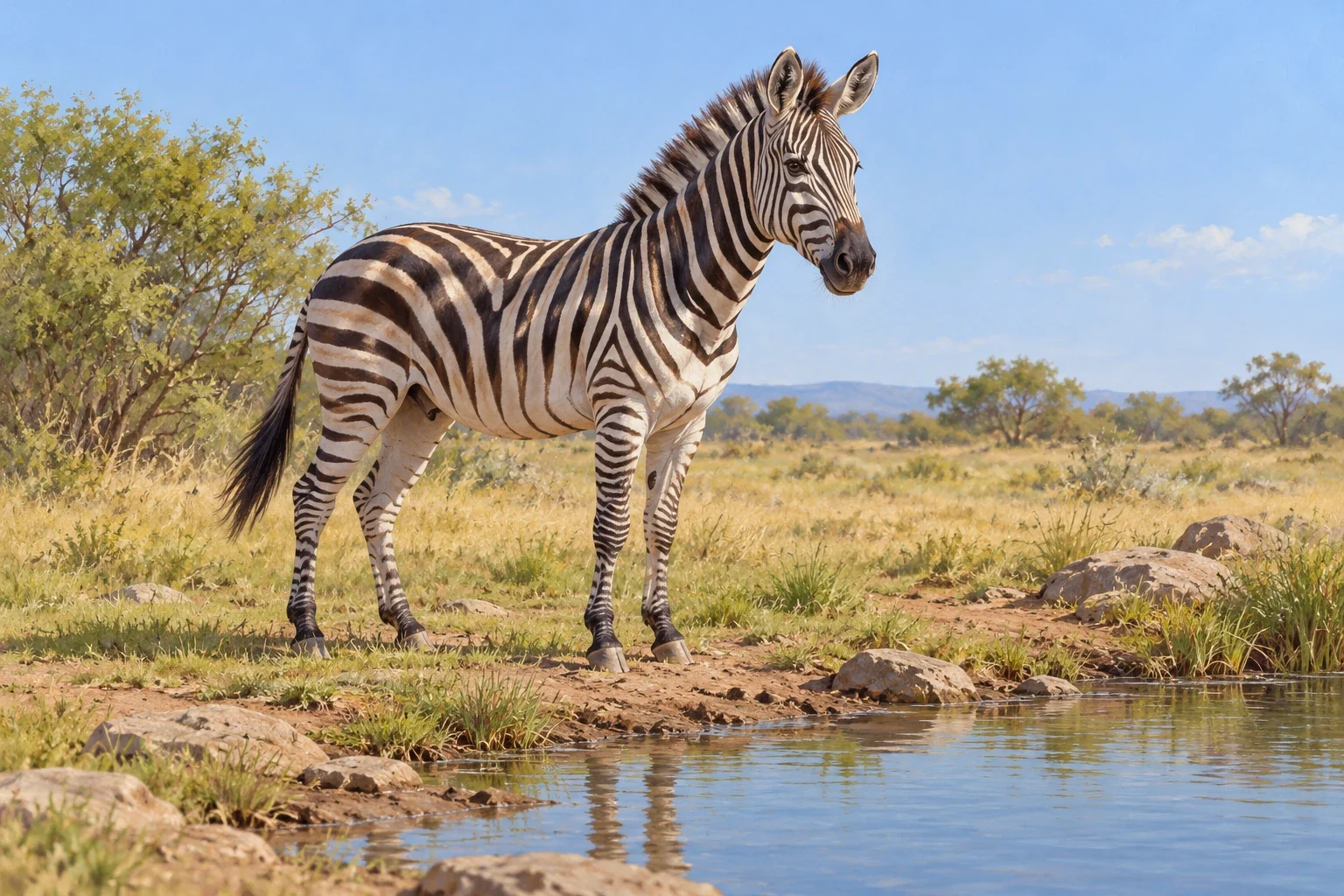
Portrayal of the grown zebra before the waterhole confrontation.
AI-generated portrayal from the historical narrative. Stripes, proportions and landscape are interpreted; no present-day population is identified.
Overview
Tale LXVII in Schultze's Nama collection begins with two zebra mares approaching a waterhole. A baboon heats pieces of iron and claims the water and its grassy margin as his own. The mares repeatedly turn back. One of them bears a male foal, and they wait until he has grown before returning together. The resulting defender is this particular young stallion in the narrated sequence, not a separately named zebra spirit or a claim that all zebras possess a special power over water.
When the three zebras approach again, the baboon repeats his assertion of ownership. This time they remain, and the young stallion goes down to drink with the mares following. The baboon burns him with an iron. The zebra seizes his opponent and forces him into the hot pieces, reversing the guard's method of excluding others. The account therefore makes the youngster's intervention answer a sustained denial of access to water; it does not introduce a contest for kingship or show the zebra acquiring the waterhole as private property.
The ending links the baboon's callosities and patches on the zebra's foreleg region with the confrontation. Schultze adds an anatomical explanation and a baboon figure beside the text, connecting the narrated marks with features he observed in animals. That collector's comparison does not establish the episode as biological history. His animal list supplies the historical label Equus zebra for the tale's zebra, without distinguishing a modern population for this individual. The German translation is accompanied by the recorded language and glosses; its bracketed words are acknowledged editorial supplements. The stallion's role can thus be followed within a specific historical witness while keeping zoological comparison, translation and oral narration separate.
Origins & earliest records
A particular Nama-language narrative transcribed and translated by Schultze in his 1907 collection. The selected account does not identify its narrator or precise telling-place.
Records & interpretation
Complete tale LXVII, original-language OCR and complete German translation, printed pp.534-536, including concluding anatomical note; narrative introduction and animal glossary read.
Selected bibliography
Documented works and useful reading. This is not a list of every appearance.
- 01
Aus Namaland und Kalahari - tale LXVII
Die beiden Zebrastuten und der Pavian; complete recorded text, German translation and concluding note.
Family & connections
A source-supported family tree or inspiration record has not yet been compiled for this profile. Related reading below indicates a connection in subject matter, not a proven lineage or creative influence.
References
Sources supporting this profile. Linked pages have their own scope and editorial standards.
- Primary recorded oral narrative and historical translationSchultze 1907, tale LXVIIResearch access: 2026-10-10
Image credits
AI-generatedPortrayal of the grown zebra before the waterhole confrontation.
AI-generated portrayal from the historical narrative. Stripes, proportions and landscape are interpreted; no present-day population is identified.