
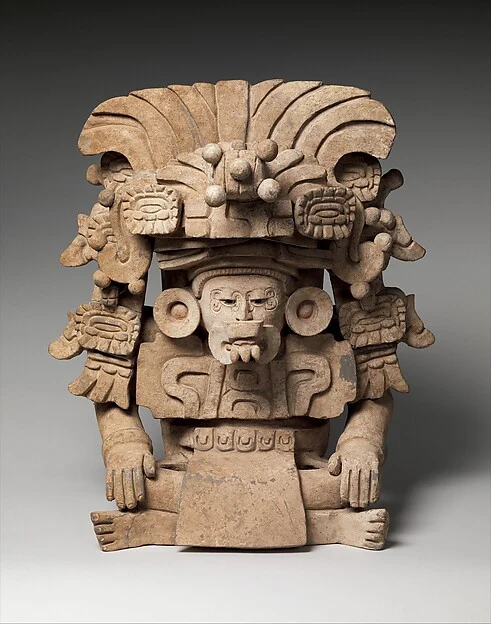
Zapotec Be’ena’a ceramic effigy urn with seated masked figure and elaborate headdress, 350–600 CE, Met 2014.632.2
This ceramic effigy urn from Oaxaca is attributed to Zapotec (Be’ena’a) makers. Its masked seated figure wears a large headdress and other regalia. The Met’s current interpretation connects such vessels with ancestors impersonating deities. This ancient object provides historical material context; it is not a portrait of contemporary Zapotec peoples.
Overview
Zapotec peoples comprise diverse living communities, especially associated with Oaxaca in southern Mexico. The national Indigenous catalogue distinguishes the Central Valleys, Sierra, Isthmus and Sierra Sur and records different regional self-designations. Its examples include ben’zaa in the Valleys, benne Xhon and benne Xhidza in the Sierra, and binniza in the Isthmus. These names make local distinctions visible within an umbrella label. They are not interchangeable spellings of one universal community name. This profile concerns contemporary peoples and cultural production; it does not assign every present community an identical descent from an archaeological site.
Linguistic diversity is finer than those broad regional divisions. INPI’s language atlas places the Zapotec grouping within the Oto-Mangue family and lists sixty-two variants in its classification. Its historical geography includes the northern and southern sierras, Central Valleys, Tuxtepec, Isthmus and coast. This is a linguistic reference system, rather than a count of sovereign governments or a test of an individual’s identity. The atlas’s population figure comes from the 2010 census and is not presented here as a current community total. Regional labels alone therefore cannot establish which language a particular publication or speaker uses.
A documented publishing project illustrates this diversity in practice. In March 2015, Fundación Alfredo Harp Helú Oaxaca reported an edition of twenty Aesop fables translated into four regional forms. Natalia Toledo and Víctor Cata worked on the Isthmus version, Pergentino José Ruiz on the Sierra Sur version, Juanita Vásquez on the Sierra Norte version and Janet Chávez on the Central Valleys version. Araceli Mancilla coordinated the work. Ruiz described translation as interpretation and adaptation, while the accompanying recordings used the translators’ voices. These are modern, credited adaptations of Aesop, not evidence that the Greek fables originated as anonymous Zapotec tradition.
Individual literary voices also circulate through translation. Deep Vellum’s 2015 edition of Natalia Toledo’s The Black Flower and Other Zapotec Poems credits Clare Sullivan with translation from Spanish and Isthmus Zapotec and includes a preface by Esther Allen. The edition gives readers a specifically attributed literary encounter rather than an exhaustive account of Zapotec society. Publisher metadata establishes the authorship, language mediation and publication date used here; the poems and the Aesop recordings have not been treated as inspected ethnographic testimony.
History & identity
Regional community histories are distinct from the publication dates of the modern language and literary sources.
Sources & representation
Complete catalogue body, complete language-atlas introduction, complete 2015 foundation report and publisher page read. No full book or audio-reading claim.
Selected bibliography
Documented works and useful reading. This is not a list of every appearance.
- 01
Esopo: regional Zapotec translations
Bibliographic attestation from the complete foundation report; book and accompanying recordings not independently inspected.
- 02
The Black Flower and Other Zapotec Poems
Publisher metadata specifies 10 November 2015 and translation from Spanish and Isthmus Zapotec; full poems not read.
Language & cultural connections
These connections link languages or specific cultural works and institutions; they do not establish biological ancestry or ethnic identity.
Otomanguean language family
INPI classifies the Zapotec linguistic grouping within Otomanguean. This describes languages, not biological ancestry or one uniform community.
References
Sources supporting this profile. Linked pages have their own scope and editorial standards.
- Official Indigenous-affairs catalogueINPI: Pueblo ZapotecoResearch access: 2026-10-05
- Official language referenceINPI: Zapotecos, language introductionResearch access: 2026-10-05
- Cultural foundation project reportFAHHO: Aesop translation projectResearch access: 2026-10-05
- Publisher bibliographyDeep Vellum: Natalia Toledo editionResearch access: 2026-10-05
Image credits
Contextual cultural object photographZapotec Be’ena’a ceramic effigy urn with seated masked figure and elaborate headdress, 350–600 CE, Met 2014.632.2
This ceramic effigy urn from Oaxaca is attributed to Zapotec (Be’ena’a) makers. Its masked seated figure wears a large headdress and other regalia. The Met’s current interpretation connects such vessels with ancestors impersonating deities. This ancient object provides historical material context; it is not a portrait of contemporary Zapotec peoples.