
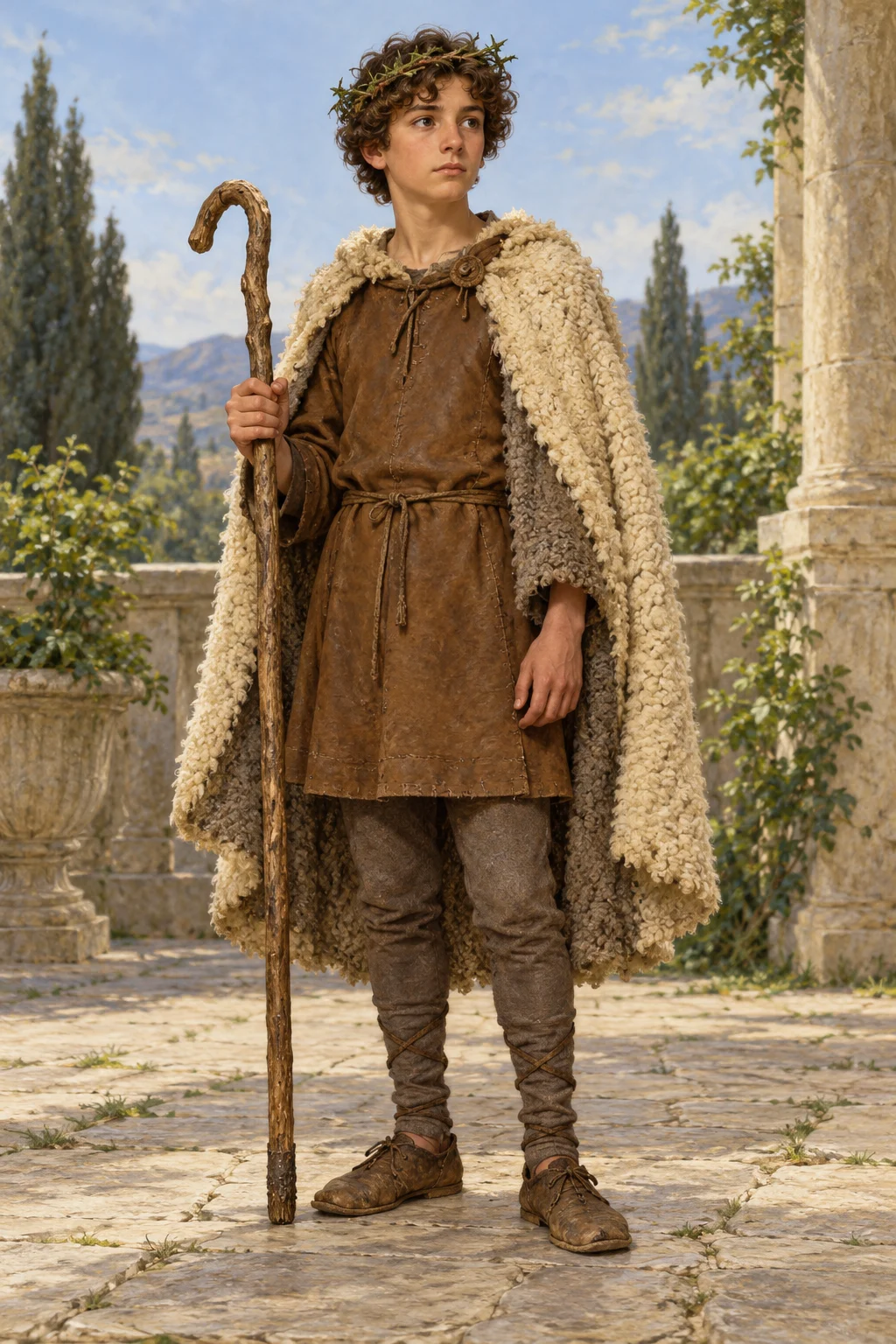
An imagined complete young King in a leather tunic and sheepskin cloak, with a briar circlet and wooden staff.
The illustration selects his plain clothing before the cathedral miracle. Face, footwear, exact tunic and cloak construction, staff shape and briar arrangement are reconstructed. It does not portray a real monarch or reproduce a devotional image.
Overview
The Young King is sixteen when the tale places him on the eve of his coronation. Raised by a poor goatherd, he has only recently been recognized as the old King’s heir. The whispered account of his secret parentage and removal from his mother remains a story reported within the narrative. Palace life awakens an intense delight in beautiful materials and works of art, even as its ceremonies restrict the freedom he knew in the forest. His greatest anticipation centres on a gold robe, a ruby crown and a pearl sceptre. During the night, however, three dreams expose the labour behind these treasures: impoverished weavers make his robe, an enslaved diver dies bringing up the sceptre’s pearl, and the search for his rubies becomes a contest between Avarice and Death. In the last dream a mirror identifies him as the king for whom the labourers have perished.
When the officers bring his regalia in the morning, he refuses to wear it and explains the dreams. Neither ridicule nor the Chamberlain’s insistence that kings require royal clothing changes his decision. He puts on his former leather tunic and rough sheepskin cloak, takes a shepherd’s staff and makes a circlet from wild briar. The public response is not uniformly sympathetic: a worker argues that the poor depend on the luxury he repudiates, and the Bishop tells him that one person cannot carry the world’s suffering. He nevertheless prays at the cathedral while angry nobles threaten him. Sunlight then clothes him in a more beautiful robe; the dead staff bears white lilies and the briar red roses with golden leaves. The people, nobles and Bishop acknowledge him, and he returns home with a face compared to an angel’s. The miraculous vindication closes this individual moral fantasy; it is not evidence for a historical coronation or a practical solution to the economic questions voiced in the tale.
First appearances & development
Oscar Wilde’s authored English literary tale in A House of Pomegranates. The retained title and edition table identify a seventh edition dated 1915 and first publication in 1891. The electronic transcription declares that historical edition; no physical copy was independently inspected.
Canon & continuity
The complete ninety-seven-paragraph source, including the dedication, all three dreams, objections from worker and Bishop, and final transformation, supports this account. Reported family rumours are distinguished from the events directly narrated.
Selected bibliography
Documented works and useful reading. This is not a list of every appearance.
- 01
Family & connections
A source-supported family tree or inspiration record has not yet been compiled for this profile. Related reading below indicates a connection in subject matter, not a proven lineage or creative influence.
References
Sources supporting this profile. Linked pages have their own scope and editorial standards.
- Primary historical authored English fictionRetained dated title, edition table and complete selected taleResearch access: 2026-10-18
Image credits
AI-generatedAn imagined complete young King in a leather tunic and sheepskin cloak, with a briar circlet and wooden staff.
The illustration selects his plain clothing before the cathedral miracle. Face, footwear, exact tunic and cloak construction, staff shape and briar arrangement are reconstructed. It does not portray a real monarch or reproduce a devotional image.