A sourced illustration has not yet been added. This gap is included in the coverage record.
Overview
The brown hare repeatedly disturbs Gruagach’s hearth and leads him with twelve sons to Yellow Face’s dwelling. The host lives with twelve daughters and keeps the hare beside them. His iron and wooden implements turn apparently sensible choices into traps: Gruagach receives almost none of the cooked food, his sons lose their lives and he himself suffers a permanent fleece-bearing wound. Yellow Face’s supernatural power lies in the cruel manipulation of these contests and the later ability to undo death; the selected account provides no independent species name for him.
Returning with Gruagach, the Shee an Gannon kills the troublesome hare, which Yellow Face calls his fighting pet, and chooses the successful side of each contest. He then uses a deadly threat to force Yellow Face to bring Gruagach’s twelve sons back alive and strong. The text does not separately restore the daughters whom the hero has attacked; that unresolved violence should not be softened into a universal happy ending. Yellow Face’s designation is a narrative name, without grounds to infer an actual ethnic identity, skin condition or cosmological parentage. The revived sons produce Gruagach’s recovered laugh, making the confrontation part of the larger marriage quest.
Origins & earliest records
Jacobs’s 1892 adapted narrative draws on Curtin and adds touches from Campbell, as its note states. Yellow Face’s household is directly inspectable in this selected episode. The profile gives no historical identification, and the oral starting date remains unknown.
Records & interpretation
The supernatural contests and explicit revival are literary evidence. They do not establish a real capacity to reverse death, while the name provides no reliable anthropological classification. The source permits an attributed pet relationship with the hare, without stating that they are one being.
In the literature
“a man named Yellow Face with twelve daughters”
THE SHEE AN GANNON AND THE GRUAGACH GAIRE; Gruagach describes the hostile house’s inhabitants
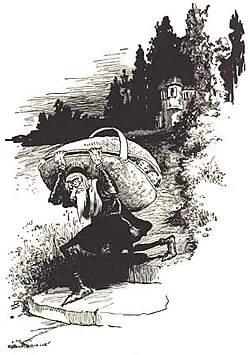
A hare draws Gruagach and twelve sons into Yellow Face’s house. The host monopolises food through the better wooden pike, then uses deceptive iron/wooden loops to kill the sons while sparing himself. He strips Gruagach’s lower-body skin and replaces it with a growing sheep fleece. No initial origin of his powers is narrated.
Selected bibliography
Documented works and useful reading. This is not a list of every appearance.
- 01
Celtic Fairy Tales: The Shee an Gannon and the Gruagach Gaire
Full selected episode and relevant editorial source note inspected; cited earlier collections remain attributed, not falsely claimed as newly read.
- 02
Celtic Fairy Tales — The Shee an Gannon and the Gruagach Gaire
Joseph Jacobs, Celtic Fairy Tales, undated selected PG7885 print/transcription; THE SHEE AN GANNON AND THE GRUAGACH GAIRE and noteXV. Complete selected body and note independently read; source text shortened and later Campbell touches explicitly acknowledged.
Family & connections
A source-supported family tree or inspiration record has not yet been compiled for this profile. Related reading below indicates a connection in subject matter, not a proven lineage or creative influence.
Located primary passages
Specific passages supporting details in this entry, grouped by their published witness.
Celtic Fairy Tales — The Shee an Gannon and the Gruagach Gaire
Joseph Jacobs, Celtic Fairy Tales, undated selected PG7885 print/transcription; THE SHEE AN GANNON AND THE GRUAGACH GAIRE and noteXV. Complete selected body and note independently read; source text shortened and later Campbell touches explicitly acknowledged.
- A hare draws Gruagach and twelve sons into Yellow Face’s house. The host monopolises food through the better wooden pike, then uses deceptive iron/wooden loops to kill the sons while sparing himself. He strips Gruagach’s lower-body skin and replaces it with a growing sheep fleece. No initial origin of his powers is narrated.
THE SHEE AN GANNON AND THE GRUAGACH GAIRE; Fighting hare, deceptive choices and imposed fleece
- The hero kills the fighting hare, chooses the effective wooden pike and obtains the food. With the wooden loop for himself, he puts iron loops on Yellow Face’s daughters and kills them, then threatens their father into reviving Gruagach’s sons. The daughters’ subsequent revival is not narrated; Yellow Face’s own death is not stated.
THE SHEE AN GANNON AND THE GRUAGACH GAIRE; Reversed choices and compelled resurrection
Complete selected body and note independently read. Narrated violence, offspring and resurrection distinguished; missing later fates not invented. No song, prayer or ritual-formula excerpts.
Primary source witness
Joseph Jacobs, Celtic Fairy Tales, undated selected PG7885 print/transcription; THE SHEE AN GANNON AND THE GRUAGACH GAIRE and noteXV. Complete selected body and note independently read; source text shortened and later Campbell touches explicitly acknowledged.
- Jacobs cites Curtin’s Myths and Folk-Lore of Ireland p114 onward, explicitly shortens the earlier tale and adds later touches from Campbell’s Fionn’s Enchantment in Revue CeltiqueI p193 onward. Hero-versus-folktale priority and Holy Grail-development theories remain attributed nineteenth-century interpretation, not confirmed source genealogy.
Confirms selected editorial practice and credit, not independently checked Curtin/Campbell printings or ancient chronology.
References
Sources supporting this profile. Linked pages have their own scope and editorial standards.
- Primary textJacobs, Celtic Fairy Tales: The Shee an Gannon and the Gruagach Gaire and source noteResearch access: 2026-10-05
Image credits
A sourced illustration has not yet been added. This gap is included in the coverage record.