
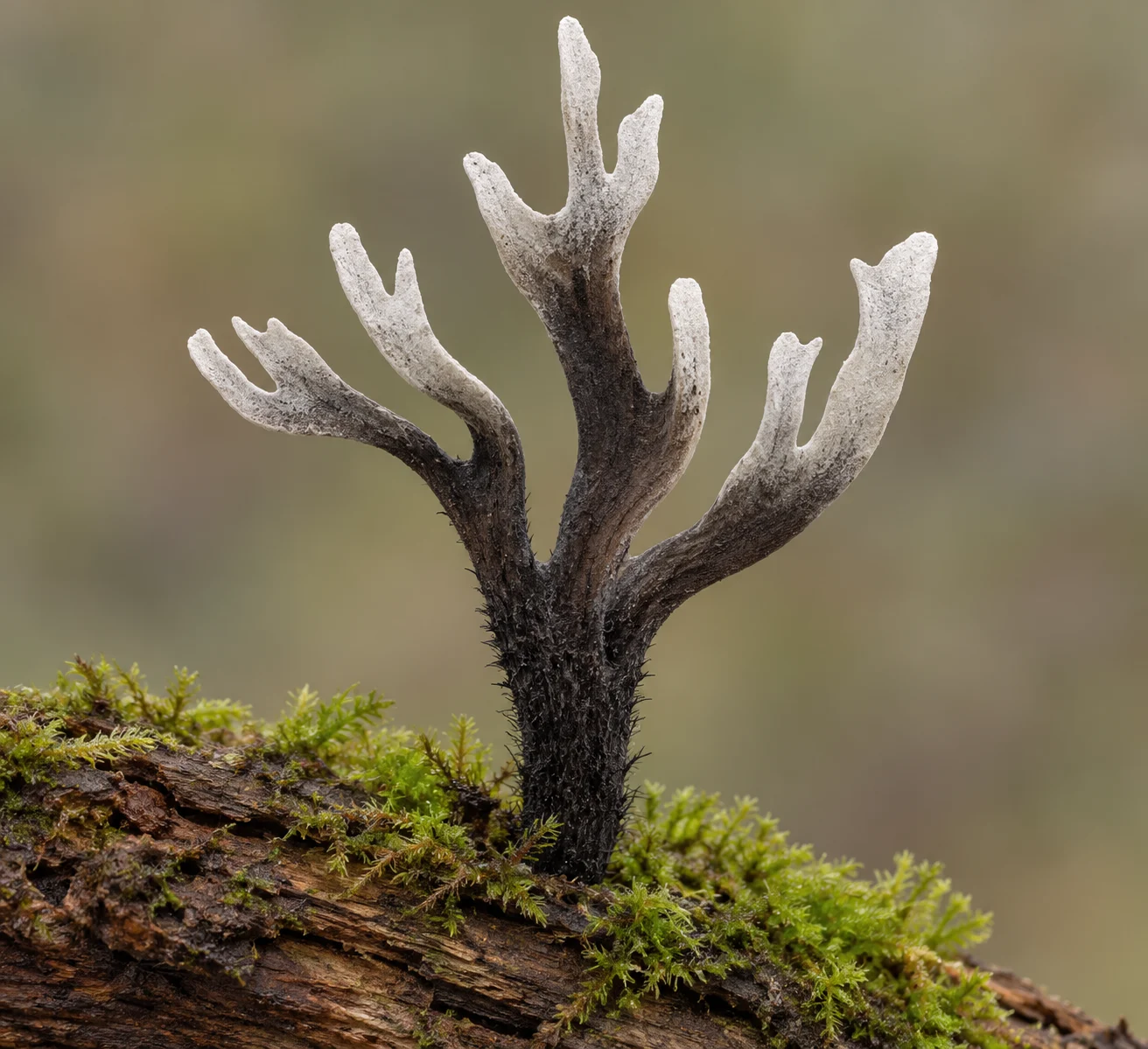
AI-generated asexual-state study.
Independent interpretation; embedded tissues are not reconstructed.
Overview
Candlesnuff fungus grows from dead wood as flattened, often branching fruiting structures. In its familiar asexual state, a dark, bristly lower portion contrasts with white powdery tips, where conidia form. This pale coating creates the snuffed-wick appearance behind its common name.
The sexual form can occur beside the pale-tipped structures but is entirely black and may branch less. Tiny surface openings lead to chambers where sexual spores develop. NatureSpot records the fungus on stumps throughout the year; Kew describes it on deadwood of broadleaved trees, sometimes among moss.
Origins & earliest records
UK woodland records.
Evidence & interpretation
Two published accounts.
Selected bibliography
Documented works and useful reading. This is not a list of every appearance.
- 01
- 02
Family & connections
A source-supported family tree or inspiration record has not yet been compiled for this profile. Related reading below indicates a connection in subject matter, not a proven lineage or creative influence.
Look for a taxonomic record and classified relativesReferences
Sources supporting this profile. Linked pages have their own scope and editorial standards.
- Community species accountCandlesnuff FungusResearch access: 2026-10-18
- Botanical garden articleFungi to see in springResearch access: 2026-10-18
Image credits
AI-generated illustrationAI-generated asexual-state study.
Independent interpretation; embedded tissues are not reconstructed.