
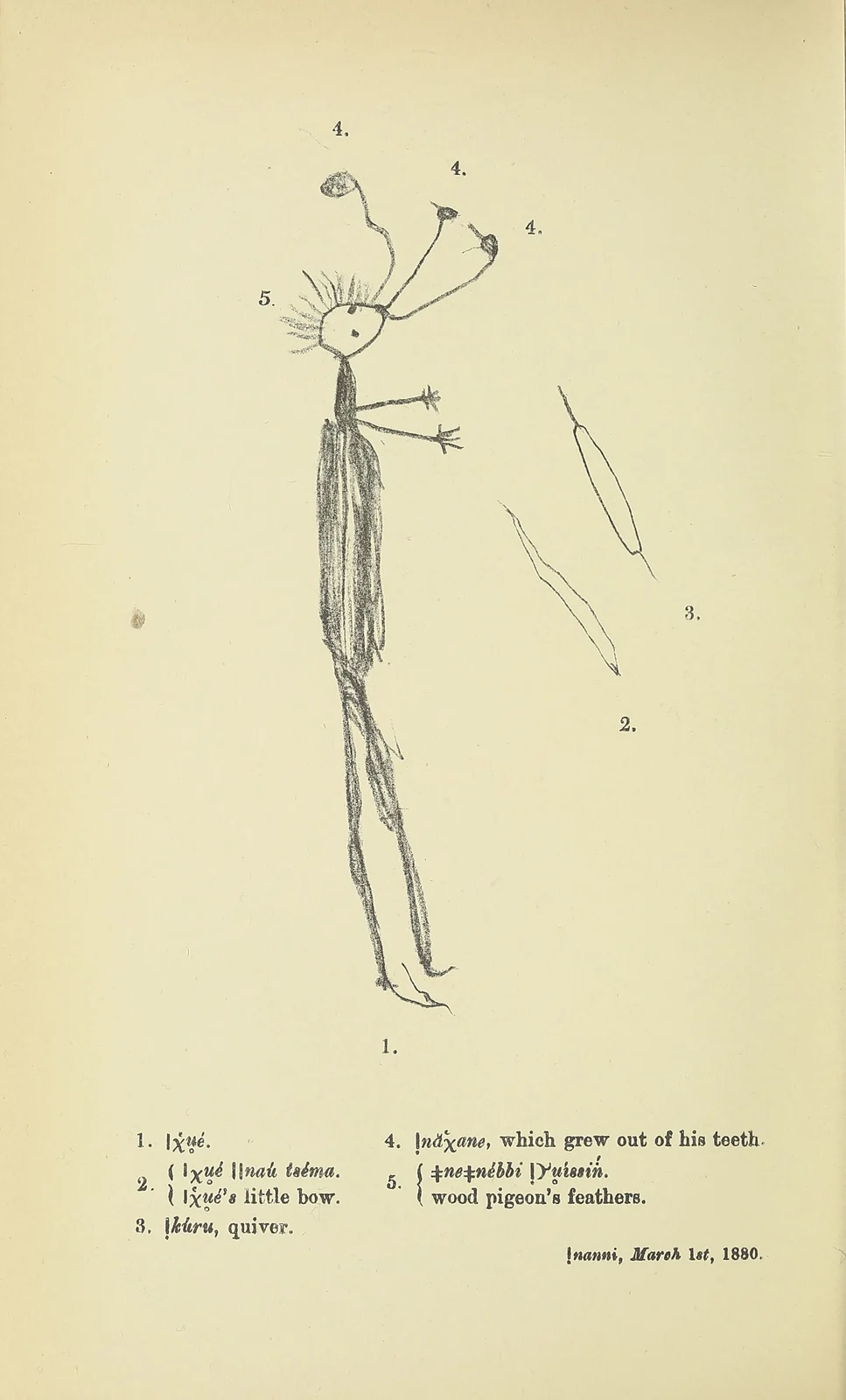
|Xue drawn by !nanni, March1,1880, with bow, quiver and transforming features
Named indigenous drawing from the separate !Kung appendix, not a |Xam Mantis representation. Printed numbered key names |Xue, his bow/quiver, plants growing from his teeth and wood-pigeon feathers. A specific historical representation of the polymorphic narrative being.
Overview
|Xue’s selected transformation episodes belong to the book’s separate appendix headed a few !Kung texts, rather than being silently merged with its |Xam Mantis narratives. The speaker credits grandfather Karu with recounting his many deeds. In one episode sunrise brings a plant or tree form and sunset restores |Xue himself. Another presents him as a thorny fruit tree; when his wife reaches for fruit, the tree vanishes and he becomes a fly. The fly settles on grass that breaks, giving an unusually weighty consequence to an apparently small insect shape.
In the water episode, |Xue lies as a lizard among fallen leaves while wood pigeons feed nearby. He becomes water beneath the tree, drawing them to drink, and also appears through grass and reed-like growth that grips a pigeon and bites its bill. The remaining birds escape. He returns to his own form, plucks the captured bird’s feathers and places them on his head, then cooks and eats it. The water disappears. The notes distinguish a small waterhole from an extensive body of water and preserve the grass/reed imagery without providing a secure botanical identification.
He next approaches Ovaherero people and hides as a little bird called |nu-erre. A child notices the bird, but people searching for |Xue cannot find him. The passage also presents him as eye-water falling to the ground before he flies toward his mother’s country. Its explanatory notes shift between one bird and many birds; this variation is kept as part of the difficult translated sequence rather than rewritten into a precise flock size.
When he sees his father, he resumes his own identity and dies. His father comes to look, then leaves; |Xue rises and calls to him. A later encounter again brings death and a lizard form. The father recognizes his child, repeats that he has seen him making fire and dying, and expresses fear. His closing speech names himself |Xe-||n’u and describes his own distant country, ||noa, as a large mountain. The father finally departs for it. Feathers and shifts of speaker remain grammatically uncertain in the text, so this is not turned into a simple final resurrection followed by a resolved family reunion.
Origins & earliest records
Bleek and Lloyd’s separate !Kung appendix, printed pp. 404–413, records !nanni’s material from his paternal grandfather Karu. The original heading p. 404 credits the opening to 18 March 1880 and transformations to March–April 1880; that heading was independently inspected by the literature researcher. This contributor and language corpus are distinct from the |Xam chapters. Edition: London, George Allen & Co., 1911.
Records & interpretation
Sections 1, 3 and complete section 4 read, including section 4’s notes and final father’s departure. Section 2 remains unused after failed access. Native publisher retrieval of section 4 succeeded on 5 October 2026 after web-reader timeout; retained source cache and SHA manifest.
In the literature
“the ||gui vanished; and |Xue was a fly.”
Appendix, |Xue transformations; 3, |Xue as a ||gui Tree and as a Fly · W. H. I. Bleek and Lucy C. Lloyd
The tree form disappears when his wife reaches toward its fruit.
“|Xue was water; and the water was (in) the shadow of the tree.”
Appendix, |Xue transformations; 4, opening sentence · W. H. I. Bleek and Lucy C. Lloyd
|Xue takes the form of shaded water before trapping a wood pigeon.
“I am afraid of my child, for my child is dead.”
Appendix, |Xue transformations; 4, speech of |Xue’s father · W. H. I. Bleek and Lucy C. Lloyd
His father expresses fear during the sequence of transformations and apparent deaths.
Selected bibliography
Documented works and useful reading. This is not a list of every appearance.
- 01
Specimens of Bushman Folklore — !Kung appendix, |Xue transformations
Selected sections 1,3,4 only; historical title retained for bibliographic identification.
- 02
Specimens of Bushman Folklore — Appendix, |Xue transformations
London: George Allen & Co., 1911. Appendix, A Few !Kung Texts, |Xue sequence, printed pp. 404–413. !nanni supplied the opening on 18 March 1880 and the transformations in March–April 1880 from paternal grandfather Karu, expressly credited in the original heading p. 404. This contributor and language corpus are distinct from the |Xam chapters.
Family & connections
A source-supported family tree or inspiration record has not yet been compiled for this profile. Related reading below indicates a connection in subject matter, not a proven lineage or creative influence.
Located primary passages
Specific passages supporting details in this entry, grouped by their published witness.
Specimens of Bushman Folklore — !Kung appendix, |Xue transformations
London: George Allen & Co., 1911. Appendix, A Few !Kung Texts, |Xue sequence, printed pp. 404–413. !nanni supplied the opening on 18 March 1880 and the transformations in March–April 1880 from paternal grandfather Karu, expressly credited in the original heading p. 404. This contributor and language corpus are distinct from the |Xam chapters.
- In daily transformations |Xue becomes forms of !naxane, including a tree, and returns to his own form to sleep after sunset.
All four English subsections read; this early translation contains ellipses and uncertain renderings. Modern classifications and exact species of plant/bird forms are not inferred.
Primary source witness
London: George Allen & Co., 1911. Appendix, A Few !Kung Texts, |Xue sequence, printed pp. 404–413. !nanni supplied the opening on 18 March 1880 and the transformations in March–April 1880 from paternal grandfather Karu, expressly credited in the original heading p. 404. This contributor and language corpus are distinct from the |Xam chapters.
- The sequence continues through dui and shao plant forms and human identities labelled Omuherero and Makoba by the translation.
All four English subsections read; this early translation contains ellipses and uncertain renderings. Modern classifications and exact species of plant/bird forms are not inferred.
Primary source witness
London: George Allen & Co., 1911. Appendix, A Few !Kung Texts, |Xue sequence, printed pp. 404–413. !nanni supplied the opening on 18 March 1880 and the transformations in March–April 1880 from paternal grandfather Karu, expressly credited in the original heading p. 404. This contributor and language corpus are distinct from the |Xam chapters.
- His wife reaches for the fruit of |Xue’s tree form; the tree vanishes as he becomes a fly, and she grieves and dies.
Appendix, |Xue transformations; 3, |Xue as a ||gui tree and fly
All four English subsections read; this early translation contains ellipses and uncertain renderings. Modern classifications and exact species of plant/bird forms are not inferred.
Primary source witness
London: George Allen & Co., 1911. Appendix, A Few !Kung Texts, |Xue sequence, printed pp. 404–413. !nanni supplied the opening on 18 March 1880 and the transformations in March–April 1880 from paternal grandfather Karu, expressly credited in the original heading p. 404. This contributor and language corpus are distinct from the |Xam chapters.
- |Xue becomes a water hole and grasses that trap a wood pigeon; he resumes his own form, plucks the bird and cooks it.
Appendix, |Xue transformations; 4, water, reeds and the wood pigeon
- Further transformations conceal |Xue from pursuers and take him to his mother’s country; he repeatedly appears to die in encounters with his father, who finally withdraws in fear.
Appendix, |Xue transformations; 4, escape and encounters with his father
All four English subsections read; this early translation contains ellipses and uncertain renderings. Modern classifications and exact species of plant/bird forms are not inferred.
References
Sources supporting this profile. Linked pages have their own scope and editorial standards.
- Primary collected narrative translationThe Doings of |Xue Are ManyResearch access: 2026-10-05
- Primary collected narrative translation|Xue as a ||Gui Tree and as a FlyResearch access: 2026-10-05
- Primary collected narrative translation|Xue as Water and Other ThingsResearch access: 2026-10-05
Image credits
Historical illustration|Xue drawn by !nanni, March1,1880, with bow, quiver and transforming features
Named indigenous drawing from the separate !Kung appendix, not a |Xam Mantis representation. Printed numbered key names |Xue, his bow/quiver, plants growing from his teeth and wood-pigeon feathers. A specific historical representation of the polymorphic narrative being.