
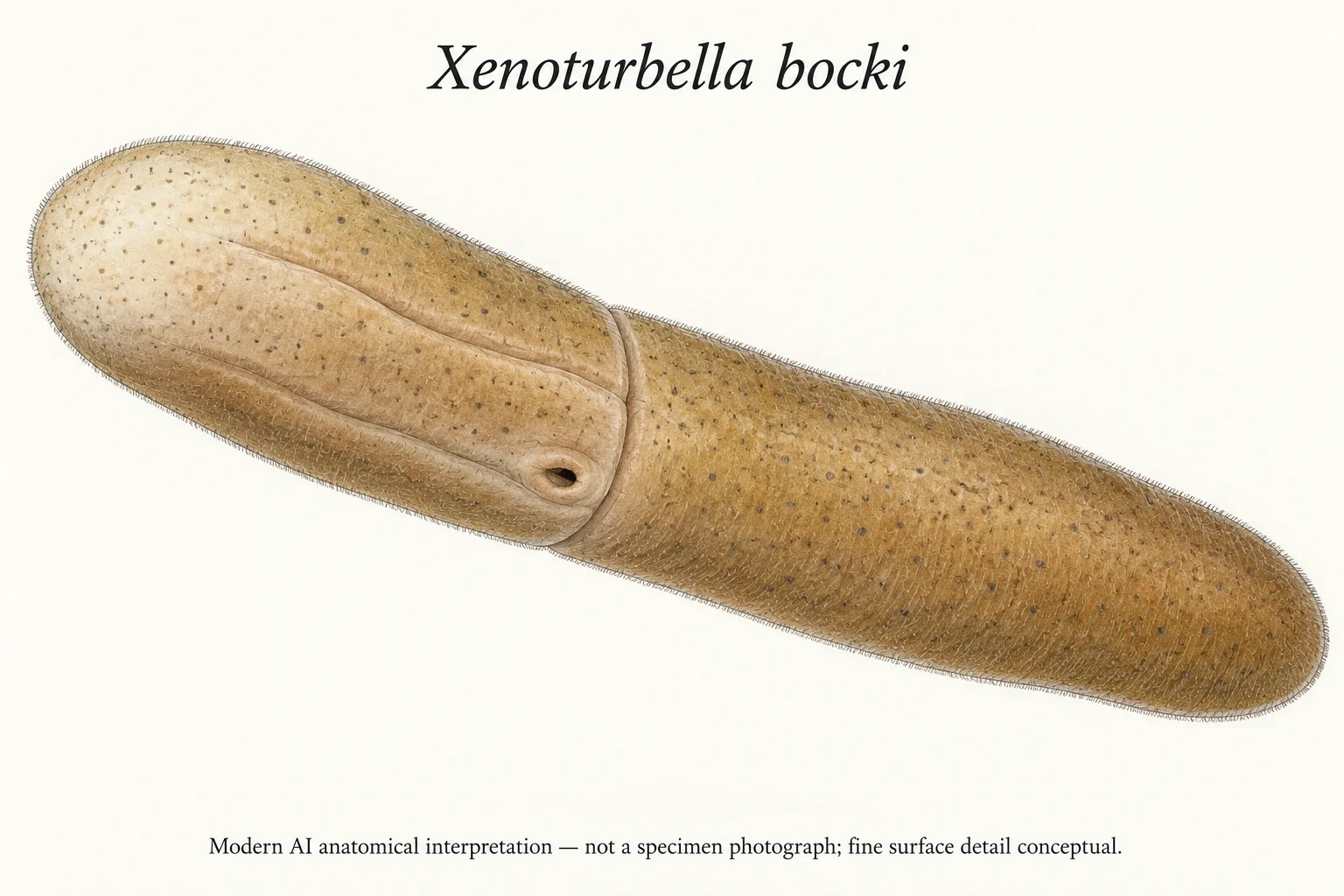
AI Xenoturbella anatomy: furrows and ventral mouth.
Modern AI anatomy; fine surface detail conceptual, not a specimen photograph.
Overview
A live adult is brownish to pale yellow. A transverse furrow encircles the body near its middle; paired side grooves extend backward from the front. The mouth lies on the underside just ahead of the transverse groove. Cilia on the outer tissue aid locomotion. There are no visible limbs, tentacles, shell or segmented trunk.
The gut ends blindly rather than opening through an anus. A nerve network occurs in the outer tissue, without an obvious brain or nerve cords. The anterior organ called a statocyst has no demonstrated balance-sensing role in Nakano’s account; its name alone does not establish its function.
Robertson and colleagues collected adults from soft mud at roughly 60–100 metres in Gullmarsfjord for their 2024 study. Single-cell RNA sequencing and tissue-localisation experiments investigated gland, muscle, neural and other cell states. This molecular approach shows why an animal with few conspicuous organs can still have differentiated tissues; the illustration cannot display its gene-expression results.
Recent analyses unite xenoturbelids with acoels and nematodermatids in Xenacoelomorpha. The 2024 paper distinguishes two broader placement hypotheses: a relationship with Ambulacraria, or a sister relationship with the remaining bilaterians. Its cell-type comparisons are consistent with the phylum, but the profile does not turn this result into a settled position for the entire animal tree.
Origins & earliest records
Described by Westblad in 1949; former flatworm placement remains historical.
Evidence & interpretation
Cited text only; no sourced image reused.
Selected bibliography
Documented works and useful reading. This is not a list of every appearance.
- 01
Single cell atlas of Xenoturbella bocki highlights limited cell-type complexity
Search-returned text; later direct-open 500 held.
- 02
Family, evolution & connections
Taxonomic classification
A hierarchy of classified groups, not a chain of direct ancestors.
Source note: Xenacoelomorpha membership supported; broader placement unresolved.
- PhylumXenacoelomorpha
- GenusXenoturbella
- SpeciesXenoturbella bocki
References
Sources supporting this profile. Linked pages have their own scope and editorial standards.
- Research textSource recordResearch access: 2026-10-11
- Research textSource recordResearch access: 2026-10-11
Image credits
AI-generated interpretationAI Xenoturbella anatomy: furrows and ventral mouth.
Modern AI anatomy; fine surface detail conceptual, not a specimen photograph.