
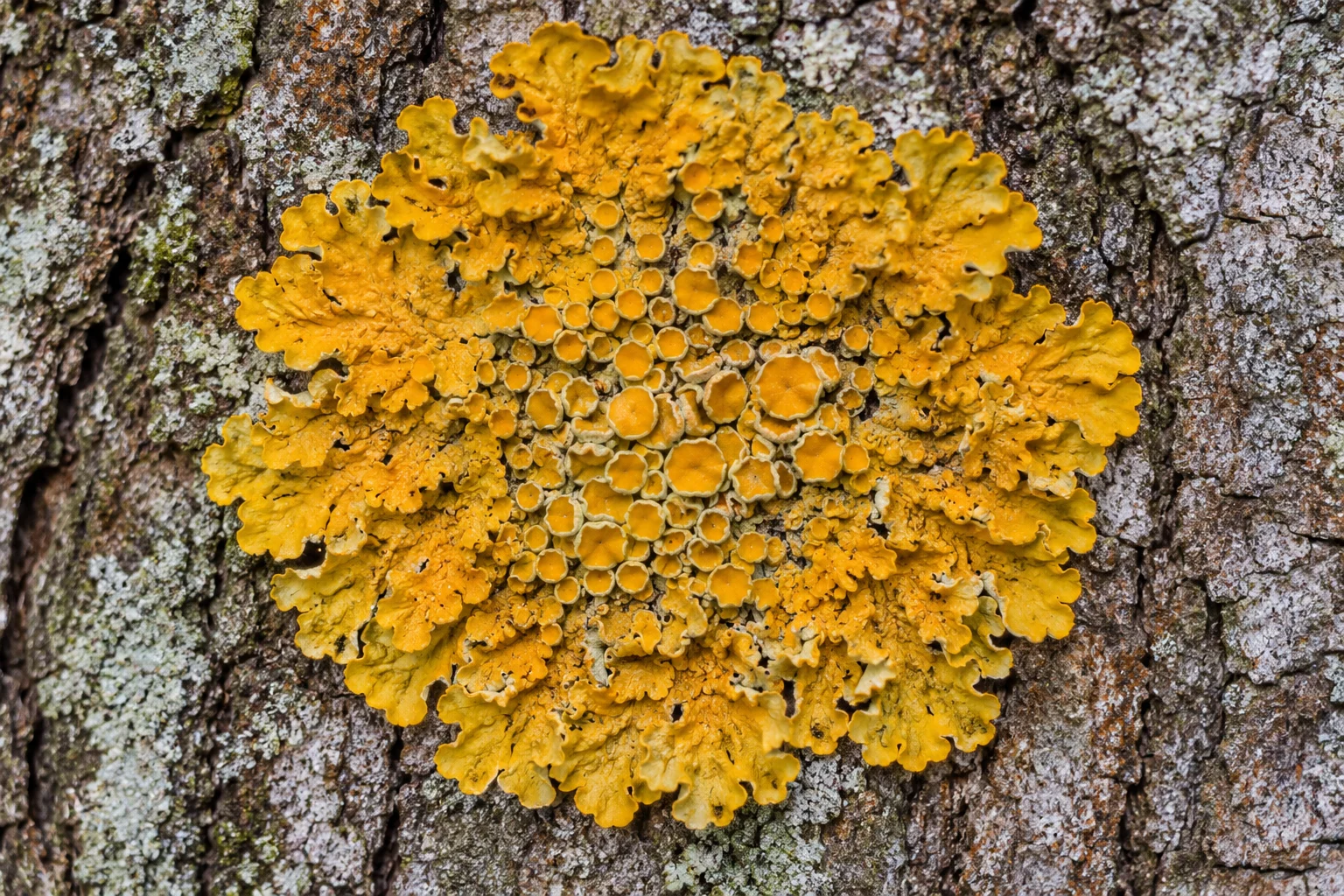
AI-generated thallus patch study.
Interpretation; not an exact specimen.
Overview
This leafy lichen forms overlapping, wrinkled lobes, with a distinct upper and lower surface. Sunlit growth is often bright yellow or orange, while shaded specimens become greener or greyer. Mature patches develop crowded, circular fruiting discs near the centre, with yellow interiors and paler rims; these release spores of the fungal partner.
It grows on tree bark, rocks, roofs and walls, including urban sites. Bird droppings enrich surfaces where it can thrive. The lichen combines a fungus with photosynthetic green algae: the fungus supplies structure and protection, while its partners provide sugars. Rain can make the growth appear greener as the algae show through the wetted tissue.
Origins & earliest records
Bark and exposed surfaces
Evidence & interpretation
Published accounts.
Selected bibliography
Documented works and useful reading. This is not a list of every appearance.
- 01
- 02
Family & connections
A source-supported family tree or inspiration record has not yet been compiled for this profile. Related reading below indicates a connection in subject matter, not a proven lineage or creative influence.
Look for a taxonomic record and classified relativesReferences
Sources supporting this profile. Linked pages have their own scope and editorial standards.
- Species accountXanthoria parietinaResearch access: 2026-10-18
- Botanical society accountXanthoria parietina – Maritime sunburst lichenResearch access: 2026-10-18
Image credits
AI-generated illustrationAI-generated thallus patch study.
Interpretation; not an exact specimen.