
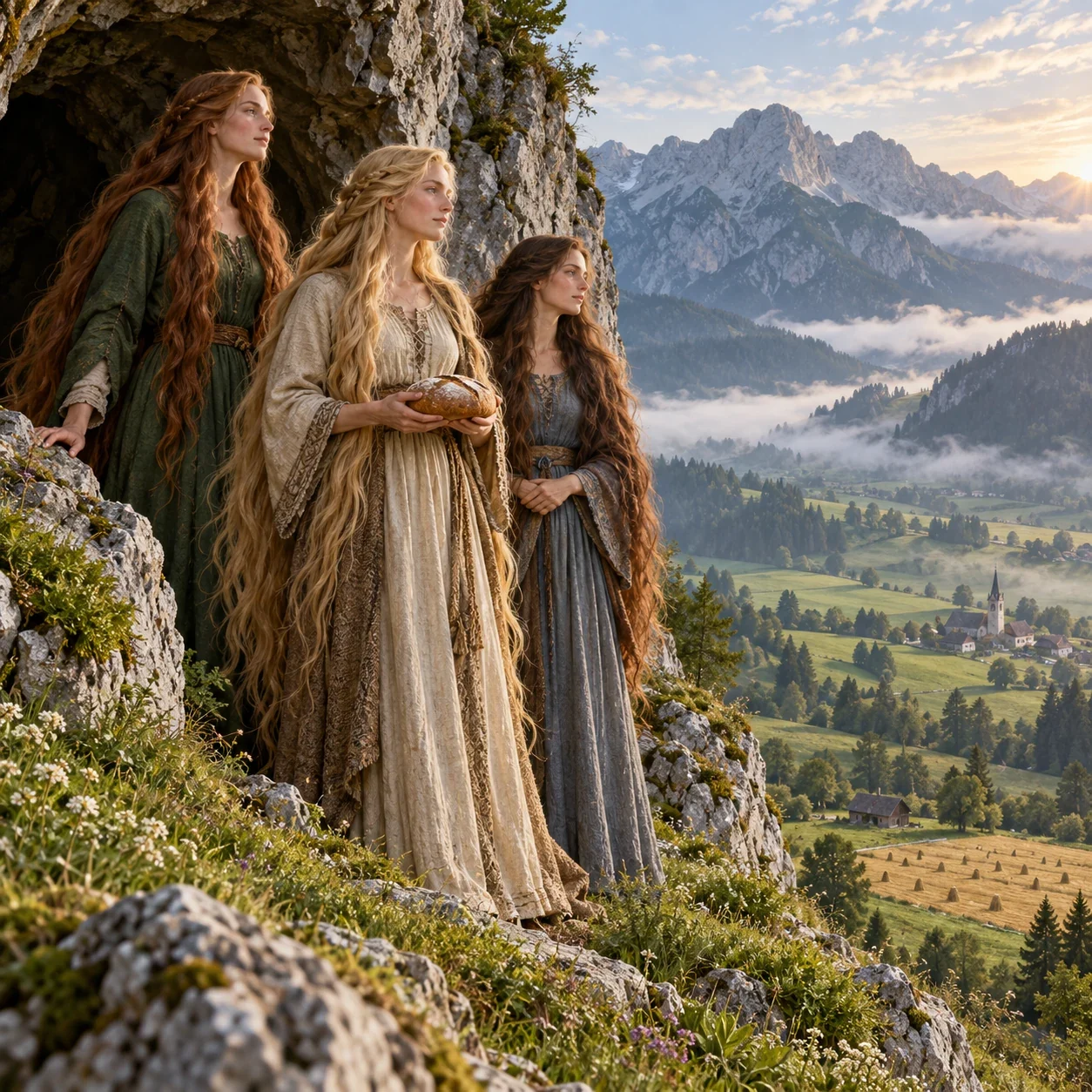
AI-generated interpretation of the Wunderberg Wild-Women’s bread-giving visits. Long hair, bread and a mountain setting follow the collected account; three women, faces, dresses, cave entrance and the exact Alpine landscape are artistic choices, not authenticated costume or eyewitness evidence.
AI-generated interpretation of the Wunderberg Wild-Women’s bread-giving visits. Long hair, bread and a mountain setting follow the collected account; three women, faces, dresses, cave entrance and the exact Alpine landscape are artistic choices, not authenticated costume or eyewitness evidence.
Overview
Keightley places the Wild-Women in a mountain landscape near Salzburg. His selected name is Wunderberg, also given as Underberg. They have long flowing hair, inhabit hills and appear either alone or with one another. He compares them with Scandinavian Elle-maids and describes their character as pious. These are the compiler’s groupings, not proof that the differently named traditions share a single origin or that every encounter is benevolent. The narrated Salzburg setting should also remain distinct from a claim that the stories fit inside present national borders.
Their mountain is imagined as hollow, containing palaces, churches, monasteries, gardens and springs of precious metals. Keightley’s framing gives it other residents: little treasure-guardians who visit Salzburg’s cathedral at midnight, giants who exhort churchgoers to piety, and a crowned emperor whom this witness specifically calls Charles V. The emperor’s beard is said to wind around his table, with its third circuit announcing the world’s end and the appearance of Antichrist. This is the account’s visionary mountain interior, not a description of an excavated site or a reason to substitute another emperor’s name without checking a different witness.
The encounters outside the mountain range from nourishment to abduction. Near Glanegg, villagers reportedly remembered the women giving bread to young cattle-herders around 1753. The women also came to the harvest fields in the morning, returning to the mountain when work ended without sharing supper. In another episode, a boy sits on a tethered horse while his father works. The women attempt to take him, but the father seizes and retains his child. They promise better care and affection within the mountain. He refuses to surrender the boy, and they withdraw in tears. Their proposed kindness does not erase the parent’s refusal or the attempt to remove him by force.
A separate boy is actually taken near the Kugelmill. About a year later, woodcutters see him wearing green and sitting on a block of the mountain. They return the next day with his parents to search, but nobody finds him again. The tale offers a sighting rather than a successful rescue, and does not settle the child’s later fate. Alongside the bread-giving and harvest visits, these incidents make the women’s closeness to rural life uncertain and potentially dangerous.
The Anif episode concerns a woman whose exceptionally long hair nearly reaches her feet. A local peasant begins spending nights beside her in the field and denies having a wife when she asks. His wife follows and discovers them, but addresses the stranger without hostility. The Wild-Woman then rebukes the man’s deception. She says his wife’s lack of malice has spared him from being trapped there, urges him to return faithfully to his marriage, gives him a shoeful of money and forbids further visits. Keightley attaches a comparison in which a wife cuts a tress from a similar woman and is asked to restore it. That footnote is a separate variant, not an additional event in the Anif story.
Keightley appends the Oldenburg Horn narrative because he thinks its maiden was probably a Wild-Woman; the identification remains his conjecture. In that account, Count Otto follows a deer to the Osenberg and wishes for a drink. A maiden emerges from the hill with an ornate gilded-silver horn and promises prosperity if he drinks. He distrusts the liquid and pours it away; splashes remove hair from his white horse. He rides off with the horn while the maiden retreats into the hill. The story claims that successive Oldenburg rulers kept it, without independently establishing its marvelous origin. Keightley’s notes trace the mountain material through Grimm to a 1782 Brixen folk-book and the horn story through Büsching to Hammelmann’s 1599 chronicle. Those upstream witnesses remain separately attributed, not independently collated here.
Origins & earliest records
Complete The Wild-Women section, including The Oldenburg Horn and notes 283–285, in Thomas Keightley, The Fairy Mythology, revised and enlarged edition, London: George Bell & Sons,1892, pp. 234–238.
Records & interpretation
Complete historical English section and all attached notes read from preserved Gutenberg 41006 master. Upstream source chains are Keightley’s attributions; no modern fieldwork, relic inspection or supernatural verification claimed.
Selected bibliography
Documented works and useful reading. This is not a list of every appearance.
- 01
The Fairy Mythology — The Wild-Women, pp234–238; notes283–285
Complete framing, all Wunderberg incidents, Anif ending and note variant, then complete appended Oldenburg Horn story.
Family & connections
A source-supported family tree or inspiration record has not yet been compiled for this profile. Related reading below indicates a connection in subject matter, not a proven lineage or creative influence.
References
Sources supporting this profile. Linked pages have their own scope and editorial standards.
- Historical English compilationKeightley1892: complete Wild-Women section and notes283–285Research access: 2026-10-27
Image credits
AI-generated illustrationAI-generated interpretation of the Wunderberg Wild-Women’s bread-giving visits. Long hair, bread and a mountain setting follow the collected account; three women, faces, dresses, cave entrance and the exact Alpine landscape are artistic choices, not authenticated costume or eyewitness evidence.
AI-generated interpretation of the Wunderberg Wild-Women’s bread-giving visits. Long hair, bread and a mountain setting follow the collected account; three women, faces, dresses, cave entrance and the exact Alpine landscape are artistic choices, not authenticated costume or eyewitness evidence.