
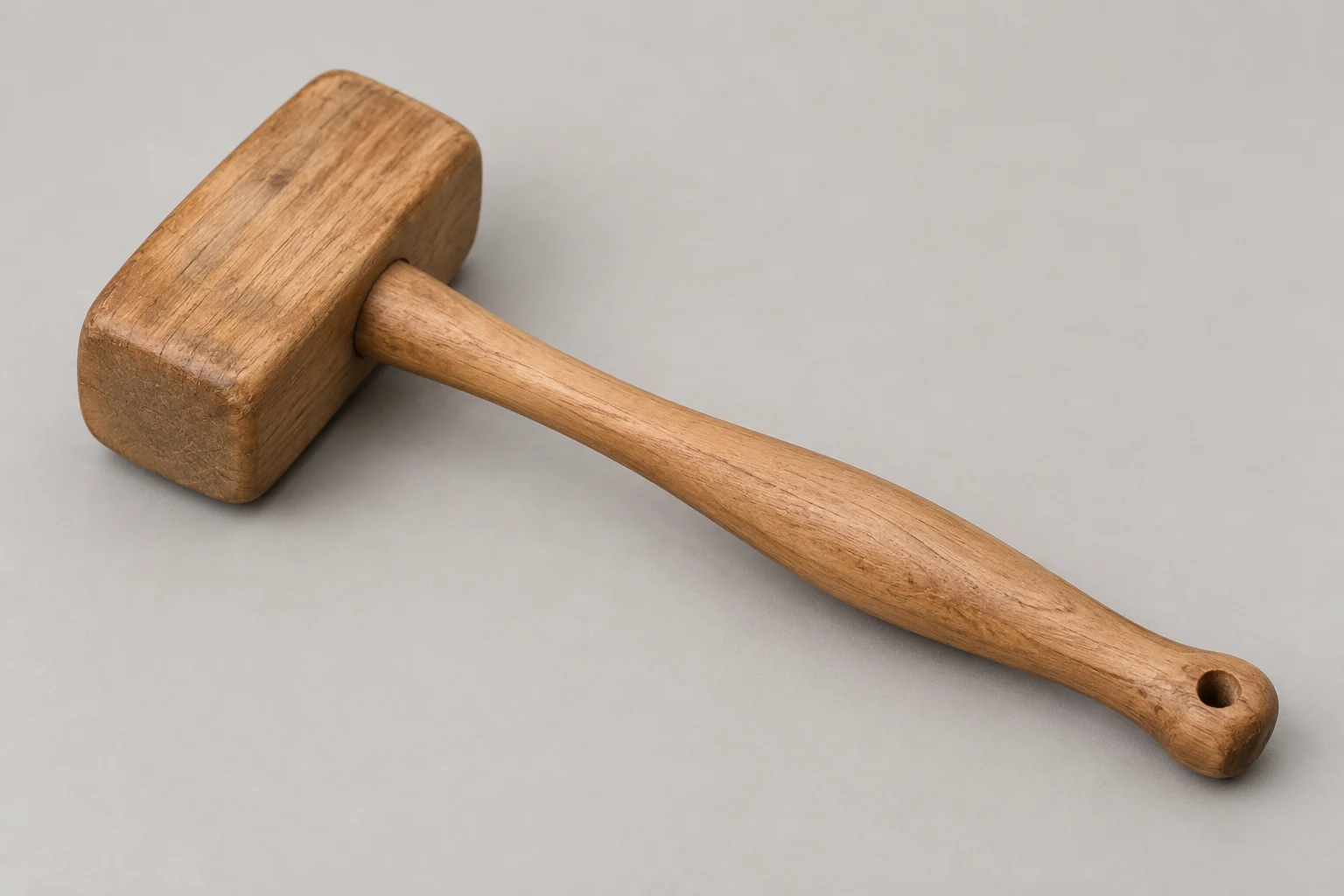
Generated interpretation of a historical textbook tool; not a photographed specimen or authenticated replica. The hanging eye is rendered as a drilled opening rather than the source drawing’s projecting loop.
Overview
The central mallet in figure 164 has a broad wooden head set across a much narrower wooden handle. Its head has a roughly rectangular outline with softened corners, while the long handle swells around the grip and narrows toward the head. A small hanging eye appears at the remote handle end. The drawing gives the whole tool without a named maker, exact dimensions, wood species or individual place of manufacture. It appears between two other mallet forms in an instructional comparison, rather than as a documented museum specimen. The surrounding text includes square, cylindrical and barrel-shaped heads and separately notes that carvers’ mallets may be turned in one piece with head and handle on the same axis; that coaxial construction should not be transferred to this cross-headed example.
Noyes distinguishes mallets from steel-headed hammers through the way their blows act on wood. In his explanation, elasticity makes the wooden head apply its force more gradually and damage a chisel handle less rapidly. His chisel discussion also distinguishes tools suited to mallet blows from long, thin paring chisels intended for hand pressure, so the book does not treat every chisel as interchangeable. Mortise cutting supplies an example of mallet-driven work. These descriptions belong to an early twentieth-century teaching manual, aimed primarily at woodwork teachers and also at professional and amateur workers. Its foreword credits Anna Gausmann Noyes with almost all the drawings and substantial editorial work, while acknowledging other contributors. It does not identify the draughtsperson of figure 164 individually. The profile presents a tool form and its instructional context, without assigning it to a national character, claiming current workshop practice or presenting generated imagery as an original manufactured object.
History & identity
William Noyes’s industrial-arts teaching manual, published by The Manual Arts Press.
Sources & representation
Title/copyright, complete foreword, selected complete tool sections and use contexts read; native figure164 inspected.
Selected bibliography
Documented works and useful reading. This is not a list of every appearance.
- 01
Handwork in Wood
Peoria,Illinois:The Manual Arts Press. Copyright1910 transcribed in digital edition; pp.54–58,95–97,figure164.
Language & cultural connections
Source-supported language and cultural connections have not yet been compiled for this profile.
References
Sources supporting this profile. Linked pages have their own scope and editorial standards.
- Historical practical teaching manualNoyes, pounding tools and related chisel accountResearch access: 2026-10-18
Image credits
AI-generatedGenerated interpretation of a historical textbook tool; not a photographed specimen or authenticated replica. The hanging eye is rendered as a drilled opening rather than the source drawing’s projecting loop.