
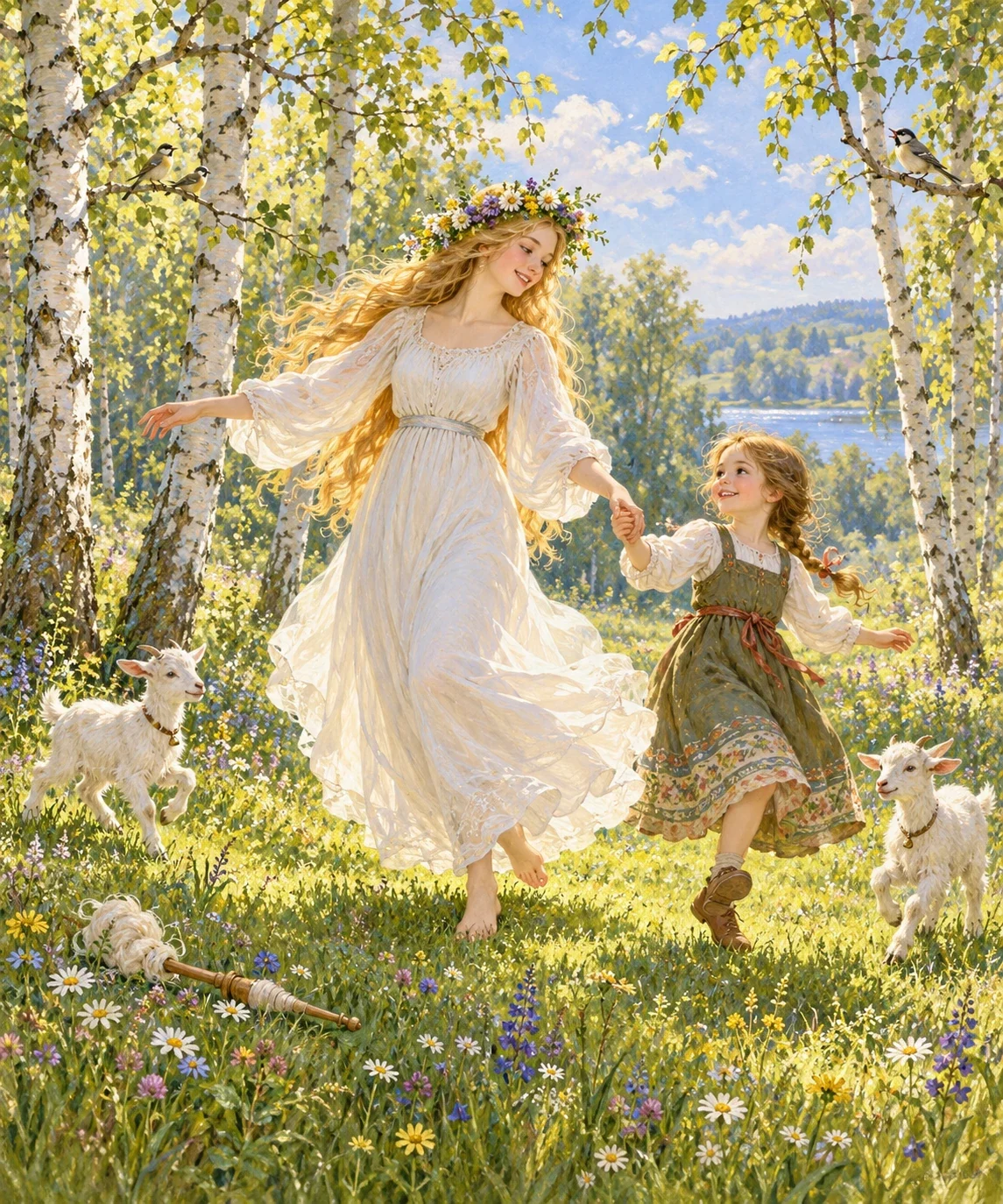
AI-generated interpretation of the wood maiden’s dance with Betushka in Fillmore’s selected retelling. Modest opaque clothing, palette and setting details are editorial choices. The woodland maiden and human child are distinct figures.
AI-generated interpretation of the wood maiden’s dance with Betushka in Fillmore’s selected retelling. Modest opaque clothing, palette and setting details are editorial choices. The woodland maiden and human child are distinct figures.
Overview
The wood maiden appears when Betushka is tending two goats in a birch wood. The girl’s widowed mother expects a full spindle each evening, and Betushka normally balances spinning with food, song and a midday dance. Her visitor is described as wearing a fine white gauze dress, with long golden hair reaching her waist and woodland flowers around her head. The maiden asks whether she likes dancing, takes her as a partner and calls forth music from birds in the branches. The narrator dresses the bird musicians in little coats, giving this particular retelling a playful appearance that need not be generalized to woodland beings elsewhere.
Their first dance lasts from noon until sunset, although Betushka does not become tired. Only when the maiden disappears does she remember the unfinished spinning. She conceals the lapse from her mother and hopes to recover the work the next day. At their second meeting the girl explains why she should not dance. The maiden promises that the spinning can be managed, and after another afternoon’s dance she winds the flax around a birch stem and fills the spindle. She also completes the previous day’s unfinished amount. Her instruction joins the gift to a condition: the yarn must be reeled without complaining.
The third meeting ends with a different gift. The maiden takes Betushka’s basket, briefly vanishes, and returns it with a warning not to look inside until she reaches home. Betushka peeks on the road and finds birch leaves. Disappointed, she throws away a handful but keeps the rest. Meanwhile her mother has been reeling the enchanted spindle. It repeatedly supplies more yarn until the mother calls it the work of an evil spirit; the yarn then disappears. When Betushka explains the meetings, her mother identifies the visitor as a wood maiden and says that such dancers can be dangerous to boys. That generalization is a character’s explanation within the tale. The selected maiden does not kill or threaten Betushka.
At home the leaves remaining in the basket have become gold. The handful discarded on the road remains ordinary leaves when the mother retrieves it the next morning. The retained wealth lets the household acquire a farm, fields and cattle, and Betushka no longer needs to herd the goats. The ending does not erase her attachment to the dance: she revisits the wood hoping to see the maiden, but never meets her again. Material improvement and the lost pleasure therefore remain separate parts of the conclusion. This is the supernatural partner of one complete narrative, not a combined profile of every fairy, vila, rusalka or forest spirit with a dancing motif.
Origins & earliest records
The selected witness is The Wood Maiden in Fillmore’s 1919 Czechoslovak Fairy Tales. His note names Czech, Slovakian and Moravian collections and explains that the English stories include deliberate changes for an American child audience. It does not attach this chapter to a named informant, a particular village, or one modern country. Betushka’s spelling follows this witness. No underlying Nemcova edition or equivalent original-language tale was independently consulted, so a more precise attribution is left unresolved rather than supplied from familiarity with related stories.
Records & interpretation
The entire chapter supports the sequence of three dances, the spinning condition, the basket warning, the mother’s complaint, the leaves’ transformation and the final failure to meet again. Appearance comes from the first encounter, rather than an illustrator’s picture. The mother’s statement about lethal dances for boys is attributed to her speech and not treated as a demonstrated event in this chapter. The evidence establishes an imagined figure in a historically mediated retelling; it does not verify supernatural woodland encounters or a comprehensive belief shared by any present-day community.
Selected bibliography
Documented works and useful reading. This is not a list of every appearance.
- 01
Czechoslovak Fairy Tales
Parker Fillmore’s 1919 English retelling, written for American children. His prefatory note explicitly permits shortening and elaboration and names Czech, Slovakian and Moravian source collections without assigning an underlying collector or named oral teller to every selected tale. Original-language editions and a physical facsimile were not independently read.
Family & connections
A source-supported family tree or inspiration record has not yet been compiled for this profile. Related reading below indicates a connection in subject matter, not a proven lineage or creative influence.
References
Sources supporting this profile. Linked pages have their own scope and editorial standards.
- Primary historical English retellingFillmore 1919, complete The Wood Maiden, pp.163–176; prefatory NOTE, pp.vii–viiiResearch access: 2026-10-23
Image credits
AI-generated illustrationAI-generated interpretation of the wood maiden’s dance with Betushka in Fillmore’s selected retelling. Modest opaque clothing, palette and setting details are editorial choices. The woodland maiden and human child are distinct figures.
AI-generated interpretation of the wood maiden’s dance with Betushka in Fillmore’s selected retelling. Modest opaque clothing, palette and setting details are editorial choices. The woodland maiden and human child are distinct figures.