
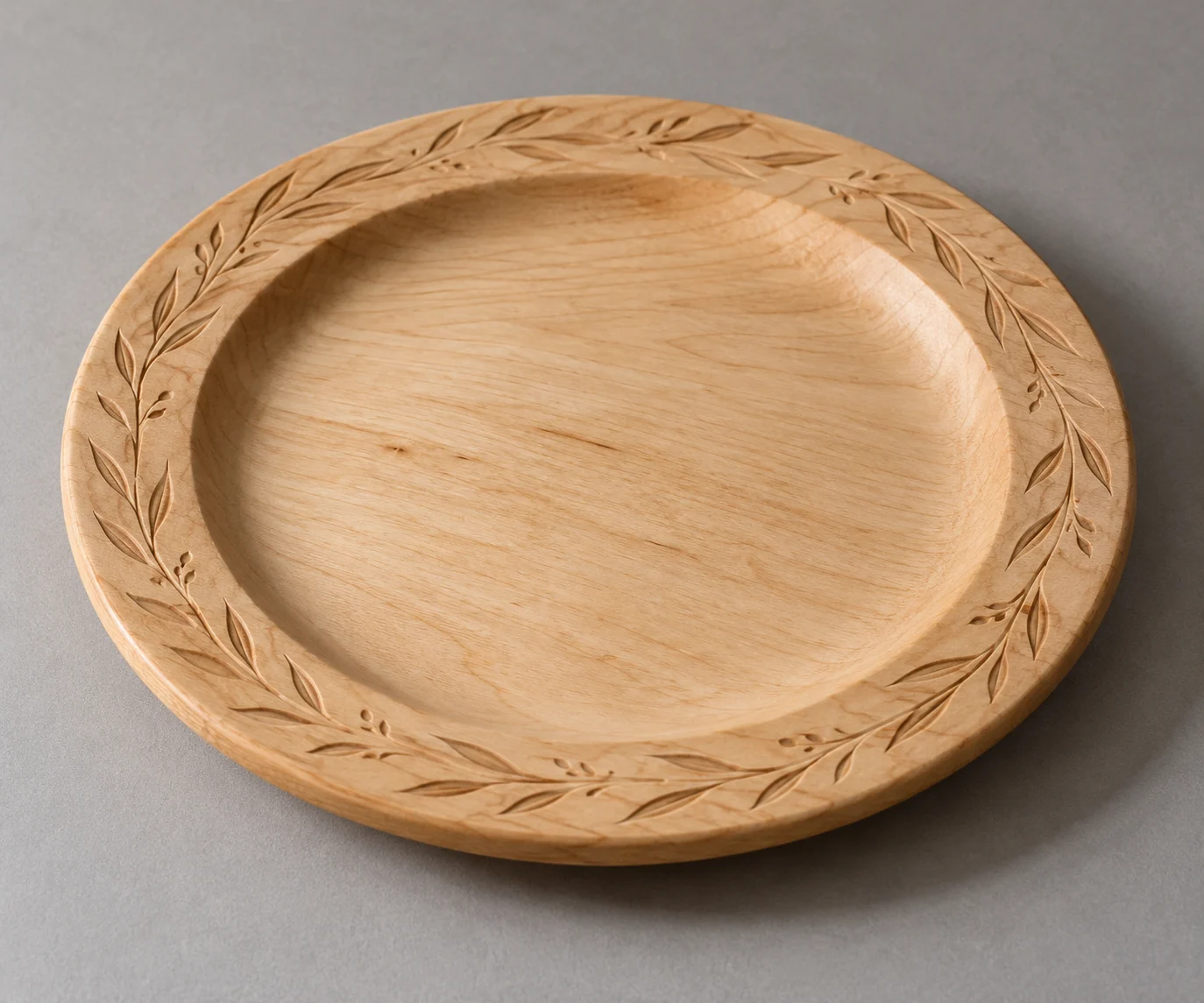
AI contextual craft study.
Design interpreted; no historical specimen reproduced.
Overview
George Jack’s 1903 manual treats wood-carving as a practice in which designing and cutting should develop together. Its opening chapter weighs the strengths of apprenticeship against independent study: repeated workshop work can build dexterity, while students need opportunities to test ideas rather than remain trapped in theory. Jack presents his handbook as a temporary guide to be supplemented by practice. His later discussion of natural forms makes light, viewing distance and the grain of wood part of design, explaining why a simplified leaf or flower may communicate more clearly than a crowded imitation of every detail.
The chapter on hardwood carving connects ornament to an object’s purpose. For a bread plate, Jack suggests hardwood such as sycamore or oak, broad plain areas and shallow, clearly arranged incisions rather than fragile surface modelling. He considers the contact of a bread knife and the difficulty of cleaning deep recesses when deciding how decoration should be cut. The accompanying drawings are proposed designs, not photographs of documented household utensils. This profile records a practitioner’s historical teaching programme, including his preference for uniting construction and ornament; it does not make his aesthetic rules universal or identify one nation as the origin of wood-carving.
History & identity
George Jack’s 1903 practitioner manual, in the inspected New York edition.
Sources & representation
Complete prefatory material and chapters I, VIII, IX and XIV; original Figures 27–28.
Selected bibliography
Documented works and useful reading. This is not a list of every appearance.
- 01
Language & cultural connections
Source-supported language and cultural connections have not yet been compiled for this profile.
References
Sources supporting this profile. Linked pages have their own scope and editorial standards.
- Primary practitioner manualWood-Carving: complete selected original sectionsResearch access: 2026-10-18
Image credits
AI-generatedAI contextual craft study.
Design interpreted; no historical specimen reproduced.