
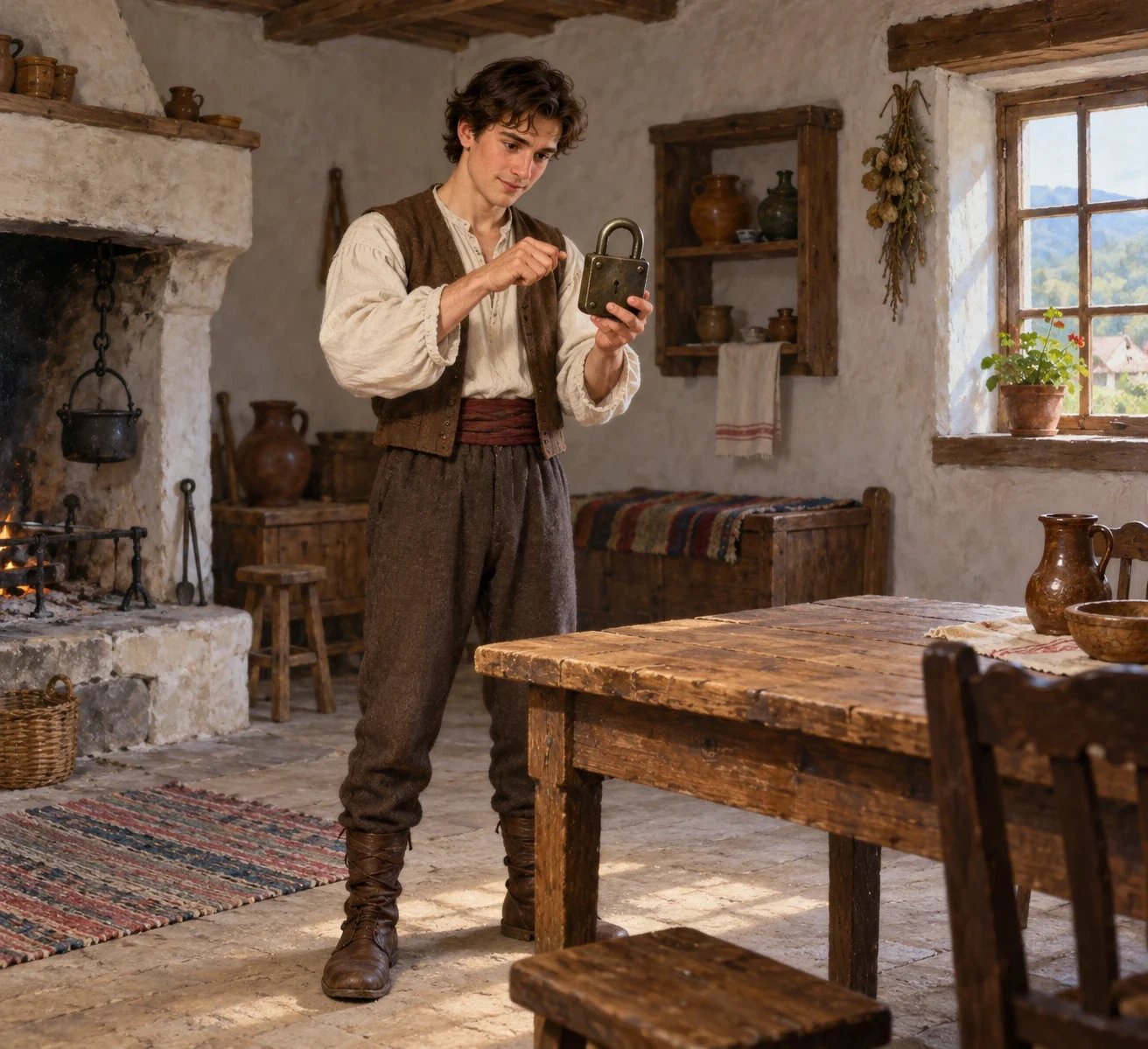
AI-generated interpretation of the wonder-working lock just before its owner knocks to summon the twelve helpers in Wratislaw’s selected 1889 tale. The ordinary padlock design, metal, scale, owner’s appearance, clothing and cottage are editorial choices, not an authenticated historical object or community costume.
AI-generated interpretation of the wonder-working lock just before its owner knocks to summon the twelve helpers in Wratislaw’s selected 1889 tale. The ordinary padlock design, metal, scale, owner’s appearance, clothing and cottage are editorial choices, not an authenticated historical object or community costume.
Overview
The lock comes to an unnamed poor young man through his care for animals. He supports himself and his mother by selling gathered wood. On three journeys he gives up the bread he has bought to save a puppy, a kitten and a beautifully marked snake from shepherds who intend to kill them. He then provides food for the whole household. When the snake grows large, she asks to be taken home and advises him to refuse money in favour of the lock hanging behind her parents’ door. They initially resist giving it away but eventually surrender it as a reward for their daughter’s return.
Knocking on the lock brings out twelve young men who ask for commands. They immediately transport its owner home and provide food for him, his mother, the dog and the cat. The device then enables him to satisfy a king’s increasingly demanding conditions for marrying the princess. Hills become productive wheatfields, with cake ready the next morning; woods become vineyards supplying grapes and new wine. The final commission provides a superior castle, cattle, a covered way to the king’s castle, and a garden with trees and singing birds. These are commanded transformations within the narrative, not properties of an ordinary mechanical lock.
During the prolonged wedding festivities, the king of the sea observes how the device works, steals it while the household sleeps and orders the castle and princess transported to the black sea. The young man and his mother wake in their former cottage. He sets out with the dog and cat to recover what has been taken. The animals cross the water together and cooperate to reach the castle. The cat gains admission because the sea king has a similar-looking cat, then secretly removes the lock. Their cooperation nearly fails when the dog demands to carry it and their quarrel sends it into the water. A fish swallows it, but the cat forces the fish to give it back.
Once the animals return the lock, its owner commands the castle, his wife and the sea king back to the former location. The husband and wife reunite; he then has the sea king put to death in the sea. The ending restores the household through both the lock’s commands and the loyalty of animals originally saved at personal cost. The lock is not said to choose a morally worthy user: the thief successfully commands the same twelve helpers. Its danger lies partly in portability and transferable control. The text supplies neither a particular metal, a key, an inscription nor the exact physical size needed for an authenticated reconstruction.
Origins & earliest records
The selected English account appears in A. H. Wratislaw’s Sixty Folk-Tales from Exclusively Slavonic Sources (London, Elliot Stock, 1889), under the historical heading Croatian Stories. The contents credit M. Krachmanov Valjavets’s National Stories, through the material assembled in K. J. Erben’s 1865 reading-book. Wratislaw explains that he translated selected tales from that anthology, which combined printed collections and previously unpublished stories. The upstream Valjavets and Erben publications have not been independently collated here. The Croatian heading supports a historical source association; it does not establish an individual narrator, precise collection village, exclusive ethnic ownership or a present-day border for the tale’s unnamed setting. This profile follows tale LIV, printed pages 284–289; the contents give Valjavets’s source page as 186.
Records & interpretation
The complete selected narrative and ending, the complete Croatian section introduction and footnote, the original preface and the contents source credit were read from the preserved historical HTML witness. Wratislaw’s comparison of tale 54 with Aladdin and characterization of tale 56 as combining destiny and ingenuity are editorial comparisons, not proof of direct borrowing or historical events. His language and population classifications are retained as nineteenth-century framing rather than imposed as current community identities. No original printed page image or upstream original-language text was independently inspected.
Selected bibliography
Documented works and useful reading. This is not a list of every appearance.
- 01
Sixty Folk-Tales from Exclusively Slavonic Sources
Complete tale LIV, pp.284–289; Croatian introduction pp.265–266 and note18; original preface and contents. Upstream National Stories p.186 credited, not independently read.
Family & connections
A source-supported family tree or inspiration record has not yet been compiled for this profile. Related reading below indicates a connection in subject matter, not a proven lineage or creative influence.
References
Sources supporting this profile. Linked pages have their own scope and editorial standards.
- Historical English translation of a collected narrative through an anthologyWratislaw 1889, complete tale LIV and original framingResearch access: 2026-10-23
Image credits
AI-generated illustrationAI-generated interpretation of the wonder-working lock just before its owner knocks to summon the twelve helpers in Wratislaw’s selected 1889 tale. The ordinary padlock design, metal, scale, owner’s appearance, clothing and cottage are editorial choices, not an authenticated historical object or community costume.
AI-generated interpretation of the wonder-working lock just before its owner knocks to summon the twelve helpers in Wratislaw’s selected 1889 tale. The ordinary padlock design, metal, scale, owner’s appearance, clothing and cottage are editorial choices, not an authenticated historical object or community costume.