
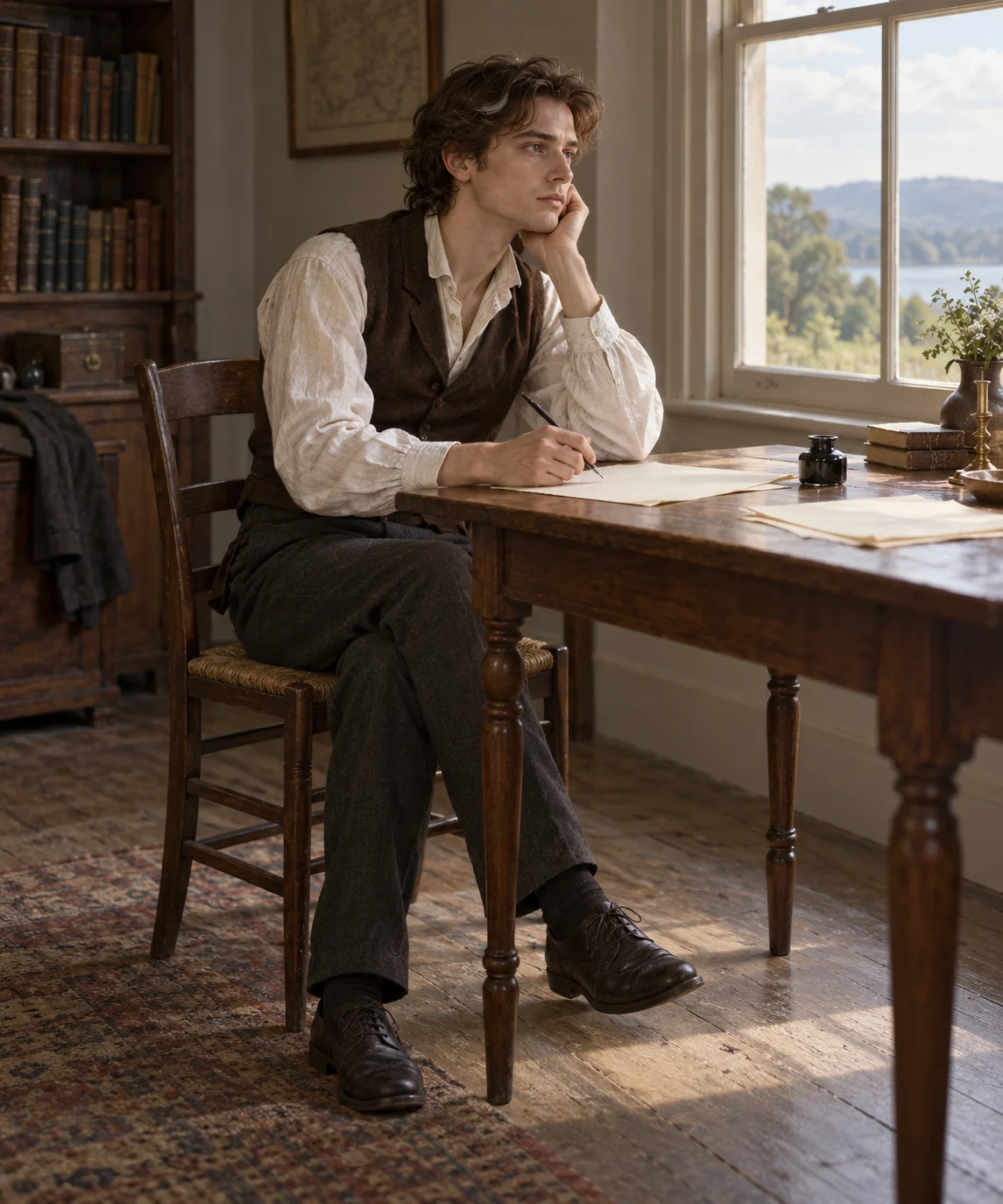
AI-generated interpretation of Shelley’s Winzy writing his account; face, costume and staging are reconstructed, while his condition remains uncertain.
Youthful appearance follows Winzy’s own account; the image supplies no proof of immortality and reconstructs unspecified dress and furnishings.
Overview
Winzy introduces his account on the anniversary of his three-hundred-and-twenty-third year, then immediately questions whether he is truly immortal. He has found a grey hair among his brown locks, but cannot tell whether it marks new decay or has been hidden there for centuries. His story begins as a poor young pupil of Cornelius Agrippa, whose supposed dealings with spirits frighten away his household. Winzy returns to the alchemist’s service to earn enough to marry Bertha. In a jealous moment he drinks half a radiant preparation which he believes will cure his love. Instead, the exhilaration that follows gives him courage to reconcile with her, and they marry. This is Shelley’s fictional Agrippa and potion, not evidence for a historical elixir.
Five years later, the dying Cornelius identifies the preparation as an elixir of immortality. A second batch is destroyed before he can drink it, and the alchemist dies. Winzy alternates between belief and doubt, initially preferring to think that he has received health and longevity rather than endless life. Nevertheless, his whole appearance remains as youthful as it was at twenty: his brow is unlined, his face unchanged and his chestnut hair still young-looking while Bertha ages. Neighbours call him the Scholar bewitched and refuse to buy his farm produce. Rather than abandon Bertha, he leaves with her for a remote part of western France, where he remains her husband and cares for her through her final years.
Bertha’s death removes the connection that Winzy says bound him to humanity. His narrative now presents centuries of isolation, weariness and unreturned affection. Yet his longing for an end coexists with fear of age and death. He wonders whether taking only half the potion has made him merely long-lived, and whether half of an eternity can mean anything finite. At the close he plans a dangerous expedition to test his condition and writes so that his name will not vanish. The account ends before that test takes place. His long survival is therefore central to the fiction, while absolute immortality and invulnerability remain claims he cannot establish.
First appearances & development
Mary Wollstonecraft Shelley’s authored English tale, read as chapter VIII of the explicitly dated 1891 Tales and Stories collection, introduced by Richard Garnett. The diary’s 1833 date belongs to the narrative framing; the retained title supplies the edition date used here.
Canon & continuity
The complete selected tale and its unresolved ending, the dated historical title and Garnett’s complete introduction were read. The introduction is a historical editor’s critical framing, not an endorsement of all its biographical judgments. The collection’s other tales and any original annual printing were not independently read.
Selected bibliography
Documented works and useful reading. This is not a list of every appearance.
- 01
Tales and Stories — VIII. The Mortal Immortal
London: William Paterson & Co.; selected story on pages 148–164. The historical English collection is the consulted version.
Family & connections
A source-supported family tree or inspiration record has not yet been compiled for this profile. Related reading below indicates a connection in subject matter, not a proven lineage or creative influence.
References
Sources supporting this profile. Linked pages have their own scope and editorial standards.
- Primary historical authored fictionTales and Stories — title, introduction and complete Mortal ImmortalResearch access: 2026-10-18
Image credits
AI-generatedAI-generated interpretation of Shelley’s Winzy writing his account; face, costume and staging are reconstructed, while his condition remains uncertain.
Youthful appearance follows Winzy’s own account; the image supplies no proof of immortality and reconstructs unspecified dress and furnishings.