
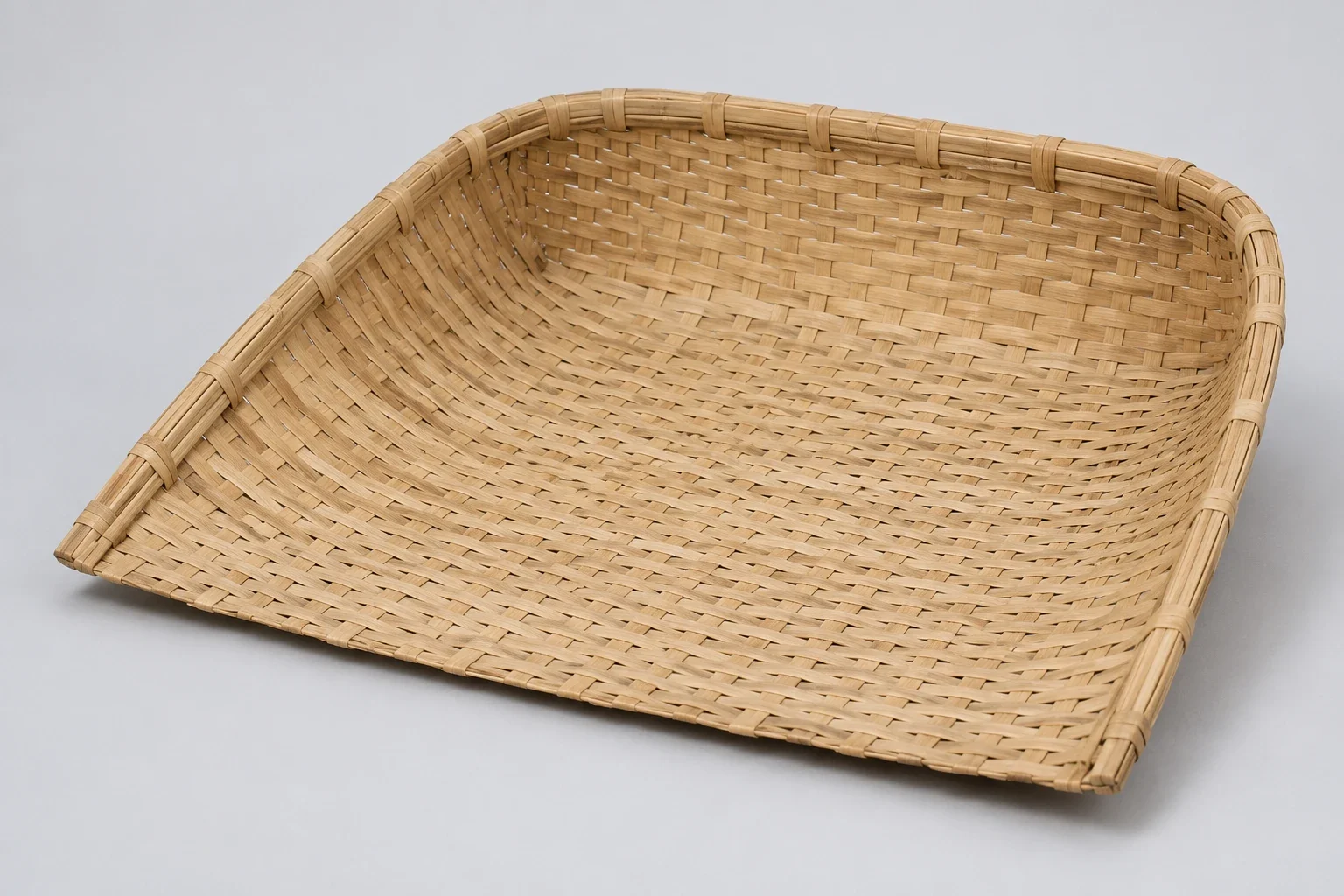
AI-generated material interpretation of a historical description; not a photographed or authenticated specimen.
Overview
Hose and McDougall describe the winnowing pan in their Kayan daily-life account as a mat shaped like a large housemaid’s dustpan. It receives rice after pounding and is worked over a separate mat laid beside the mortar. Their account explains the important relationship between shape and motion: the operator repeatedly tosses the contents so that heavier grain falls toward the back of the pan, while lighter chaff and dust move forward onto the mat. The description supports a broad, shallow holding surface with a front opening, rather than a deep storage basket or a metal scoop. It does not supply a measured outline, separate handle or exact weave pattern for a particular pan.
A second person sieves the material separated onto the mat, distinguishing fine broken rice from the chaff. The source says that broken rice dust is used to feed pigs and that the cleaned grain is commonly returned for further pounding before cooking. Winnowing and pounding are consequently different operations within one preparation sequence: the mortar applies impact, while the pan sorts the resulting mixture through movement and differences in how its components fall. A contextual study of the pan can make that function clear without adding a mechanical fan or portraying a staged household scene.
The authors’ basket-work chapter lists winnowing trays among the household baskets and discusses rattan strips and other plant materials used in basketry. It does not identify the plant species or maker of the pan in the daily-life passage. Plate 128’s charcoal figures offer only general corroboration of this rice-processing setting; rounded carried shapes in that drawing are not treated as a precise specimen photograph. The separately captioned Iban seat-mats and seed-baskets in Plate 43 are not relabelled as Kayan winnowing pans. The profile concerns the documented historical tool and operation, with exact dimensions, binding details and present-day continuity left open.
History & identity
The 1912 work combines Charles Hose’s Sarawak observations with William McDougall’s collaboration and writing; their stated scope is the close of the nineteenth century.
Sources & representation
Complete selected Kayan daily-life and basketry passages, both prefaces and 1912 title viewed; Plate 128 supplies general process corroboration, not a measured tool specimen.
Selected bibliography
Documented works and useful reading. This is not a list of every appearance.
- 01
The Pagan Tribes of Borneo
London: Macmillan; volume I, chapter VII pp. 118–119; selected basket-work account and Plate 128.
Language & cultural connections
Source-supported language and cultural connections have not yet been compiled for this profile.
References
Sources supporting this profile. Linked pages have their own scope and editorial standards.
- Original historical field accountThe Daily Life of a Kayan Long House; Basket-workResearch access: 2026-10-21
- Original historical illustrationVolume I, 1912, general charcoal drawing Plate 128Research access: 2026-10-21
Image credits
AI-generatedAI-generated material interpretation of a historical description; not a photographed or authenticated specimen.