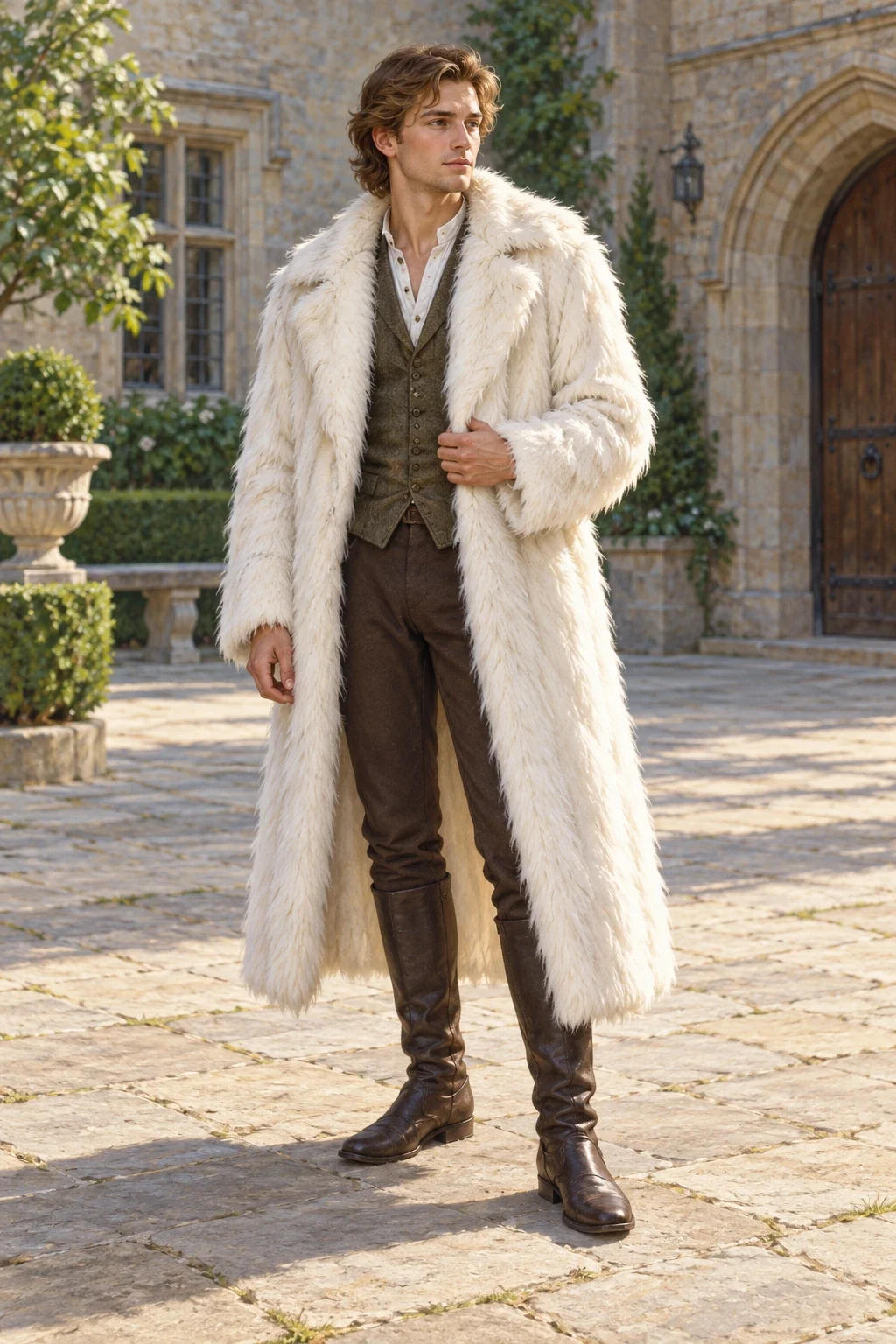
Portrayal of the White Wolf’s revealed human state.
AI-generated portrayal of the source’s revealed human state before pelt burning. Fur-garment construction, face, clothes and courtyard are interpreted.
Overview
In Brugman’s White Wolf tale, a king returning from Wilna finds the flower covering his youngest daughter requested upon a white wolf’s head. The wolf refuses money and instead demands whatever first comes to meet the king. That turns out to be the daughter herself. An attempted substitution of a chambermaid fails when the wolf questions her about how her father would use a forest. The princess is sent in her place, takes the flower covering with her and is carried to the suitor’s estate. There the narrative states that he is not truly a wolf but a handsome young gentleman wearing a wolf-pelt. It does not identify a biological wolf species or explain the precise mechanism of every appearance.
After six months he takes her to her eldest sister’s wedding and tells her to return immediately at his whistle, which she does. At a second family wedding they stay overnight. Her mother sees him put off the pelt, revealing the gentleman, and orders servants to burn it. He disappears with a storm-like rush and returns to his own estate without the princess. Her search leads successively to the Wind, a star, the Moon and the Sun. They give her increasingly powerful travelling shoes; the Sun also provides a spinning wheel and directions for reaching the estate beyond a glass mountain. The search is chiefly the princess’s work rather than an exploit the gentleman performs himself.
He has meanwhile chosen another bride. The princess enters service in disguise and exchanges her silk-producing spinning wheel for a night beneath his bed, but a sleeping draught prevents him from hearing her account. Wakeful doorkeepers repeat it to him, and he recognises that his former wife has returned. At the proposed wedding he asks the guests whether an old recovered key or its replacement is preferable, then dismisses the second bride and reunites with his first wife. The tale provides this recognition ending without naming the gentleman, explaining the origin of the pelt or describing a permanent liberation by a kiss. Comparative variants are not used to supply those missing details.
Origins & earliest records
German XXIII, corresponding to Lithuanian original V, teller E: Eva Baugüte of Roželen, in Brugman’s Godlewa collection.
Records & interpretation
Complete German tale, pp. 438-443, footnote and complete Wollner comparative note; original V retained and header binding inspected; full collection/translation framing read.
Selected bibliography
Documented works and useful reading. This is not a list of every appearance.
- 01
Litauische Volkslieder und Märchen aus dem preussischen und dem russischen Litauen
German XXIII, pp. 438-443; original V, teller E; full comparative note retained separately. Original Strassburg, Karl J. Trübner edition; German translation is the narrative basis.
Family & connections
A source-supported family tree or inspiration record has not yet been compiled for this profile. Related reading below indicates a connection in subject matter, not a proven lineage or creative influence.
References
Sources supporting this profile. Linked pages have their own scope and editorial standards.
- Historical collected Lithuanian narrative in original German translationLeskien and Brugman 1882 original bilingual collectionResearch access: 2026-10-18
Image credits
AI-generatedPortrayal of the White Wolf’s revealed human state.
AI-generated portrayal of the source’s revealed human state before pelt burning. Fur-garment construction, face, clothes and courtyard are interpreted.