
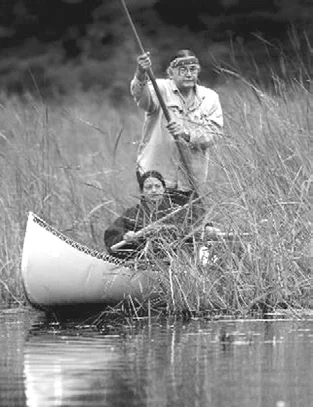
Two people in a canoe among tall wild-rice plants, one seated near the bow and one standing with a long pole, identified by the original caption as White Earth tribal members.
White Earth tribal members harvesting wild rice, as identified in the original conservation-plan caption. The photograph records this particular activity; it does not portray every member or community practice. Photograph credited to FWS.
Overview
White Earth is a particular Anishinaabe nation in Minnesota, not a name for all Ojibwe people. Its public history locates the reservation in Becker, Clearwater and Mahnomen counties and dates its establishment by treaty to 1867. That administrative date does not mark the beginning of Anishinaabe life. The account challenges histories that begin only with European arrival and identifies Indigenous authorship as essential: William W. Warren’s work drew on conversations with elders, while reservation newspapers The Progress and The Tomahawk recorded community events and traditions. It also recognizes that written sources, archaeology and oral history each contribute knowledge without providing an exhaustive picture of the past.
The nation’s Cultural Division describes an ongoing effort to integrate culture into programmes, schools and events. Language use is a central concern, alongside outreach involving beadwork, quillwork and other arts. Its stated remit connects community history with land, food, gardens and the economy, rather than confining culture to performances or museum objects. The division also directs learners toward language resources intended for people in different schools and places of residence. These are public institutional commitments; participation and language ability vary, and neither is treated here as a test of political membership.
White Earth Tribal and Community College dates its establishment by the Tribal Council to September 1997 and its first classes to the following month, when fourteen tribal students entered a two-room building in Mahnomen. Its mission links higher education with Anishinaabe culture and language, and its purpose includes community service and self-determination. Lifelong learning is presented as engagement both with academic disciplines and with community traditions. The college’s public values statement applies principles such as respect and honesty to everyday relationships in study and work. This is the institution’s educational framework, not a claim that all community members interpret those principles identically.
The college’s Community Extension page makes some of that practical work visible through public event notices and resource listings. A September 2026 seed-keeping meeting offered instruction and hands-on experience; the page also lists materials on tomato seed saving, winter sowing and fruit-tree growing systems. These notices document educational offerings, rather than proving attendance or agricultural outcomes. They place continuing community learning beside formal college programmes. The underlying guides, historical newspaper issues and Warren’s book have not been read for this profile, so their contents are not represented as independently examined evidence.
History & identity
White Earth and tribal-college public accounts; reservation chronology distinguished from Indigenous history.
Sources & representation
Complete history and cultural-division bodies, college establishment and purpose sections, and extension notices/resource descriptions read.
Selected bibliography
Documented works and useful reading. This is not a list of every appearance.
- 01
White Earth Nation: History
Community institutional account
Language & cultural connections
These connections link languages or specific cultural works and institutions; they do not establish biological ancestry or ethnic identity.
White Earth Tribal and Community College
The Tribal Council established the college in 1997; its educational mission centers Anishinaabe culture.
References
Sources supporting this profile. Linked pages have their own scope and editorial standards.
- Community institutional accountWhite Earth Nation: CultureResearch access: 2026-10-06
- Community institutional accountAbout White Earth Tribal and Community CollegeResearch access: 2026-10-06
- Community institutional accountWETCC Community ExtensionResearch access: 2026-10-06
Image credits
FWS documentary photograph of specifically captioned White Earth tribal members harvesting wild riceTwo people in a canoe among tall wild-rice plants, one seated near the bow and one standing with a long pole, identified by the original caption as White Earth tribal members.
White Earth tribal members harvesting wild rice, as identified in the original conservation-plan caption. The photograph records this particular activity; it does not portray every member or community practice. Photograph credited to FWS.