
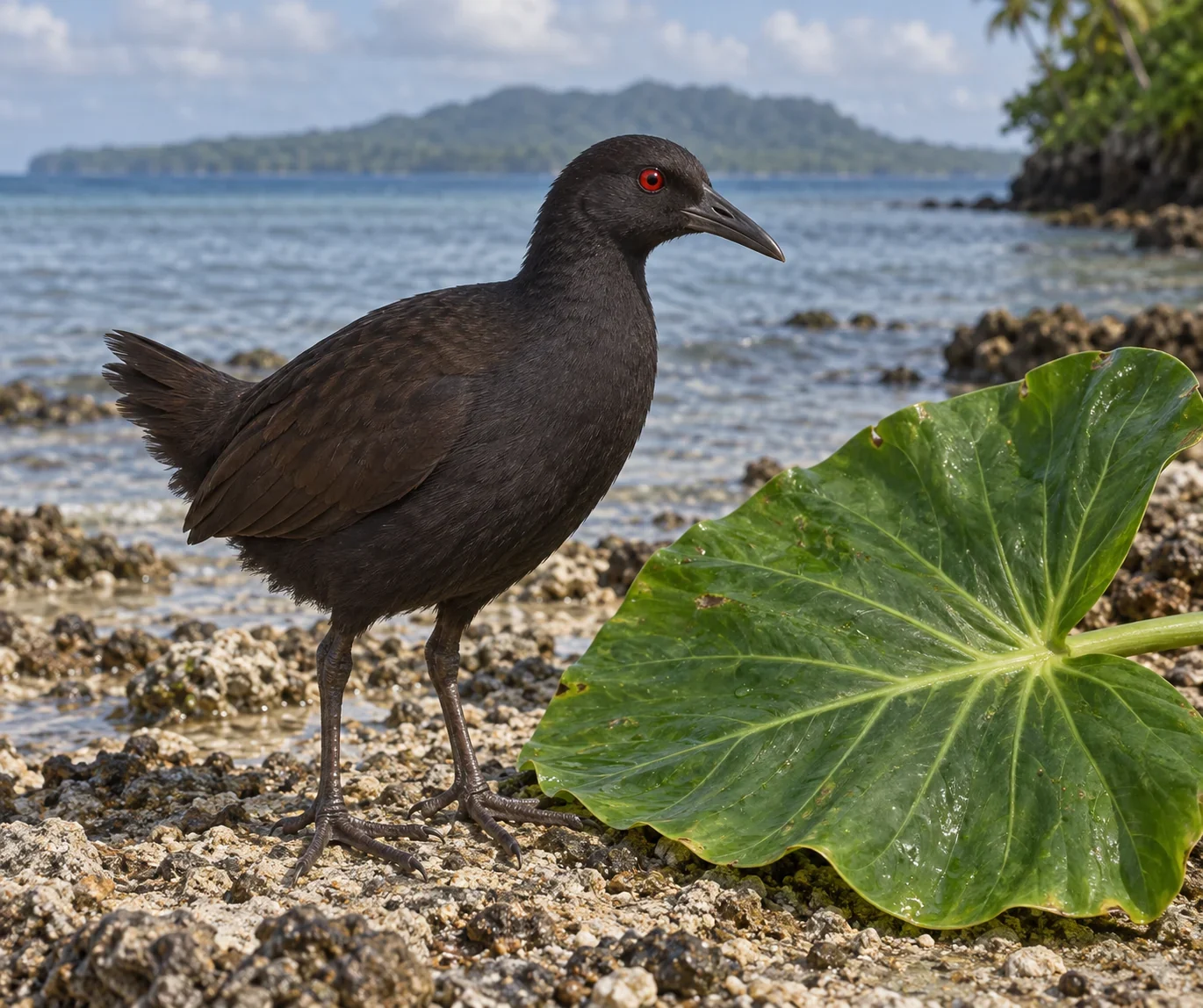
Imagined whole bird for Weru in the Mota canoe story.
Unofficial AI interpretation. Selected narrative bird form; exact species, plumage details and scene arrangement imagined.
Overview
Weru is the bird who repeatedly warns a hermit crab and then searches for him after a leaf canoe sinks in Codrington’s Mota voyage story. The party plans to travel to Qakea to eat tawan fruit. A green parrot, another bird and a pigeon insist on joining, while the crab argues that he can eat fallen fruit beneath the trees even though he cannot climb. Weru gives him a place nearby and warns him against shuffling his claws on the canoe, which is made from a giant arum leaf.
The crab disregards the warning and pierces the leaf. Water enters, and the travellers jump overboard. Most swim to shore; the crab sinks and travels along the seabed. Another version mentioned within the printed account makes the crab puncture the canoe while bailing it. These are two mechanisms for the same wreck, not evidence that the crab deliberately attacks the other passengers. Weru’s repeated caution explains why the later rescue effort carries particular urgency.
On shore, the passengers believe the crab missing and ask who will look for him. Others refuse, but Weru volunteers. She repeatedly swims and dives without finding him, becoming dark-bodied and red-eyed through the effort. The crab has already reached land, so her unsuccessful search results from mistaken information rather than a confirmed drowning. When he emerges, the group learns that everyone has survived. The narrative then turns to mutual grooming and the owl’s dispute with the rat; these later incidents do not belong to Weru’s rescue alone.
The English presentation identifies Weru parenthetically as eulabeornis and describes her changed body and eyes. This supplies a bird identity and a narrative explanation of appearance, rather than a reliable modern species diagnosis. The proposed portrait therefore uses an imagined whole bird whose dark body and red eyes follow the selected episode. Exact proportions, feathers and shoreline plants are artistic choices. Codrington’s collection mediates the story through a nineteenth-century English witness; it does not establish that every present-day Mota resident shares one belief or that real diving physically causes this colour pattern.
Origins & earliest records
R. H. Codrington, The Melanesians: Studies in their Anthropology and Folklore, 1891. Selected historical English presentation; collection date is not the tradition’s origin.
Records & interpretation
Retained original narrative inspected; own prose distinguishes the selected variant and leaves exact zoological identity unclaimed.
Selected bibliography
Documented works and useful reading. This is not a list of every appearance.
- 01
The Melanesians: Studies in their Anthropology and Folklore
Selected original narrative.
Family & connections
A source-supported family tree or inspiration record has not yet been compiled for this profile. Related reading below indicates a connection in subject matter, not a proven lineage or creative influence.
References
Sources supporting this profile. Linked pages have their own scope and editorial standards.
- Primary historical textThe Melanesians: Studies in their Anthropology and Folklore
Image credits
Unofficial modern AI interpretationImagined whole bird for Weru in the Mota canoe story.
Unofficial AI interpretation. Selected narrative bird form; exact species, plumage details and scene arrangement imagined.