
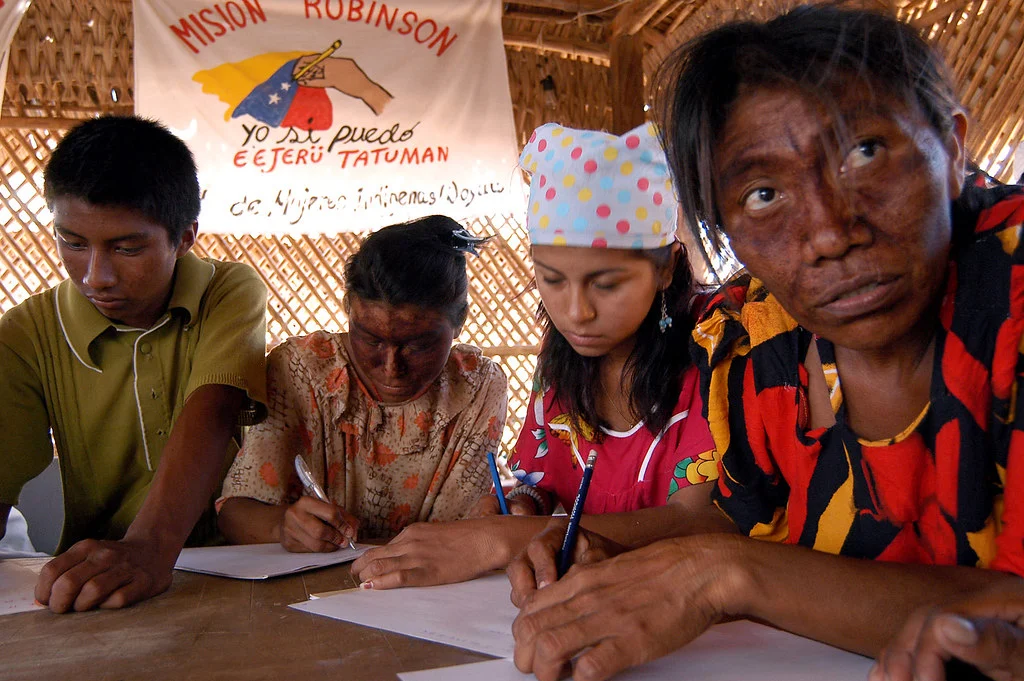
Wayuu participants writing during a Mision Robinson literacy class in Casusai, Zulia, Venezuela, photographed by Franklin Reyes in 2004
Franklin Reyes identifies this scene as Wayuu participants learning to read and write through Mision Robinson in Casusai, Zulia, in May 2004. It records one educational setting in Venezuela, rather than a representative appearance, a measure of literacy among all Wayuu, or an endorsement of the programme.
Overview
The Wayuu live across the La Guajira peninsula in northern Colombia and northwestern Venezuela. ONIC’s profile describes rancherías, extended-family settlements and mobility connected with seasonal conditions and work. Wayuunaiki belongs to the Arawak language family; linguistic classification is distinct from state citizenship or biological descent. The profile also describes fishing, herding, cultivation, trade and textile work, showing several livelihoods rather than a single occupational stereotype. It compiles Colombian government and craft-institution accounts, so its publication by an Indigenous organization does not make every passage an independently recorded Wayuu testimony.
Matrilineal clan relationships are important to the social accounts used here. Colombia’s cultural-heritage description explains the work of pütchipü’üi, mediators known in Spanish as palabreros. Parties in a dispute seek an experienced intermediary who opens negotiation and helps arrange compensation and reconciliation. The description places maternal uncles in this respected role and connects authority with ethical conduct. It also identifies the autonomous Junta Mayor de Palabreros Wayuu, formed in 2008, as responsible for developing the safeguarding plan with cultural workers, educators and traditional authorities. Recognition of the normative system in 2010 records an international heritage designation; it does not date the origin of Wayuu law.
Textile practice is another form of knowledge and expression. ONIC’s account differentiates types of bags, hammocks and patterned weaving, and relates designs to names and meanings. These selected descriptions cannot catalogue the work of every maker or establish that all Wayuu households follow identical practices. Nor should older census and speaker figures embedded in that 2016 page be repeated as present-day counts.
Wayuu cultural expression also includes individually authored poetry and public intellectual work. The Medellín poetry festival identifies Miguel Ángel López, writing as Vito Apüshana, with Carraipia near Maicao and presents his poetry alongside an author statement. His reflections connect poetic language with collective memory while maintaining the difference between language and the experience it evokes. The festival selection reaches into encounters with other Indigenous worlds; those literary voices must not be converted into ethnographic proof that all the represented peoples share one belief system. Its listing of Encuentros en los senderos de Abya Yala offers a named literary route, while the selected poems remain the work of a particular author rather than anonymous testimony from an entire people.
Estercilia Simanca Pushaina offers a contrasting personal position in her 2024 essay ¿Por qué no soy oralitora? She identifies herself as a lawyer and writer of the Wayuu people while explaining that she thinks and writes in Spanish. Her refusal of the label oralitora concerns her own literary practice, not a denial of belonging. The essay connects fiction with her legal advocacy and criticism of institutional failures to listen. It also acknowledges her Afro-Colombian paternal inheritance. Its ending revisits language transmission through a grandmother teaching the author’s daughter Wayuunaiki under different family circumstances. This is an individual account of changing relationships across generations, not a universal definition of Wayuu authorship or a requirement that every writer reproduce traditional narratives.
History & identity
Living communities and ancestral territory are distinguished from present national borders and the 2010 heritage listing.
Sources & representation
ONIC regional profile and its stated source credits; complete Colombian heritage-page body; selected festival poems and complete author biography/statement. No full poetry-volume reading is claimed. Complete2024 essay read; original opening and ending pages inspected.
Selected bibliography
Documented works and useful reading. This is not a list of every appearance.
- 01
Encuentros en los senderos de Abya Yala
Named in the festival selection; publication date of the complete volume not independently verified.
- 02
¿Por qué no soy oralitora?
Boletín Cultural y Bibliográfico58(107),18–31; complete essay and notes read.
Language & cultural connections
Source-supported language and cultural connections have not yet been compiled for this profile.
References
Sources supporting this profile. Linked pages have their own scope and editorial standards.
- Indigenous organization compilationONIC Wayuú profile,3May2016Research access: 2026-10-05
- Cultural heritage institutionWayuu normative system and safeguarding organizationResearch access: 2026-10-05
- Author and literary institutionVito Apüshana, festival selection and author statementResearch access: 2026-10-05
- Author testimonySimanca Pushaina:2024 essayResearch access: 2026-10-06
Image credits
Contextual community education photographWayuu participants writing during a Mision Robinson literacy class in Casusai, Zulia, Venezuela, photographed by Franklin Reyes in 2004
Franklin Reyes identifies this scene as Wayuu participants learning to read and write through Mision Robinson in Casusai, Zulia, in May 2004. It records one educational setting in Venezuela, rather than a representative appearance, a measure of literacy among all Wayuu, or an endorsement of the programme.