
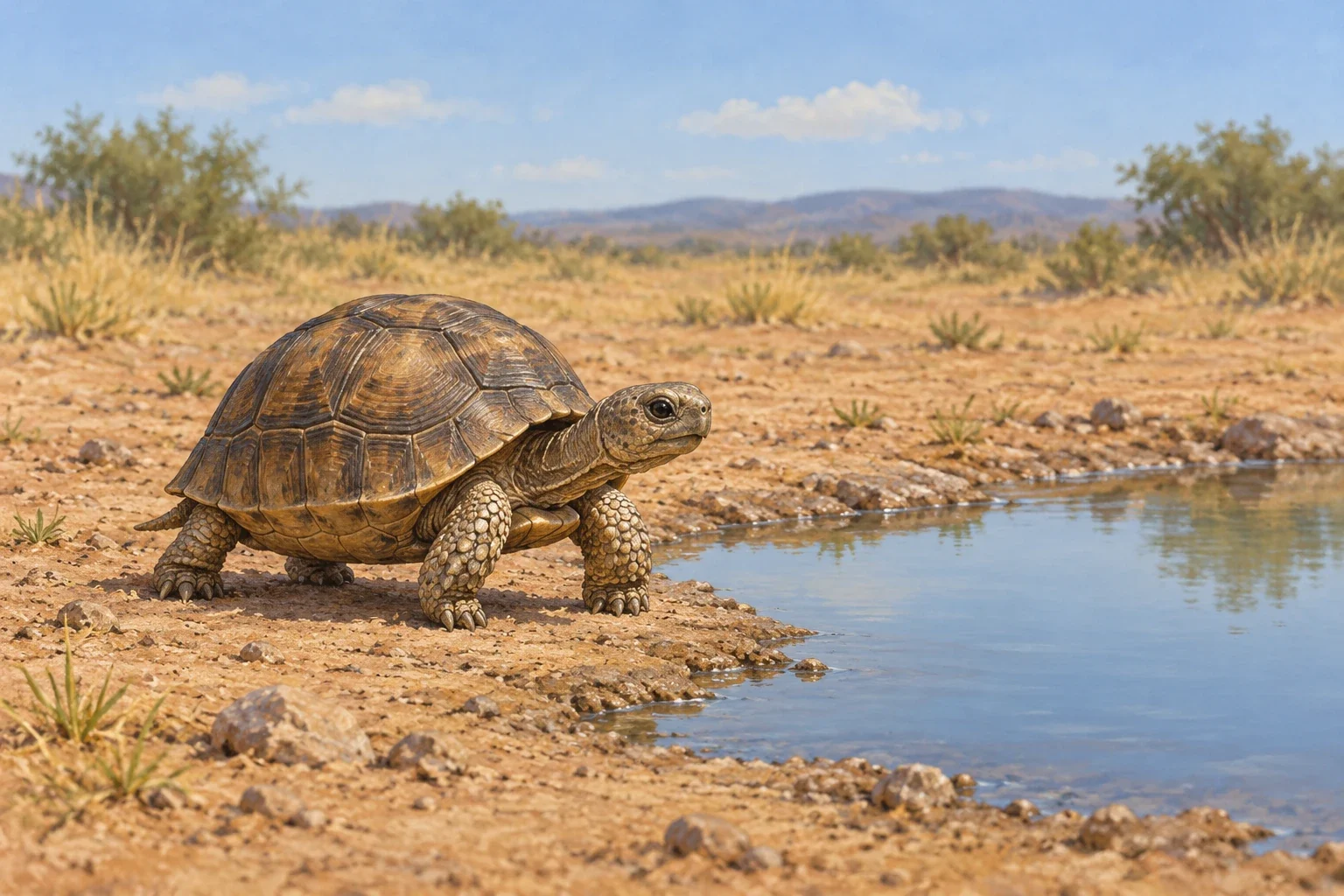
AI narrative interpretation of The Water-Guardian Tortoise in Rath’s Fable in Bleek’s Reynard the Fox in South Africa (1864).
AI interpretation of the little Tortoise guarding the Elephant’s water in Bleek’s fable14, attributed to Rath’s Herero-language manuscript. Species-like anatomy, shell, colors and the unlocated quiet waterbank are invented; no biological species or authenticated traditional icon is identified.
Overview
After the Elephant disputes his dependence on Rain, Rain leaves. A Vulture refuses his request to cast lots for rain, but a Crow agrees and rain falls. The lagoons gradually dry until only one remains. Before going hunting, the Elephant leaves the Tortoise at this water. A succession of thirsty animals asks for a drink, and the Tortoise repeatedly answers that the water belongs to the Elephant.
The Giraffe, Zebra, Gemsbok, Wildebeest, Roodebok, Springbok and Jackal receive that answer. When the Lion arrives, however, he seizes and beats the little Tortoise before it can respond. The Lion drinks, and the narration makes this the beginning of the animals’ access to water. The Tortoise does not voluntarily give the water away or defeat the Lion.
Returning from the hunt, the Elephant learns that the animals have drunk. He asks whether he should chew the Tortoise or swallow it; the Tortoise requests swallowing and is taken down whole. Inside, it tears off the Elephant’s liver, heart and kidneys, killing him. The Tortoise emerges from the dead body and goes wherever it wishes. The fable reports this extraordinary survival without supplying a separate spell, magical shell or explanation of its bodily mechanics.
This profile covers the Tortoise in fable 14 alone. Its manuscript-language attribution is retained separately from Bleek’s conjecture that the story came from a different tradition. The waterhole is unlocated, and no exclusive modern national origin, biological species or general community belief is established.
Origins & earliest records
Fable 14, The Elephant and the Tortoise, in Bleek’s Reynard the Fox in South Africa (1864), printed pp. 27–29; the heading identifies J. Rath’s manuscript pp. 27, 29.
Records & interpretation
Bleek’s 1864 edited English publication identifies J. Rath’s manuscript, pp. 27, 29, in the language labelled o Tyi-hereró or Damara. The preface says these original-language pieces were written down by unnamed contributors, copied by Rath and accompanied by his German translation. Bleek acknowledges omissions and alterations for English readers and a translation that is not exactly literal. Neither the original manuscript nor an oral performance has been independently collated.
Selected bibliography
Documented works and useful reading. This is not a list of every appearance.
- 01
Reynard the Fox in South Africa
Bleek’s 1864 edited English publication identifies J. Rath’s manuscript, pp. 27, 29, in the language labelled o Tyi-hereró or Damara. The preface says these original-language pieces were written down by unnamed contributors, copied by Rath and accompanied by his German translation. Bleek acknowledges omissions and alterations for English readers and a translation that is not exactly literal. Neither the original manuscript nor an oral performance has been independently collated.
Family & connections
A source-supported family tree or inspiration record has not yet been compiled for this profile. Related reading below indicates a connection in subject matter, not a proven lineage or creative influence.
References
Sources supporting this profile. Linked pages have their own scope and editorial standards.
- primaryBleek 1864 — fable 14 and complete preface with Rath manuscript contextResearch access: 2026-10-21
Image credits
AI-generatedAI narrative interpretation of The Water-Guardian Tortoise in Rath’s Fable in Bleek’s Reynard the Fox in South Africa (1864).
AI interpretation of the little Tortoise guarding the Elephant’s water in Bleek’s fable14, attributed to Rath’s Herero-language manuscript. Species-like anatomy, shell, colors and the unlocated quiet waterbank are invented; no biological species or authenticated traditional icon is identified.