
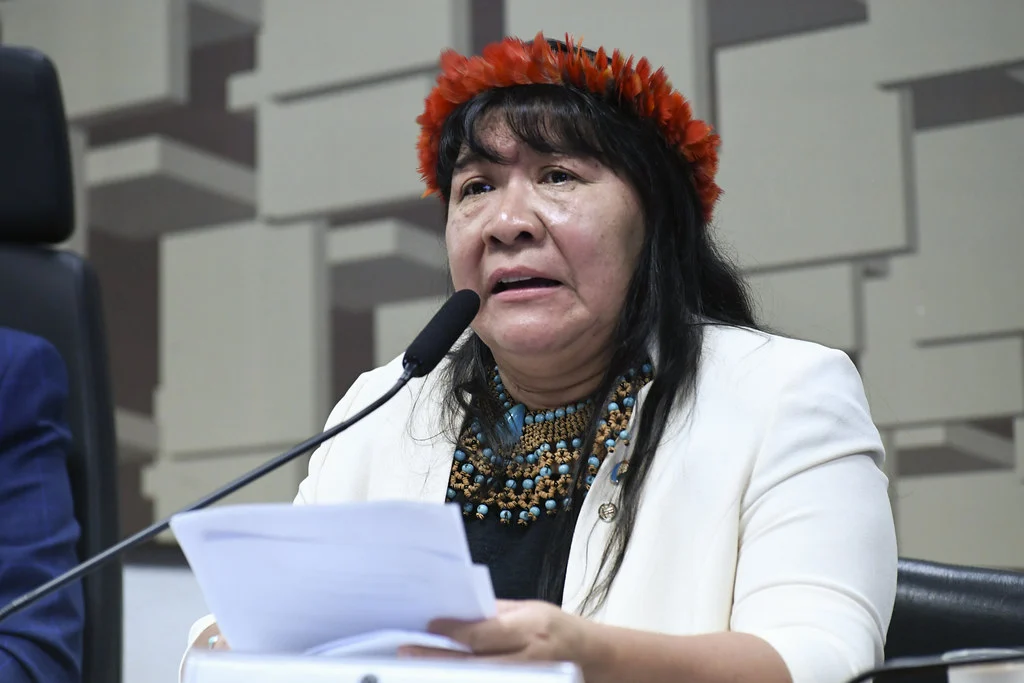
Joenia Wapichana speaks into a microphone while holding papers at a Senate hearing, wearing a white jacket, red feather headband and necklaces.
Joenia Wapichana at the Senate’s CTEYANOMAMI public hearing on 29 March 2023, when she was president of Funai. The photograph documents her public work at that event, not a representative appearance or political position of all Wapichana people.
Overview
Wapichana communities live in the borderlands of Brazil and Guyana, including the Branco, Tacutu and Rupununi regions. Their language belongs to the Arawakan family, a linguistic relationship that does not make all Arawakan-speaking peoples one ethnic community. Instituto Socioambiental describes different experiences of multilingualism and language transmission in settlements near towns and those connected through kinship across the border. Its cited surveys belong to particular decades; they are not current speaker counts. Colonial boundaries divide a region of continuing relationships, while national citizenship, residence, language proficiency and community affiliation remain distinct matters.
A July 2026 report from the Conselho Indígena de Roraima documents language work involving fluent Wapichana teachers and community leaders at Canauanim. The meeting concerned validation of a Portuguese-to-Wapichana constitutional translation project, while the organization also presented translations of ILO Convention 169 in Wapichana and Macuxi. The report describes planned editing and distribution after validation, so it should not be read as proof that every announced edition was already available. It demonstrates language use in public institutions and collective advocacy; the translations themselves are not reproduced or independently evaluated here.
The same organization’s communications history records Wapichana participation within a broader, multi-people network. It names Davison Buckley and Mayra Wapichana among earlier contributors and describes the development of the Wakywaa network through training and community nomination. Participants chose its Wapichana name in 2020 after discussing alternatives in both Wapichana and Macuxi. News production, photography and digital communication therefore appear as community activities with their own institutional histories. CIR represents multiple peoples; its communications team cannot be treated as a government or cultural voice belonging exclusively to the Wapichana.
Literature also has identifiable contemporary authors. The Brazilian Chamber of Deputies’ library introduction presents Cristino Wapichana as a storyteller, writer, musician and filmmaker born in Boa Vista. It credits A boca da noite to him with illustrations by Graça Lima and gives its 2016 publication, alongside later books and educational work. Naming writer and illustrator helps distinguish creative authorship from a general description of community belief. The library’s bibliographic account is the source used here, rather than a claimed complete reading of the book or viewing of the linked author event.
History & identity
Branco–Rupununi regional histories predate the national border; linguistic classification is not treated as biological descent.
Sources & representation
ISA selected geography/language sections; complete CIR translation and communications bodies; complete Chamber library author introduction. No current speaker counts or full linked legal/book/video inspection claimed.
Selected bibliography
Documented works and useful reading. This is not a list of every appearance.
- 01
A boca da noite
Bibliographic reference confirmed by Chamber library page; complete book not read.
Language & cultural connections
Source-supported language and cultural connections have not yet been compiled for this profile.
References
Sources supporting this profile. Linked pages have their own scope and editorial standards.
- Research organizationInstituto Socioambiental: WapichanaResearch access: 2026-10-05
- Indigenous organizationCIR: translation-validation meeting,17July2026Research access: 2026-10-05
- Indigenous organizationCIR: communications historyResearch access: 2026-10-05
- LibraryChamber of Deputies library: Cristino WapichanaResearch access: 2026-10-05
Image credits
Documentary photograph of a named Wapichana public figure at a specifically dated public hearingJoenia Wapichana speaks into a microphone while holding papers at a Senate hearing, wearing a white jacket, red feather headband and necklaces.
Joenia Wapichana at the Senate’s CTEYANOMAMI public hearing on 29 March 2023, when she was president of Funai. The photograph documents her public work at that event, not a representative appearance or political position of all Wapichana people.