
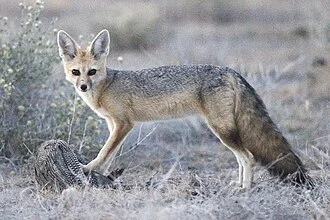
A pale Cape fox standing on dry open ground.
Cape fox photographed in Etosha National Park, Namibia.
Overview
ADW describes silver-grey pelage, a reddish head and forelimbs, pale cheek and underside markings and a bushy tail. Open arid savanna and semi-desert scrub provide habitat, while forest is generally avoided.
The 2019 account records southern Angola, Botswana, Namibia, South Africa and southwestern Zimbabwe. Small mammals and insects dominate foods, alongside birds, reptiles and fruit. Tawny ear backs and white anterior ear-margin hairs aid identification.
Solitary behaviour predominates, with occasional feeding gatherings and nonexclusive scent marking. ADW describes initial parental care by both adults.
Origins & earliest records
The 2019 account gives the name as Vulpes chama (Smith, 1833); this records formal naming, not when the species arose.
Evidence & interpretation
Institutional and 2019 scientific species accounts.
Selected bibliography
Documented works and useful reading. This is not a list of every appearance.
- 01
Vulpes chama (Carnivora: Canidae)
Selected bibliography; Mammalian Species account.
Family, evolution & connections
Taxonomic classification
A hierarchy of classified groups, not a chain of direct ancestors.
Source note: Phenotypic resemblance is not a molecular sister-species finding.
- OrderCarnivora
- FamilyCanidae
- SpeciesVulpes chama
References
Sources supporting this profile. Linked pages have their own scope and editorial standards.
- Institutional species accountCape fox: ADW accountResearch access: 2026-10-07
- Scientific species accountCape fox: Mammalian Species (2019)Research access: 2026-10-07
Image credits
Attributed biological photographA pale Cape fox standing on dry open ground.
Cape fox photographed in Etosha National Park, Namibia.