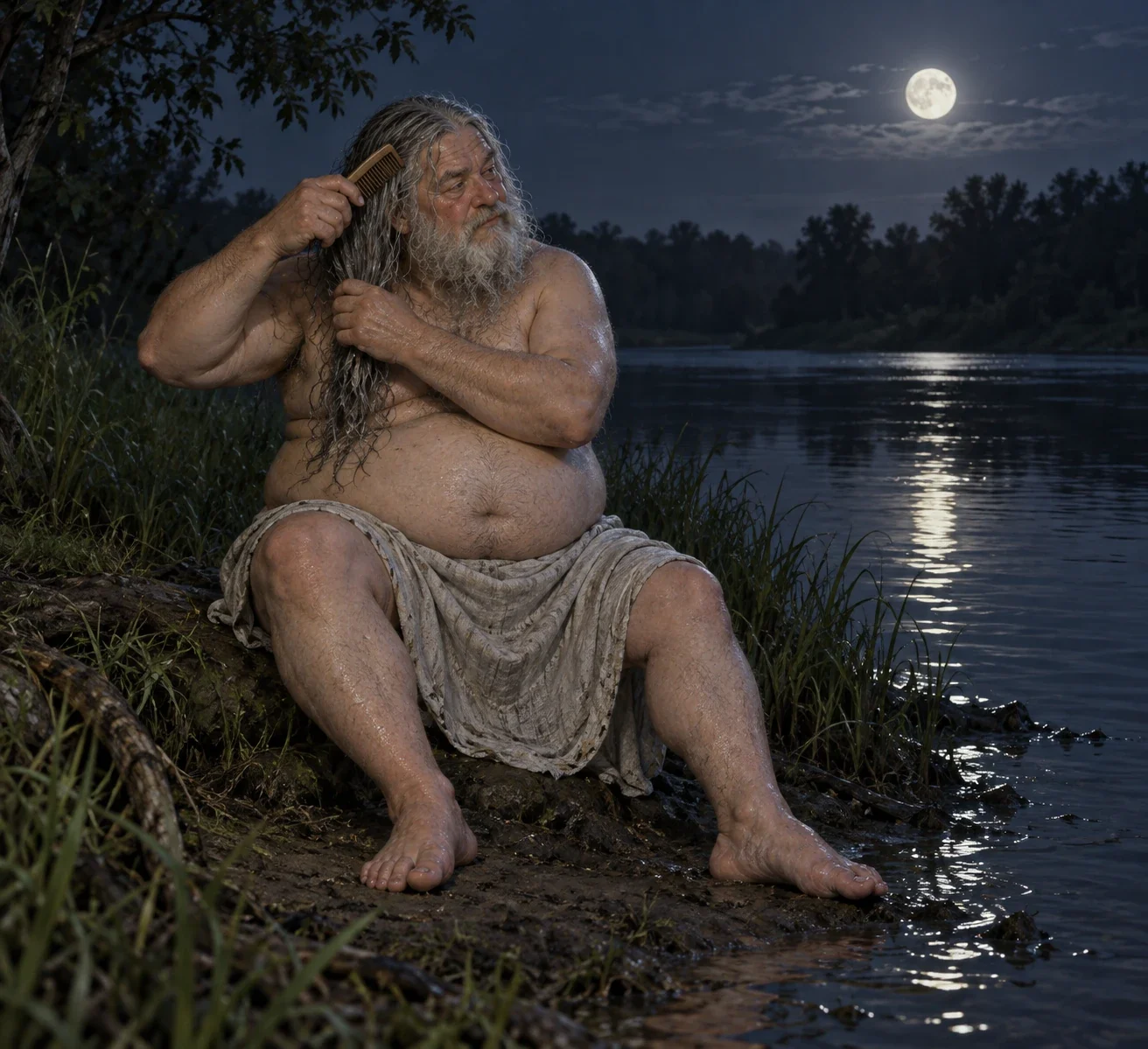
AI-generated interpretation of Ralston’s old-man Vodyany; cloth covering, face, hair and setting imagined. Other forms and regional reports differ.
Interpretation of the principal old-man form in Ralston’s selected account. Covering cloth is a modesty convention; face, hair, colour and exact landscape imagined. Regional variants and alternate bodies remain separate. No game artwork used.
Overview
Ralston’s 1872 Songs of the Russian People describes the Vodyany as a male water-spirit associated with rivers, lakes, pools and sometimes swamps. Millstreams are especially favoured, and the miller’s prosperity is said to depend on knowing how to deal with their supernatural inhabitants. Ralston distinguishes these spirits from the storybook Water King and his beautiful daughters. His statements about what peasants believe belong to this nineteenth-century compilation, rather than establishing a universal or present-day Russian belief.
The principal appearance is an unclothed old man with a large belly and swollen face, fond of drinking and card-playing. The account also gives him underwater property, livestock, a wife and children. Other appearances must remain separate: a visitor in ordinary human guise betrays himself by dripping water and leaving a wet seat; another episode has a seemingly dead body laugh and leap from a fisherman’s boat. Ralston also reports fish transformation, especially into a pike, and a merman-like form. These are alternatives in a collected discussion, not instructions for assembling one body with every feature.
His dealings with people are dangerous but not uniformly hostile. A captured water-child is returned to its father, who honours a promise to send fish into the captors’ nets. Elsewhere the spirit tears fishing nets or tries to drag a hunter under water. One complete embedded story follows a drowned woman who lives with a water-spirit, revisits her village and finds that nobody recognizes her. She returns to the water; two days later her mutilated body appears while the spirit laments. The account preserves that ending rather than supplying a rescue or reconciliation.
Regional reports and offerings give the figure a wider setting. Ralston separately attributes to Bohemia the image of a shore-dweller using coloured ribbons to lure children. His discussion associates the spirit’s winter sleep and hungry spring awakening with propitiatory offerings, including animals and oil, and relates underwater wedding revels to violent water and damaged mill-dams. These are reported explanations and practices, not confirmed supernatural causes or advice to follow. The selected passage does not establish that every Vodyany is a drowned human, nor that a Witcher Drowner reproduces its anatomy, household or ritual associations.
Origins & earliest records
W. R. S. Ralston, The Songs of the Russian People (London: Ellis & Green, 1872), complete selected Vodyany discussion, pp. 148–153. A literary compilation with cited earlier scholarship, not a verbatim named performance transcript.
Records & interpretation
Complete passage from The traditions of the Russian peasants on p. 148 through summer months on p. 153 read in extracted text and all six original scanned pages. The preceding noon-spirit passage and following Lyeshy passage are outside this profile. Entire volume retained, not claimed read in full.
Selected bibliography
Documented works and useful reading. This is not a list of every appearance.
- 01
The Songs of the Russian People: As Illustrative of Slavonic Mythology and Russian Social Life
London: Ellis & Green. Selected Vodyany account pp. 148–153. Retained scan title page explicitly dated 1872; no edition ordinal inferred.
Family, evolution & connections
Drowner (The Witcher)
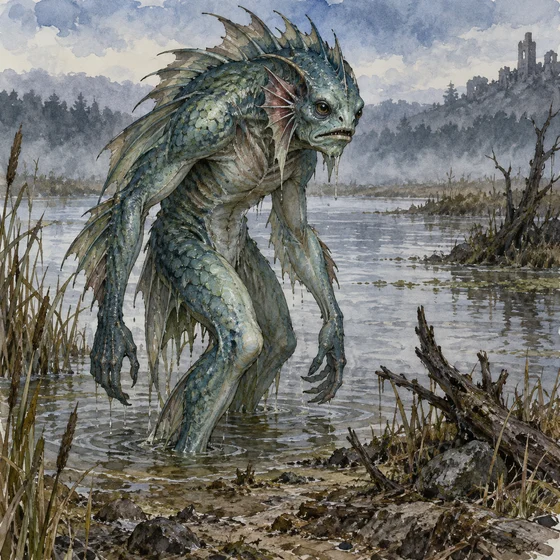
Drowners are aquatic humanoid scavengers and pack predators whose corpse-like appearance encourages an origin belief that later Witcher game lore explicitly disputes. Ralston’s Vodyany account instead includes fishing bargains, underwater households and several alternative appearances. This compares water-danger motifs; no creator-source route or identical anatomy is established.
References
Sources supporting this profile. Linked pages have their own scope and editorial standards.
- Historical English compilation; original scan inspectedRalston 1872, complete Vodyany account, pp. 148–153Research access: 2026-10-24
Image credits
AI-generated historical interpretationAI-generated interpretation of Ralston’s old-man Vodyany; cloth covering, face, hair and setting imagined. Other forms and regional reports differ.
Interpretation of the principal old-man form in Ralston’s selected account. Covering cloth is a modesty convention; face, hair, colour and exact landscape imagined. Regional variants and alternate bodies remain separate. No game artwork used.