
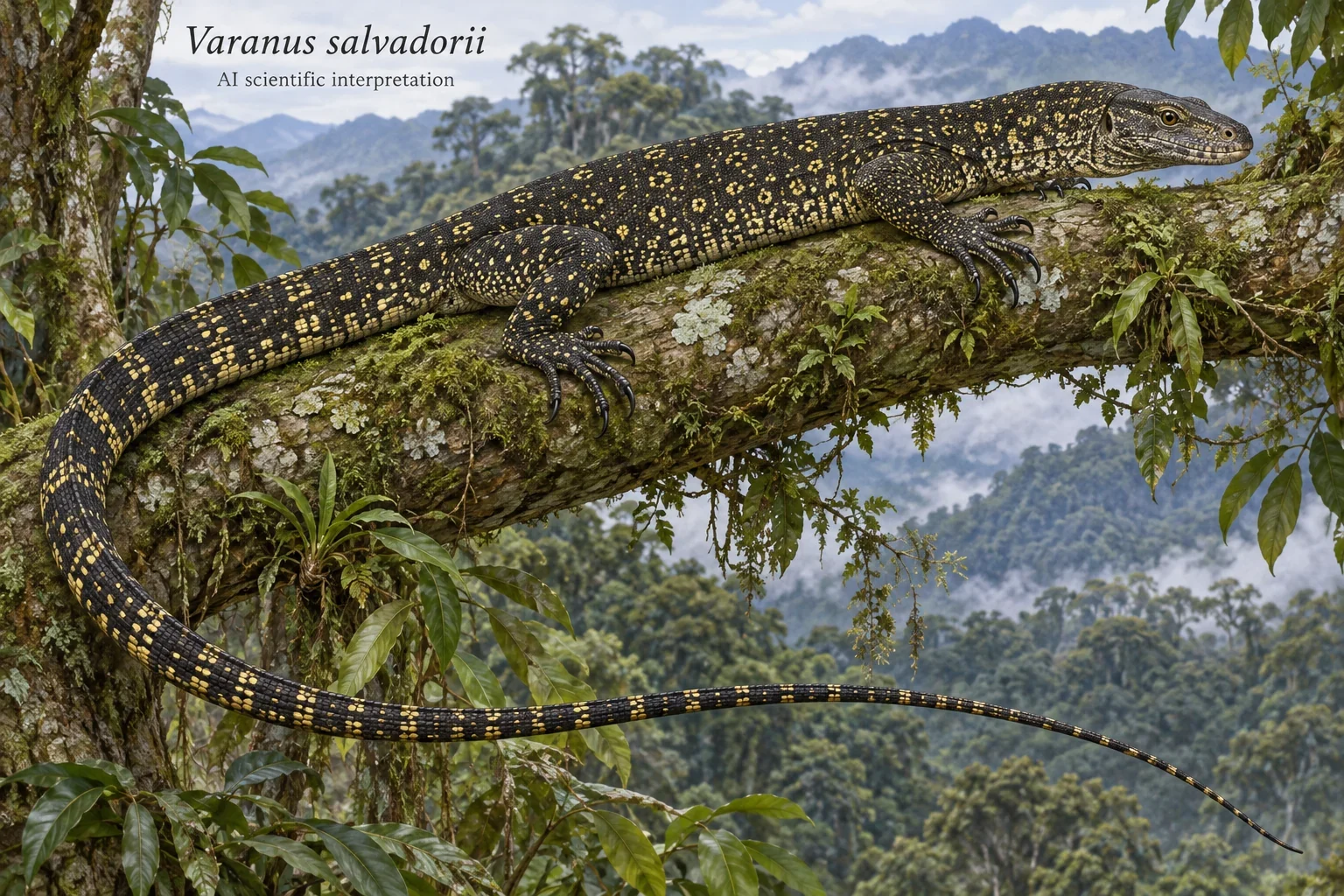
AI scientific interpretation of Varanus salvadorii.
AI scientific interpretation of an imagined Varanus salvadorii.
Overview
Prague Zoo describes a light-bodied climber with long limbs, conspicuous spots and a tail forming nearly two-thirds of total length. It spends much of its life in tree crowns. The account places it in New Guinea’s tropical forests and swampy areas, feeding on vertebrates and carrion.
Camina, Salinas and Cuevas reported captive breeding at two Madrid zoological parks in 2013. One Madrid Zoo female laid ten eggs in July 2009; three hatched, while others were infertile or failed. Later clutches produced different outcomes under managed incubation.
The authors observed distinct individual temperaments and aggression during some introductions. These small captive groups provide husbandry observations, not a census of wild reproduction. Dense-forest habits and limited wild observations constrain broader conclusions about the species.
Origins & earliest records
Zoo diagnosis complements a first-hand captive breeding report.
Evidence & interpretation
Observed clutch outcomes remain specific to managed animals.
Selected bibliography
Documented works and useful reading. This is not a list of every appearance.
- 01
- 02
Family, evolution & connections
Taxonomic classification
A hierarchy of classified groups, not a chain of direct ancestors.
Source note: The zoo assigns Varanidae; no ancestral reconstruction is implied.
- FamilyVaranidae
References
Sources supporting this profile. Linked pages have their own scope and editorial standards.
- Zoo natural historyVaran SalvadoriůvResearch access: 2026-10-11
- Primary captive observationsHusbandry and Breeding of the Crocodile Monitor Varanus salvadorii Peters & Doria, 1878 in CaptivityResearch access: 2026-10-11
Image credits
AI-generated interpretationAI scientific interpretation of Varanus salvadorii.
AI scientific interpretation of an imagined Varanus salvadorii.