
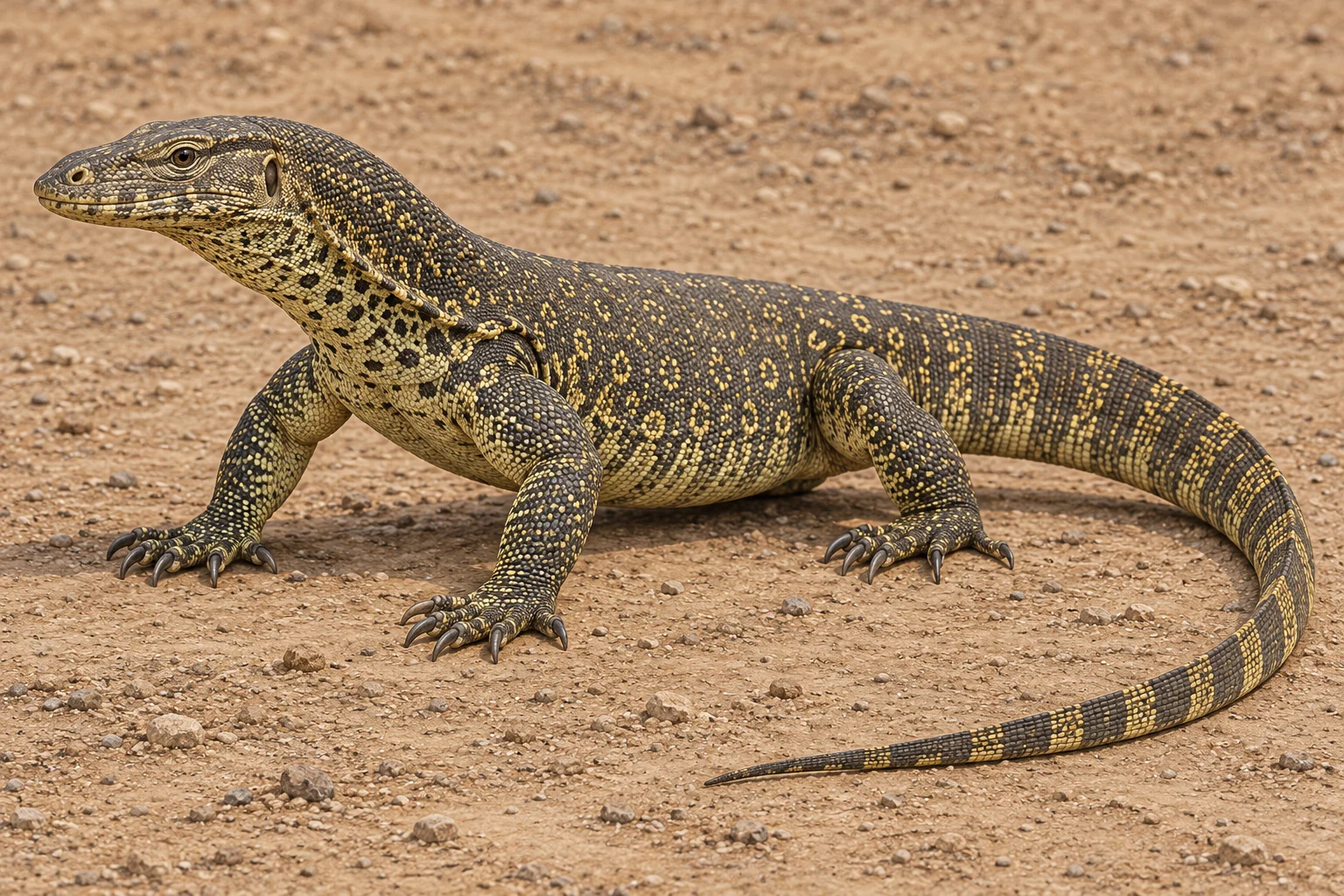
AI-generated natural-history illustration.
Independent interpretation; visible form only.
Overview
The Nile monitor has a stout body, powerful clawed limbs and a long tail flattened from side to side. Small bead-like scales cover its skin. Adults have greyish to olive-brown upperparts marked with yellowish spots and bands, while young animals show a stronger black-and-yellow pattern.
These lizards forage on land but also climb and swim well. They often bask on exposed waterside surfaces and can retreat into water or burrows when disturbed. Their forked tongues gather chemical information, and their varied animal diet includes invertebrates, small vertebrates and eggs.
Origins & earliest records
African species accounts
Evidence & interpretation
Published accounts.
Selected bibliography
Documented works and useful reading. This is not a list of every appearance.
- 01
- 02
Family & connections
A source-supported family tree or inspiration record has not yet been compiled for this profile. Related reading below indicates a connection in subject matter, not a proven lineage or creative influence.
Look for a taxonomic record and classified relativesReferences
Sources supporting this profile. Linked pages have their own scope and editorial standards.
- Biodiversity institute accountNile monitorResearch access: 2026-10-18
- University species accountVaranus niloticusResearch access: 2026-10-18
Image credits
AI-generated illustrationAI-generated natural-history illustration.
Independent interpretation; visible form only.