
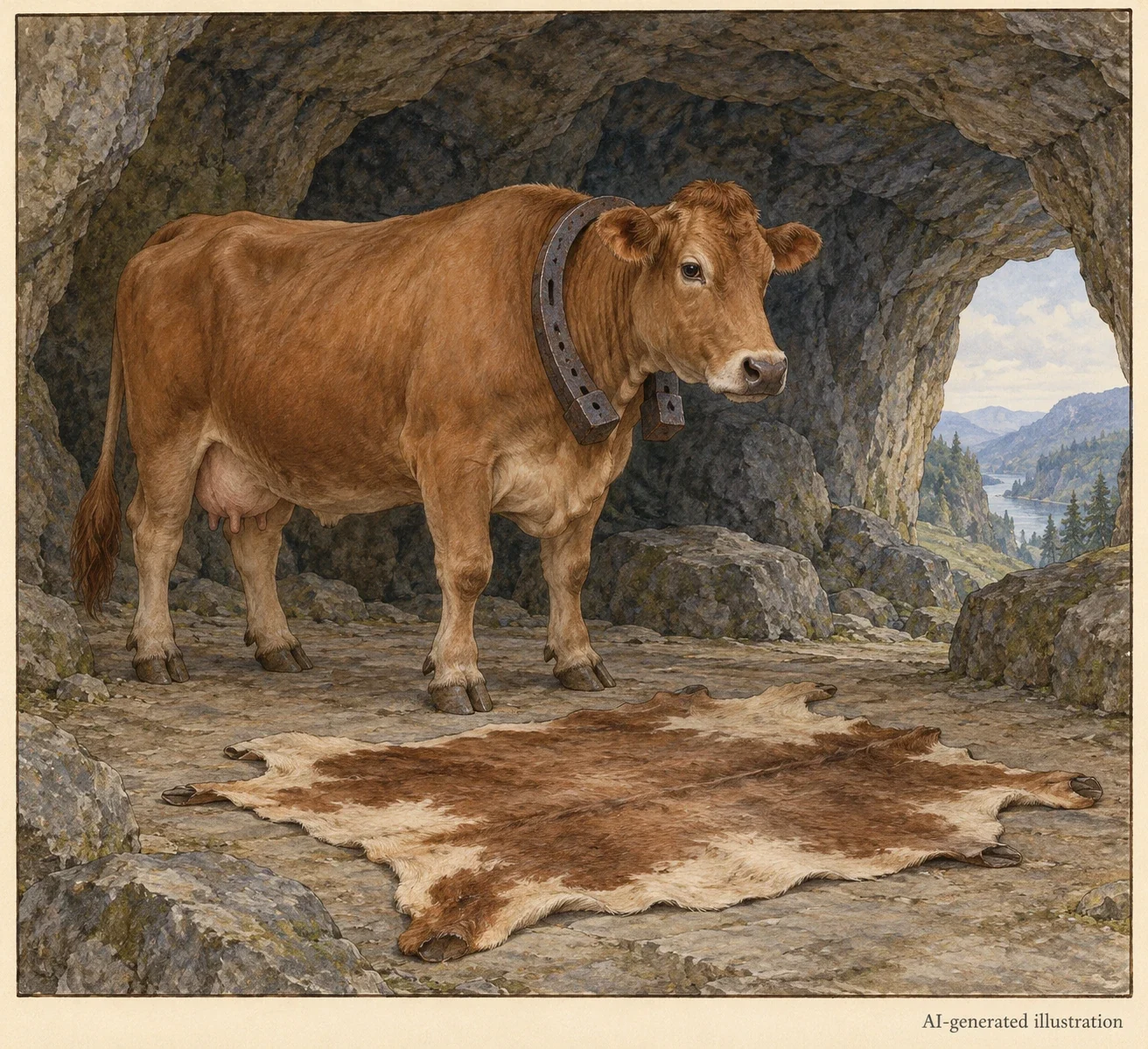
An imagined massive cow stands in a rock chamber beside a flat hide, with a horseshoe-shaped restraint around her neck.
Urko stands confined with the horseshoe restraint and cow-hide allowance in Hofberg/Myers’s selected tale. Unspecified appearance, colours, prop construction and setting are declared illustrative choices; no source artwork copied.
Overview
The chapter first fixes its landscape around Lake Sommen’s northern fjord, North Wij and Asby. Near Vishult it describes Urberg as a steep, wooded rock wall with openings among piled stones. Urko, an enormous cow, is said to have ploughed the ground into the lake and its many branching fjords while she was free. A Troll man from Tulleram eventually catches her, squeezes a horseshoe around her neck and confines her inside Urberg. Her allotted food is the hair of a large cow-hide: she may eat one hair each Christmas Eve. When the last hair is gone, her release is to bring destruction to Ydre and the whole world.
A separate condition concerns a king crossing Ydre. The cow may leave her prison and pursue him, killing him if she catches him before he passes the territory’s bounds. In one version a king called Frode or Fluga mistakenly believes he has escaped and stops at Fruhammer, formerly Flude or Flugehammer. Urko overtakes and gores him; four stones are pointed out as his grave. Another account, said to be known only in the southeastern part of the territory, lets an unnamed king cross safely before he hears the pursuit. Urko overshoots the boundary and paws a huge hollow into gravelly ground where he had paused. It becomes a bog edged with displaced earth.
The closing passage reports fetters rattling in the mountain, particularly before storms, extraordinary happenings by the mountain and lakeshore, and residents claiming to have seen Urko’s splendid rooms. These are attributed local reports, not the compiler’s demonstrated sightings. The accompanying note proposes that the legend arose from a flood story and interprets confinement as water returning to its bed. That is an editorial explanation, distinct from the cow narrative and from a geological finding. The English translation provides no individual teller, coat colour, horn shape or exact body measurements; its vivid topography does not independently verify the creature or the events.
Origins & earliest records
Herman Hofberg, Swedish Fairy Tales, translated by W. H. Myers, Chicago: Belford-Clarke Co.,1890. The Urko of North Wij, pp.131–134, including the retained flood-interpretation note.
Records & interpretation
Complete selected chapter and its note read continuously from retained original-edition English HTML. Complete author and translator prefaces read; Swedish original and local oral witnesses not independently inspected.
Selected bibliography
Documented works and useful reading. This is not a list of every appearance.
- 01
Swedish Fairy Tales
The Urko of North Wij, printed pp.131–134, complete chapter and retained note. Author/translator prefaces pp.3–4.
Family & connections
A source-supported family tree or inspiration record has not yet been compiled for this profile. Related reading below indicates a connection in subject matter, not a proven lineage or creative influence.
References
Sources supporting this profile. Linked pages have their own scope and editorial standards.
- Historical literary collection in its original English translationHofberg/Myers — complete Urko of North Wij chapter and noteResearch access: 2026-10-17
Image credits
Original imagined narrative illustration; appearance, costume, props and setting beyond stated details are reconstruction. No source artwork copied.An imagined massive cow stands in a rock chamber beside a flat hide, with a horseshoe-shaped restraint around her neck.
Urko stands confined with the horseshoe restraint and cow-hide allowance in Hofberg/Myers’s selected tale. Unspecified appearance, colours, prop construction and setting are declared illustrative choices; no source artwork copied.