
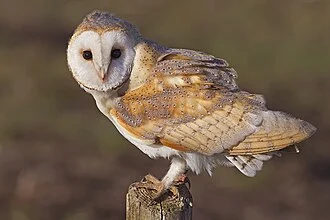
A pale barn owl with a heart-shaped facial disc perched on a wooden post.
Barn owl photographed in Lancashire, United Kingdom, consistent with the Western Barn Owl treatment followed here.
Overview
British birds have a heart-shaped face, grey-buff wings and mostly white underparts. They hunt low and quietly for small mammals; breeding output responds to prey abundance. British and Irish birds are chiefly sedentary, with dispersal mainly involving young. Ring recoveries document road-traffic mortality.
The Natural History Museum explains that the facial disc directs sound toward ears at different heights, aiding prey localization. UK farmland hunting occurs at dusk, dawn and night, with occasional daytime activity.
A 2024 whole-genome study of 75 European barn owls linked MC1R and two other genomic regions to much of the white-to-rufous variation in that sample. It also proposed that a sex-chromosome region interacting with MC1R may contribute to sex differences.
Origins & earliest records
ITIS records Scopoli, 1769, originally Strix alba, and attributes Western Barn Owl to the IOC 14.2 split.
Evidence & interpretation
Specialist account, taxonomic report, museum account and original genomic abstract.
Selected bibliography
Documented works and useful reading. This is not a list of every appearance.
- 01
The genomic architecture of continuous plumage colour variation in the European barn owl (Tyto alba)
Selected bibliography; Proceedings of the Royal Society B 291:20231995.
Family, evolution & connections
Taxonomic classification
A hierarchy of classified groups, not a chain of direct ancestors.
Source note: Ranks follow ITIS (TSN 177851).
- OrderStrigiformes
- FamilyTytonidae
- SpeciesTyto alba (Scopoli, 1769)
References
Sources supporting this profile. Linked pages have their own scope and editorial standards.
- Specialist species accountBarn Owl — British Trust for OrnithologyResearch access: 2026-10-07
- Taxonomic reportTyto alba — Integrated Taxonomic Information SystemResearch access: 2026-10-07
- Primary research abstractCumer et al.: European barn-owl colour (2024)Research access: 2026-10-07
- Museum accountBarn owl (Tyto alba) — Natural History MuseumResearch access: 2026-10-07
Image credits
Attributed biological photographA pale barn owl with a heart-shaped facial disc perched on a wooden post.
Barn owl photographed in Lancashire, United Kingdom, consistent with the Western Barn Owl treatment followed here.